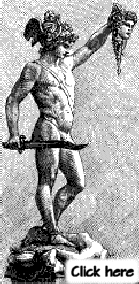
Consequences exist for those who do not acknowledge their opposing archetypes, for the energy of each opposing thought needs to find release. Denying the existence of unacceptable archetypes channels the opposing energy into a complex, thus inducing them into being independent and out of conscious control. Should the boy in the previous example dismiss the existence of his unpalatable idea, feeling incapable of accepting it within himself, his displaced energy would then be fed into a shadow complex. As a complex grows, it becomes increasingly powerful until the ego is overcome by unforeseen reactions . The complex might manifest itself in disturbing dreams, misdirected anger, or emotional outbursts should the denied archetype be the shadow. In the case of the denial of the anima, the complex might manifest itself in stereotypically female behaviour (i.e. being more emotionally involved, taking things more personally). Thus, the danger of ignoring archetypes, which are a window to the unconscious, is that they will take control of your conscious mind. Similarly, in mythology, archetypal characters must be confronted by the hero. Once confronted, the archetypal character is incorporated in some way into the hero. For example, once Perseus has sliced off the head of Medusa, he can now carry the head as a weapon with which to turn his new enemies to stone. Or, in medieval legends, the hero is often faced by a dark knight, who, when defeated, reveals himself to be the hero's brother. Here again is shown the psychological importance of archaic myths. Jung stated the problems that arose in a society lacking myth or religion:
- Among all of my patients in the second half of life, that is to say over thirty-five, there has not been one whose problem in the last resort was not that of finding a religious outlook on life. It is safe to say that every one of them feel ill because he had lost that which the living
religions of every age have given to their followers and not one of them has been really healed who did not regain his religious outlook.6
When the archetypes are ignored, they can have disastrous effects on the character. It is for those suffering from these effects that Jung hoped his theory would help heal. As archetypal complexes become more powerful, they separate the personality they are acting on from reality. Jung concentrated on two mental illness that resulted from overpowering complexes: dissociative identity disorder (formerly known as multiple personality disorder); and schizophrenia. In the case of dissociative identity disorder, the archetypes express themselves internally; in effect, previously unconscious archetypes rest control from the ego. With schizophrenia, the archetypes are projected externally until the ego is unable to determine imagination from reality. In both cases, the ego has lost touch with reality.
The cure for the two disorders focuses on restoring reality by having the patient acknowledge and unify the archetypes, a psychologist-facilitated process of transcendence. For dissociative identity disorder, a psychologist has the patient accept the different archetypes dominating his personality as projections of his unconscious. One method the psychologist might have the patient undergo is a “therapeutic growth” of his alternate personalities in order to bring them closer together in small but significant ways. This is intended to fuse these personalities into the patient's central “ego.” For example, psychologist and dissociative identity disorder patient, Cameron West had many personalities with different characteristics representing his numerous archetypes. Per was the calming mentor archetype, Leif the hero, Switch the shadow, Dusty was the anima, etc. After acknowledging that all of his alters were only individualized archetypes, he underwent a therapeutic process of merging his personalities: first by age, sex, and finally in mannerisms. Similarly, treatment for a schizophrenic would focus on having the patient acknowledge the archetypal images replacing his reality as parts of the patient's own unconscious. Jung's favorite method for accomplishing this recognition was to have patients express themselves creatively, through painting, what they were experiencing; in this way, he provided a channel through which the archetypes could enter reality and the conscious mind, and so be understood.