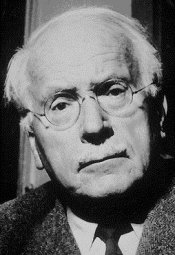
Carl Jung's theory of archetypes has been criticized sharply for being more mystical than scientific, while at the same time it has opened up many of the doors that lead directly to the understanding of modern psychology. Whether they are entirely accurate or not, Jung's ideas revolutionized the willingness to understand, and the ability to treat, patients with psychotic disorders. Further, the concept of archetypes seems to have struck a nerve in the popular consciousness, entailing that Jung's theory may lie closer to a psychological truth than many, more empirical theories. The goals and content of Jung's theory bear strong resemblance to those of the religions and mythologies of earlier cultures, suggesting that Jung is detailing a form of psychological healing intuitive to humans since primitive times. Jung's theory of archetypes, then, produced a new interpretation of mental illness by reintroducing mythological concepts into a modern setting.
At the end of the nineteenth century, mental illness was poorly understood. Often, doctors would only recognize psychosis if it were connected with some apparent physical defect. When Jung entered psychology, he decided that “doctors were hypnotized by their belief in physical causation, since they saw only the worst cases in the mental hospitals, cases that could account for largely the terminal states of prolonged hospitalization”1. In these situations, no one studied the onset of the illness, or understood why it had arose. Treatment was limited to commitment to an asylum, which did nothing more for the patients than to keep them away from society. Freud, the founder of psychoanalysis, had done preliminary studies into the unconscious in an attempt to understand the neuroses of his patients. Jung, “armed with a powerful desire to bring much needed emotional healing and relief”2, delved much deeper into the unconscious for the benefit of those suffering from psychotic disorders.
Early in his career, Jung experienced a near psychological breakdown. During this time, he recognized that many of the symbols appearing in his dreams resembled symbols recurrent in mythology and religion. From this realization, Jung developed his theory of archetypes, or primordial and eternal symbols through which the unconscious could be interpreted. And, his theory shared a similar purpose with mythology and religion. Carl Jung stated that the purpose of his investigations was to bring the unconscious into the conscious. Joseph Campbell declared that myths are the dreams of the world, and so are a chart of the unconscious. According to him, Carl Jung's discovery “that the patterns and logic of fairy tale and myth correspond to those of dream” has led to “the long discredited chimeras of archaic man” returning “dramatically to the foreground of modern consciousness”3. “Mythology, in other words,” he continues, “is psychology misread as biography; history, and cosmology” 4. Since the Enlightenment, religion and mythology have played an increasingly small role in everyday life. In our scientific age of globalization, neither mythology or its organizational structure, religion, are taken seriously, and with them have been lost the guiding principles contained in the myths. Jung's archetypes are an attempt to recapture an understanding of the symbols used by our unconscious.
Archetypes are encountered in the decisions faced in everyday life. Jung felt that the cause for mental conflict within people is the denial of certain archetypes in your psyche. To resolve the conflict, three principles must be understood: the concepts of opposition, equivalence, and entropy. The principle of opposition explains that for each thought, there exists an opposing thought. As an example, a little boy catches a frog and is awed by the delicacy of the small creature in his hands. At the same time, the thought will cross his mind at how easy it would be to crush the frog to death. This second thought will originate in the archetype of the psyche's dark side, the shadow. Equivalence, the second principle, states that equal energy is given to each thought: the boy has a strong urge to crush the frog, but an equally strong part of him is revolted by the idea and holds him back. The third principle, entropy, takes place once the mind has acknowledged the opposing thoughts, causing the their energy to decrease in their extremity. At this point, he can make a dispassionate choice. With age and wisdom, energy naturally decreases until the archetype has been completely acknowledged and has no more power to provoke impulsive reactions; it is said the archetype has been transcended. Jung believed that perfection was achieved once all the archetypes had been transcended and the self was realized. At this point
- every aspect of your personality is expressed equally. You are then neither and both male
and female, neither and both good and bad, neither and both conscious and unconscious,
neither and both an individual and the whole of creation. And yet, with no oppositions,
there is no energy, and you cease to act. Of course, you no longer need to act.5
And so, according to Carl Jung, only in death could you achieve perfection.