D e v i c e s
Internal memory is data storage in the computer.
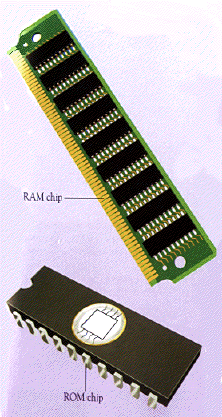
There is a certain amount of physical memory in every computer. This is often referred to as RAM (random-access memory) or 'main memory'. If one byte of information holds one character then a computer which has 1 megabyte of memory holds 1 million bytes of information.
You can read and write data from RAM. However most RAM is volatile, which means that it requires a constant flow of electricity to retain its contents. So if the power is switched off, the information that was in the RAM is lost. This is different to ROM which cannot be written to. ROM (read-only memory) holds the instructions for starting up the computer and almost all computers contain a small amount of ROM.
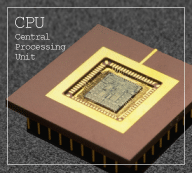
The CPU (or Central Processing Unit) is the brains of the computer. Found on the motherboard (the main circuit board in the computer), it is a small device which interprets and carries out instructions. On personal computers the CPU is housed in a single chip, or microprocessor.
A sound card is a circuit board which enables the computer to manipulate and output sounds. They are necessary for nearly all CD-ROMs and very common on modern computers.
Also known as the Network Interface Card (or NIC), the network adaptor is an expansion card which allows computers to connect in a network. When an expansion card is installed in each computer and server on the network, the NIC acts as the connection between computer and network cable.