|
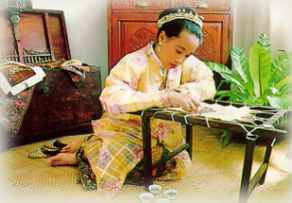
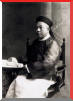
Nyonya girl
I had lived in Malaysia for
several years and knew nothing of the Baba-Nyonya, until my Chinese
wife Noi and I were visiting the Singapore museum, where a display was
showing this beautiful selection of clothes and jewellery, and wedding
baskets all highly decorated, Noi told me they were of the Baba-Nyonya
culture in Malacca.
Noi was born and brought up in
China until the age of 11 years of age, when she was adopted by her
aunt Lo Gan who lived in Malacca
That may sound strange (Adoption by an aunt) but in Chinese society in
the olden days, girls were not as highly treasured as boys, and girls
were usually sent to live with family members in other countries who
were more well off to lessen the load of the family in China.
I met Noi one day in Malacca,
the sun seemed to shine more brightly as I looked into her eyes, she
was to me the most b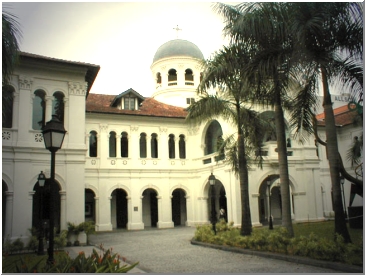 beautiful
lady in the world, and after a long period of courtship where we were
escorted by her friends I went and asked her Aunt if I could marry Noi
and take her to the UK, with the promise that we would return and
visit. She accepted my offer and Noi and I married in Malacca lived
together for 27 years throughout the world, having two daughters. beautiful
lady in the world, and after a long period of courtship where we were
escorted by her friends I went and asked her Aunt if I could marry Noi
and take her to the UK, with the promise that we would return and
visit. She accepted my offer and Noi and I married in Malacca lived
together for 27 years throughout the world, having two daughters.
Noi collapsed and died suddenly
whilst we were on holiday abroad, the tears still flow after all these
years --
I had no idea at the time, that
the family Noi's Aunt, Lo Gan looked after in Malacca were of the
Baba-Nyonya culture, they were wealthy Rubber Estate plantation owners
and lived in a
typical Baba-Nyonya bungalow which was beautiful as I spent many hours
there visiting Lo Gan.
History of
Baba-Nyonya
Peranakan, Baba-Nyonya and Straits Chinese ( named after the Straits
of Malacca) are terms used for the descendants of the early Chinese
immigrants to the Nusantara region, including both the British Straits
Settlements of Singapore, Malacca and Penang and the Dutch-controlled
island of Java among other places, who have partially adopted Malay
customs in an effort to be assimilated into the local communities.
Baba house museum in Malacca, Malaysia,
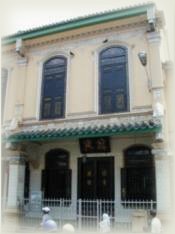 which
was a place for many Peranakan Straits ChineseThe word Peranakan is
also used to describe Indonesian Chinese. In both Malay and Bahasa
Indonesia 'Peranakan' means 'descendants'. Babas refer to the male
descendants and the Nyonya the female. which
was a place for many Peranakan Straits ChineseThe word Peranakan is
also used to describe Indonesian Chinese. In both Malay and Bahasa
Indonesia 'Peranakan' means 'descendants'. Babas refer to the male
descendants and the Nyonya the female.
Most Peranakan are of Hokkien ancestry, although a fair denomination
of them are of the Teochew or Cantonese descent. Written records from
the 19th and early 20th centuries show that Peranakan men usually took
brides from within the local Peranakan community. Peranakan families
also commonly imported brides from China and sent their daughters to
China to find husbands. A small group of Indian Peranakans, known as
the Chitty, does exist as well.
Language
The language of the Peranakans, Baba Malay (Bahasa Melayu Baba) , is a
dialect of the Malay language (Bahasa Melayu), which contains many
Hokkien words.
 It is a dying language and contemporary use is mainly
limited to members of the older generation; this is indicative also of
the Peranakan culture at large. It is a dying language and contemporary use is mainly
limited to members of the older generation; this is indicative also of
the Peranakan culture at large.
History
In the 15th century, the city states of the Malay Peninsula often paid
tribute to various kingdoms such as the kingdoms of China and Siam.
Close relations with China were established in early 15th century,
during the reign of Parameswara, when Zheng He visited Malacca. In
return for such tribute, a princess of China, Hang Li Po was presented
as a gift to Sultan Mansur Shah, the Sultan of Malacca, at that time
(+/-1459 AD). The royalty and servants who accompanied the princess
initially settled in Bukit Cina and eventually grew into a class of
straits-born Chinese known as the Peranakan. The Peranakan retained
most of their ethnic and religious origins (ancestor worship), but
assimilated the language and culture of the Malays. They developed a
unique culture and distinct foods. A lot of sources claim that the
early Peranakan inter-married with the local Malay population.
However, the lack of physical resemblances have also led many experts
to believe that the Peranakan
 Chinese
ethnicity has hardly diluted. The Peranakan often sent their sons and
daughters to China to look for spouses. Also, the religion of the
local Malay population was Islam which forbids inter-marriage with
other religions without conversion first. In the early 1800s, new
Chinese immigrants to the Straits Settlements bolstered the Peranakan
population. Chinese
ethnicity has hardly diluted. The Peranakan often sent their sons and
daughters to China to look for spouses. Also, the religion of the
local Malay population was Islam which forbids inter-marriage with
other religions without conversion first. In the early 1800s, new
Chinese immigrants to the Straits Settlements bolstered the Peranakan
population.
By the middle of the Twentieth century, most Peranakan were English
educated, as a result of the British colonisation of Malaya, and the
natural propensity of these people who were able to easily embrace new
cultures. Because the Peranakans readily embraced English culture and
education, administrative and civil service posts were often filled by
prominent Straits Chinese. The interaction with the British also
caused many in the community to convert to Christianity. The Peranakan
community thereby became very influential in Malacca and Singapore and
were known also as the King's Chinese due to their perceived loyalty
to the British Crown. Because of the interaction of the different
cultures and languages that Peranakans had, up to the mid-1900s, most
Peranakans were trilingual, able to converse with Chinese, Malays and
the British. Common vocations were as merchants, traders, and general
intermediaries between China, Malaya and the West; the latter was
especially valued by the British,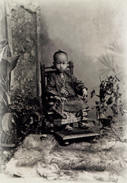 since the Babas also enjoyed good
relations with the Malay community and served as advisors to the royal
Malay courts. In fact the term "Baba" is an honorific term in Malay;
probably derived from Hindi/Sanskrit [Baba: literally means
grandfather or father, and is used as a term of reverence and
affection for an elderly gentleman]. since the Babas also enjoyed good
relations with the Malay community and served as advisors to the royal
Malay courts. In fact the term "Baba" is an honorific term in Malay;
probably derived from Hindi/Sanskrit [Baba: literally means
grandfather or father, and is used as a term of reverence and
affection for an elderly gentleman].
Culture
Historical and cultural items from the Baba culture are displayed in
cultural establishments on Heereen Street and Jonker Street in Malacca
and in Penang in Malaysia, and at the Peranakan Museum in Singapore.
There one can find museums displaying furniture's, food wares, and even
traditional clothes of the Baba and Nonya. There are also a small
number of "Nyonya" restaurants in Singapore, Penang, Malacca, and the
West.
The Peranakans were partially assimilated into the Malay culture
(especially in food, dress, and language),
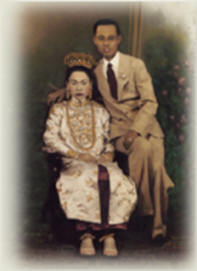 while retaining some
Chinese traditions (religion, name, and ethnic identity), thereby
creating a fusion culture of their own. For instance, from their Malay
influence, a unique
"Nyonya"
cuisine
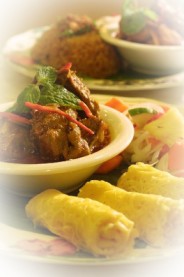
has developed using the spices of Malay cuisine (examples
are Chicken Kapitan, a dry chicken curry, and Inchi Kabin, a Nyonya version of fried chicken). The women (Nyonya) have taken to wearing
the baju kebaya (a Malay dress, seen most notably as the uniform of
Malaysia and Singapore Airlines' female flight attendants). However,
most of the Peranakans are not Muslim, and have retained the ancestral
worship tradition of the Chinese; though some converted to
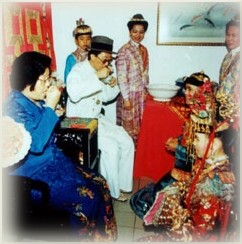
Christianity. The wedding ceremony of the Peranakan is largely based
on Chinese tradition, and is one of the most fascinating wedding
ceremonies in Malaysia and Singapore. while retaining some
Chinese traditions (religion, name, and ethnic identity), thereby
creating a fusion culture of their own. For instance, from their Malay
influence, a unique
"Nyonya"
cuisine
has developed using the spices of Malay cuisine (examples
are Chicken Kapitan, a dry chicken curry, and Inchi Kabin, a Nyonya version of fried chicken). The women (Nyonya) have taken to wearing
the baju kebaya (a Malay dress, seen most notably as the uniform of
Malaysia and Singapore Airlines' female flight attendants). However,
most of the Peranakans are not Muslim, and have retained the ancestral
worship tradition of the Chinese; though some converted to
Christianity. The wedding ceremony of the Peranakan is largely based
on Chinese tradition, and is one of the most fascinating wedding
ceremonies in Malaysia and Singapore.
The cause for their cultural extinction is largely due to racial
politics and economics brought about by nationalism in Singapore and
Malaysia. Without colonial British support for their perceived racial
neutrality, Peranakans feel pressured to assimilate back into the
mainstream Chinese culture in both countries following independence
from the British. In Singapore, the Peranakans are classified as
ethnically Chinese by government policies, and because second language
instruction (so-called "Mother Tongue") is decided based on ethnicity,
this requires them to learn Mandarin Chinese instead of Malay in
formal education. While in Malaysia, the standardisation of Malay
[Bahasa Melayu Malaysia] -required for all ethnic groups- has led to a
disappearance of the unique characteristics of Baba Malay.
Les Parkin |