|
|
|||||
|
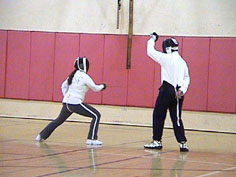
In Marcelli's manual of fencing (1686), saber is first mentioned as a heavy curved weapon. By the eighteenth century, the Hussars, or Hungarian Light Horsemen, adapted this weapon originally from the Turks. Italo Santelli, an Italian fencing master, at the turn of the twentieth century revolutionized the theory and practice of saber fencing; it has since been the foundation of the modern sport of saber. Today's weapon is much lighter and more flexible than that used by the Hussar cavalry. But the basic idea of a cutting weapon versus a thrusting weapon, remain the basic premise of today's weapon. This class is designed to introduce, develop, and apply the skills and knowledge of fencing at the most basic level. No former experience is required. The progression of skills begins with footwork and conditioning. Like any physical activity, muscles that are not used or are less active need to be conditioned for strength and the prevention of injury. The college will issue you a jacket for the semester, but there is a sixty-dollar deposit. You will get your deposit back at the end of the semester once you have returned you jacket. Masks and sabers will be issued at the beginning of the class. They will be returned at the end of class. The masks and sabers are not to be taken home. Take your jackets home and wash them for the next class. Wear a t-shirt underneath the jacket. Cotton gym pants and the non-marking tennis shoe are required. Do not wear jeans to the class. Buy your own glove when we begin to use the saber. |
Your grade will consist of 25% mid term, 25% final,
25% skills, and 25% attendance. You will be allowed one absence. The class
meets once a week; attendance is important for the acquisition of skills
and the introduction to new material for each class. Learning saber fencing
is both process and goal orientated. The object then, is to achieve a
skill and acquire a knowledge that would allow you to understand basic
saber.
The nature of saber is obvious, so dangerous play is
not tolerated. The emphasis is on control, style, and function. Fencing
is competitive and confrontational, but don't misunderstand competitiveness
as aggression. It is my philosophy, that by control and discipline, one
can meet his opponent or at least surpass himself.
Whatever the fascination, be it the romantic, dramatic, or the physical conditioning, the saber class will develop some insight on your own ability to concentrate under a combative situation. It will test your ability to think, intuit, and act. |
||||