PRISON
ACTIVIST AND FORMER BLACK PANTHER. Robert King Wilkerson,
one of the prisoners known as "the Angola 3," will be speaking
in Bristol (Easton Community Centre) on Wednesday 15th May at
8pm.
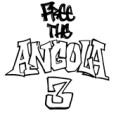
ROBERT KING WILKERSON VISIT TO UK, -A speaking tour
of the LJK is being planned for in May 2002. Whilst he will
be speaking out about the US prison system and for the release
of Woodfox and Wallace we hope his visit will also help to
highlight cases here with visits being made to framed prisoners.
The tour is being organized to raise solidarity with those
in the US who are suffering the same injustice under a far
more brutal and reactionary regime.
http://www.prisonactivist.org/angola/ http://www.geocities.com/bristol_abc/
[email protected]
Robert King Wilkerson, one of the prisoners known as "the
Angola 3," was released from the Louisiana State Penitentiary
on Feb. 8, 2001, after spending 29 years in solitary confinement
for a murder he did not commit.
Now that he is free, Wilkerson plans to travel and speak
out against the imprisonment of the two other Angola 3: Woodfox
and Wallace and the continuing growth of the American prison-industrial
complex. And so he’ll be touring the UK.
All three men entered prison on unrelated robbery charges
and quickly joined the prisoners' rights movement that was
sweeping the country in the late 1960s. In the ensuing years,
the men continued their activism from within solitary confinement
by organizing hunger strikes, educating other prisoners, and
by becoming highly-skilled jailhouse lawyers.
ANGOLA. HISTORY
Known as "The Farm," the Louisiana State Penitentiary at Angola
is the largest prison in the United States. Around three-quarters
of its inmates are African-American. According to the Academy-Award-nominated
documentary The Farm, 85 % of the inmates who are sent to
Angola will die there. Angola is an 18,000-acre complex of
antebellum plantations that the state of Louisiana purchased
and converted into a prison around the turn of the century.
The penitentiary is called Angola because most of its former
slaves came from the African country of the same name. Angola
still operates on the plantation model. Prisoners perform
back-breaking labor, harvesting cotton, sugar cane, and other
crops from dawn to dusk. In the early 1970s, Angola was known
as the most brutal prison in the United States, with stabbings
an almost-daily occurrence. Armed "Inmate guards" patrolled
the prison, and they frequently used their state-issued rifles
to settle scores with other inmates, sometimes at the behest
of Angola officials. On one occasion, a prisoner died after
five men were locked together in a sweltering isolation cell,
without food or water, during the hottest days of summer.
Dozens of bodies are rumored to be buried in the swampland
where Angola borders the Mississippi River.
Among the men who have been marooned at Angola are Albert
Woodfox, Hertnan Wallace, and Robert King Wilkerson. Of the
world's political prisoners, few have been held in solitary
confinement for as long as they have: 28 years. All three
men initially arrived at Angola with sentences for robbery
and a dedication to political activism. Their activism led
them to found a chapter of the Black Panther Party at Angola,
but it also made them targets of the all-white prison administration.
In 1972 and 1973, in an effort to put a stop to their organizing,
prison officials concocted murder charges against Woodfox,
Wallace, and Wilkerson, and placed all of them on permanent
lockdown. Relying on the testimony of prison snatches and
arguing their cases to all-white juries, Angola officials
won convictions against the three men, all of whom received
sentences of life without parole.
The Formation of the Black Panther Party at Angola
In 1971, Woodfox and Wallace organized the Black Panther
Party at Angola. Woodfox had joined the Party in New York,
where he had fled after a daring 1969 escape from the courthouse
in New Orleans. After spending time imprisoned under an assumed
name in New York, where he helped organize several rebellions
in the New York City correctional system, Woodfox, along with
his newfound politics, was extradited back to Louisiana. Wallace
became a Panther while he was incarcerated at the New Orleans
Parish Prison with the political prisoners known as the "New
Orleans Paither 12. " When they were shipped off to Angola,
Woodfox and Wallace took the Black Panther Party with them.
The Angola Panthers not only challenged the 'son administration,
but they also organized to end aspects of the inmate social
order that hindered prisoner unity and played into the hands
of the guards. The Panthers risked their lives to protect
younger and weaker inmates from the rape, prostitution, and
sex slavery that pervaded prison life. As Woodfox puts it,
"It wasn't much help to go to the, security because most of
the security people were condoning that type of activity.
They would benefit from it because they would get money or
favors for allowing rapes to happen. Some of the guards themselves
would be involved in the rapes."
The Panthers worked to mend the schism between black and
white prisoners that the prison officials manipulated to their
advantage, a difficult feat considering that the prisoner
housing, dining halls, and worksites were still racially segregated,
with privileged living arrangements and work assignments going
to white prisoners. The BPP also exposed the widespread corruption
of the people who ran Angola, many of whom came from families
that had lived on state land and had worked at the prison
for several generations. Guards often diverted food, grown
by the prisoners for their own consumption, to their own families
and friends or sold it in town.
The administration of the prison responded to the rise of
the Panthers by filling its isolation units with activist
prisoners. The associate warden of the 'son, Hayden Dees,
testified in court proceedings to the need to keep "a certain
type of militant or revolutionary irunate, maybe even a Communist
type," on permanent lockdown.
Indeed, Woodfox and Wallace believe they were targeted for
prosecution and long-term lockdown because of their organizing.
"I think the fact that they were never able to break my spirit
or Herman Wallace's spirit, the fact that they could not shake
our political beliefs or convictions, contributed to the reason
why we were held in CCR [Closed Cell Restricted, or solitary
confinement]," Woodfox says.
ROBERT KING WIILKERSON IN BRIEF
Wilkerson, 58, was convicted of the 1973 murder of a fellow
Angola prisoner despite the fact that another man confessed
and was convicted of the murder. After two prisoners who testified
against Wilkerson - the only evidence ever presented against
him - retracted their testimony and revealed that it had been
coerced by prison officials, the United States Court of Appeals
in December issued a ruling that almost certainly would have
led to his release.
In response, in what his supporters characterized as a face-saving
move, the state offered Wilkerson a plea bargain, which he
accepted. Six hours later, to the cheers of a throng of family
and supporters, Wilkerson walked out of Angola a free man.
He has pledged to dedicate his life to winning freedom for
Albert Woodfox and Herman Wallace, the other two members of
the Angola 3, and for all of the other innocent men with whom
he was incarcerated for the past three decades. "I may be
free of Angola, but Angola will never be free of me," Wilkerson
said.
Woodfox and Wallace have also been held in solitary confinement
for 29 years. They were convicted of the 1972 murder of an
Angola prison guard - a murder that they have unwaveringly
claimed they did not commit. In recent years, new evidence
of their innocence has surfaced. Even though the new evidence
was suppressed at the time of their trials, they have thus
far been unable to win Justice from the courts.
Wilkerson, Woodfox, and Wallace have always believed that
they were framed by prison officials because they organized
the Angola chapter of the Black Panther Party. Prior to being
placed in solitary confinement, the men led campaigns to end
prisoner rape, improve race relations, and ameliorate conditions
at the slave plantation-tumed- prison. The American Civil
Liberties Union is currently pursing a federal lawsuit alleging
that the merf s 29-year stay in solitary confinement amounts
to unconstitutional cruel and unusual punishment.
BLACK PANTHERS
The US government carried out a dirty war against the Panthers
in the 70s called COINTELLPRO. As a result many Panther members
were imprisoned or murdered, Leading members were regularly
framed and sentenced to life - 30 years - natural life in
order to break there resistance to racism and oppression in
the states. Many including Mumia Abu Jamal are still facing
death or natural life in prison for their political beliefs.
Many are systematically abused during their captivity.
APPEAL
We need two things to make the tour a success: money and audiences.
Could your Organisation help? FINANCES. More than anything
we have a cash flow problem. We are looking for people to
sponsor the tour through a interest free loan. We estimate
that we need to raise approximately I 000 to cover flights
for Robert and his partner and travel expenses to get around
the UK. We will ask for a collection after the meeting to
help with the costs and we feel pretty sure (from past speaking
tours) that the majority of the costs will be recouped. We
also accept loans from anyone who wants to sponsor this event/tour/cause.
you offer a loan to help us set things in motion. All amounts
are welcomed. Cheques to : B’ham Free Mumia Campaign
For further info : Bristol Prisoners Support group – ABC
Box 12, 14 Robertson Rd, Easton, Bristol BS5 6JY
http://www.geocities.com/bristol_abc/ [email protected]
For further information on Robert King Wilkerson and the
Angola 3 visit: www.prisonactivist.org