Osprey Observation in Branford, CT
Hazards to Ospreys
 "The development of the shore for recreation has reduced the number of available osprey nest sites. Human activities encourage the presence of predators, such as raccoons, that climb into the nests and destroy the eggs or young. One of the most detrimental human activities is littering. Carelessly discarded litter along the shoreline, especially plastic six-pack yokes and monofilament fishing line, which are often used as nest material, can cause the strangulation death of young osprey. People are encouraged to dispose of all litter in an appropriate, safe manner. Human disturbances also affect nesting success by keeping adults off the nest, thus preventing them from attending young. During the nesting season, people or their pets should maintain a distance of at least 500 feet from an osprey nest. Disturbance of ospreys is prohibited under the Federal Migratory Bird Treaty Act of 1918 and the Connecticut General Statutes Section 26-92." http://www.ct.gov/dep/cwp/view.asp?a=2723&q=326054&depNav_GID=1655&pp=12&n=1 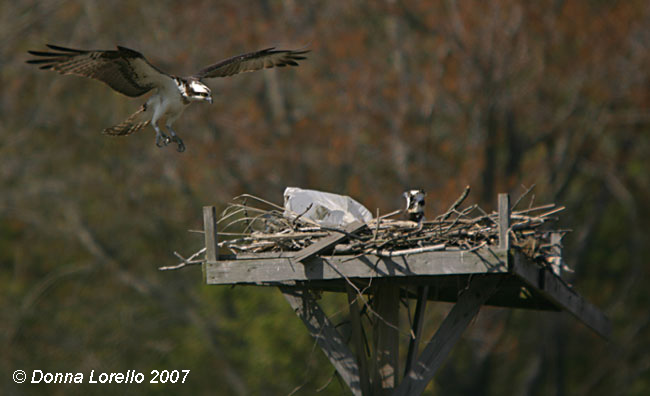 Ospreys are notorious for lining their nests with anything they find interesting. It goes without saying that some of these materials can prove fatal to adults and chicks alike. Here, a white plastic shopping bag sits in a nest. Please make it a point to put garbage into the proper receptacles. 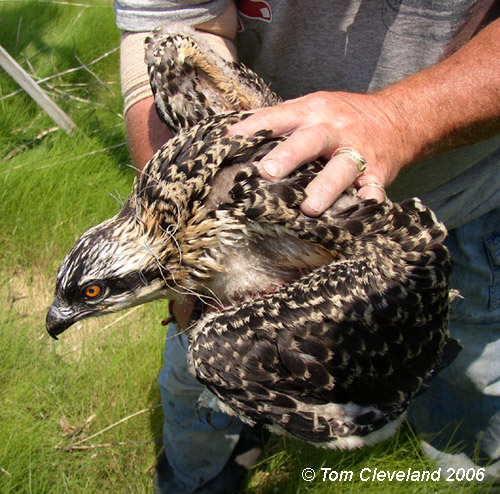 This chick was lucky! During the 2006 banding session, this chick's neck was wrapped tightly with monofilament netting. Luckily, it was removed. Had it not, this chick would certainly have died from strangulation.
|
|||||||||||