History
of Osprey Populations in Connecticut
by Chris Bodner (posted with permission)
Pandion haliaetus, or the Osprey, is a species of
hawk that can be found throughout the world. It makes its home
very close to water, and, thus, it is considered a part of many
saltwater marsh, costal marine, and large inland lake ecosystems.
They construct large nests naturally at the top of large dead trees
(snags), on the top of rock pinnacles, or on the ground, and have taken
to utilizing telephone poles, channel markers, even rooftops and
chimneys. They are large birds, the males weighing up to 3.5
pounds and the females more than 4 pounds. Being birds of prey,
they hunt for their food, which is mostly fish, by plunging into the
water feet-first. Ospreys are generally recognizable by their
completely white underbelly and the distinct shape of their
wings. They are known to have a life span of between 15 and 20
years, in which time they only have one mate. The average female
lays around three eggs in the month of April, and the chicks are flying
within 60 days after hatching. Ospreys in the northeastern United
States head south for the winter months, usually down to Florida and as
far as South America. They return each year, to their nests up
north, and begin the process again.
The osprey populations in Connecticut have taken a
few major turns throughout the 20th century. The Connecticut
Department of Environmental Protection has estimated that, prior to
1940, there were somewhere around 1,000 active osprey nests between
Long Island and Boston, many of them existing along the Connecticut
shoreline. From this point on, more and more pressure was being
put on the osprey population by human development. In addition to
the quickly shrinking size of nesting areas, a chemical pesticide
called DDT was contaminating the areas in which the ospreys
lived. It was widely used before the 1970s, and was responsible
for thinning the birds’ eggs so much that the osprey pre-hatching
infant mortality rate rose dramatically from where it was in the
‘40s. This resulted in a dramatic decline in the active nest
sites, and by 1969, the 1,000 active nests (nests containing eggs) had
dropped to a mere 150, the lowest ever recorded for the Long Island
Sound area. Connecticut experienced its lowest nesting activity
in 1974, when the count was a measly nine active nests.
In the 1970s, DDT was banned, restrictions were placed on the use of
other chemical pesticides, and environmentalists began constructing
nesting platforms along the Long Island Sound wetlands for
ospreys. From that point on, the osprey population increased
slowly, but steadily, and still is. According to both the DEP and
the Connecticut chapter of the Nature Conservancy, by 1984, there were
around 75 active nests in Connecticut. By 1990, this number broke
100, and by 1997, there were 131 active nests recorded. Another
large jump occurred between then and 1998, when 141 nests were
recorded. The most recently recorded number I have been able to
find was from 1999, when 162 active nests were accounted for, 21 more
than the previous year. The osprey population is recovering very
well, and will hopefully continue growing, at least until it returns to
where it was before 1940.
Although the use of chemical pesticides has been limited since the
1970s, they continue to plague the osprey populations, to a lesser, but
still substantial extent. This is more of a problem in their
wintering grounds in Central America and upper South America, where
pesticides are used more often with few, if any, restrictions.
Back in Connecticut, a far larger problem now is litter. Ospreys
build their nests out of anything they can find, so they aren’t
hesitant to use trash left by people. Leftover monofilament fishing
line used to build up a nest can tangle up the chicks and either
suffocate them or keep them from being able to leave the nest.
They are likely to starve if this occurs. If this situation does
not improve, the enormous positive jumps in the osprey population may
not continue for much longer. We should really do all we can to
bring back the ospreys, and in turn restore the major position in the
ecosystem they were unable to fulfill for nearly half a century.
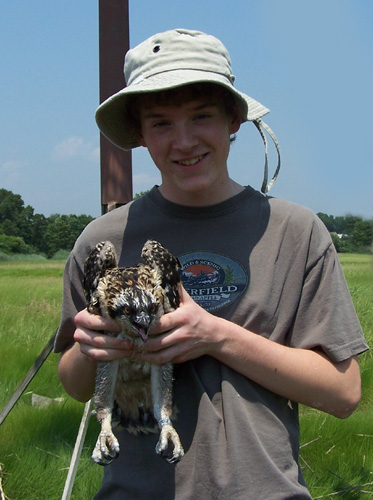
webmaster's note: Chris was one of
the program's most enthusiastic student participants and has continued
his interest in the program today. He has great interest in the
environment and hope he can inspire other young adults to take
proactive interest in the environment. Here, he posed with an
Osprey
chick on Banding Day in 2006.