The
sky's the limit as Wesley Snipes and newcomer Yancy Butler reach criminal
velocities (and petrify Paramount) in John Badham's airborne action thriller,
Drop Zone.
 There's
something in the air over Hollywood. No, it's not the latest fired or retired
entertainment executive sailing off on a "golden parachute", but a genuine
skydiver: This autumn has already brought Buena Vista's Terminal Velocity,
which, after losing Charlie Sheen and Natasha Kinski into the clear blue,
did a dusty belly flop at the box office. Now Paramount is setting its
sights aloft with the daredevil action thriller Drop Zone, directed by
John Badham [Point of No Return]. In fact, the high-flying studio (can
you say Forrest Gump?) has dropped a whopping $52 million bet that audiences
will fall for the film - promising that it will bring staunch terrafirma
types closer to the thrill of skydiving than ever before.
There's
something in the air over Hollywood. No, it's not the latest fired or retired
entertainment executive sailing off on a "golden parachute", but a genuine
skydiver: This autumn has already brought Buena Vista's Terminal Velocity,
which, after losing Charlie Sheen and Natasha Kinski into the clear blue,
did a dusty belly flop at the box office. Now Paramount is setting its
sights aloft with the daredevil action thriller Drop Zone, directed by
John Badham [Point of No Return]. In fact, the high-flying studio (can
you say Forrest Gump?) has dropped a whopping $52 million bet that audiences
will fall for the film - promising that it will bring staunch terrafirma
types closer to the thrill of skydiving than ever before.
"I
think it might inspire a lot of people to actually jump," enthuses top-billed
Wesley Snips, who was still wafting on the success of Demolition Man when
he got a $7 million inspiration to pull the rip cord. "People will see
what a beautiful sport it actually is."
Skydiving
may indeed be beautiful. But the acto-dramatics of Drop Zone, due out December
16, get off to a decidedly ugly start. While U.S. marshall Pete Nessip
(Snipes) is escorting convicted computer hacker Earl Leedy (Michael Jeter)
to a federal prison aboard a commercial 747, an apparent terrorist attack
on the jet results in the death of Nessip's brother - who's traveling with
Nessip - and Leedy's disappearance. Afterward, Nessip's badge is suspended;
no one will believe his theory that the incident was actually a prison
break, with the participants - who appeared to have been swept to their
doom through the airliner's blown door - escaping by parachute.
Determined
to nab his brother's killers and track Leedy down, Nessip reluctantly acquaints
himself with the world of exhibition skydiving, finding an alluring ally
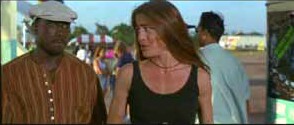
in championship jumper Jessie Crossman (Yancy Butler). Together they scour
the swamps and skies of southern Florida for a renegade parachute squad
led by Ty Moncrief (Gary Busey), whom Nessip suspects has major plans for
Leedy's genius. The magnitude of those plans becomes evident at the film's
climax, which unfurls in knuckle-gnawing fashion during a Fourth-of-July
exhibition in Washington D.C.
In
weighing the role of Nessip, Snips was intrigued by the character's "fish
out of water" mien amongst the skydivers. "Pete doesn't know who's on his
side," he explains.
"This
is their world, so anybody could be pulling the wool over his eyes. He's
taking everything one step at a time until he feels everything out.
"He
just has a misunderstanding of [the sport] and kind of a condescending
attitude toward it," continues Snipes. "He thinks sky-diving is something
that only thrill seekers who have a death wish are into, and that no sane
person would ever consider jumping out of a perfectly good, working airplane."
Nessip,
then, would classify most of the cast and crew of Drop Zone insane - including
Snipes. "I've always enjoyed the physical challenges of my work," says
the 32-year-old actor. "I'm not one to do films without preparing in a
way that makes me feel a connection to my character, so I went skydiving
and thoroughly enjoyed it. You scream, and all your macho stuff goes right
out the window."
For
Yancy Butler, it was the very challenge of doing that "macho stuff" that
drew her to the role Jessie Crossman. "Skydiving is something that's completely
foreign to me," says the husky-voiced actress, who played a law enforcing
lady cyborg in the defunct television series Mann & Machine and made
her movie debut last year opposite Jean-Claude Van Damme in Hard Target.
"But two or three days after I got the part, I went down to Paris Valley
[Calif.] and jumped out of a plane!"
Butler
laughs as she recalls her impulsive act of bravado, which was strictly
'chute first, ask questions later. "I wanted to do it the quickest, easiest
way, so I chose to jump in tandem with an instructor," she says. "I sat
in this guy's office for about 15 minutes while he explained some basic
things. Very basic things. And then I went into a room and signed my life
away, which was when I started to get a little scared."
Yet
she avoided a complete freak out, breezing through the experience with
more exhilaration than one gets from a York peppermint patty: "Every sense
was heightened to the fullest. There was an adrenaline running through
my body that was beyond belief. I was abuzz for a couple of days afterward."
Getting
that sensation is what keeps professional skydivers - more than 60 were
hired to realize Drop Zone's aerial acrobatics - going back up for more.
"They do it for the rush, and they do it because that's where you can really
fly," says director Badham, who's clearly awed by the sport. "They try
to pack as much activity into that 60 to 90 seconds of free falling as
possible."
No
one has spent more time gliding through the air than Badham's skydiving
supervisor, Guy Manos, a world-record holder with over 8,000 leaps and
the civilian contractor who instructs Navy S.E.A.L.S on skydiving. It was
Manos' best friend, Tony Griffin, who conceived the idea of an action thriller
about the sport while Manos was competing in the Skydiving World Championships
in Yugoslavia in 1985. "Tony said to me, 'You know, this is so cool. We've
got to write a movie based on this," Manos recalls. "So we started putting
down notes and story lines and batted a treatment around for a couple of
years."
According
to Manos, the treatment gained momentum when Tony's father, Merv Griffin,
read it in 1990. The television and real estate magnate, who'd made some
changes to the concept and drafted a screenplay with his own write, Peter
Barsocchini, passed the project on to producers Wallis Nicita and Lauren
Lloyd (Mermaids, The Butcher's Wife), who in turn took it to Paramount.
The studio showed to director Jan DeBont (then pre-Speed); but he passed.
"Along
the way were were making changes, changes, changes," says Manos, who ultimately
received story credit with Tony Griffin and Peter Baroscchini, with the
screenplay credited to Baroscchini and John Bishop. "It finally evolved
into Drop Zone."
But
not before it landed on the plate of veteran helmer John Badham in early
1993. Badham, a respected and versatile director of character driven dramas
and actioners like Saturday Night Fever, Blue Thunder and Wargames, felt
the script needed further retooling - and brought in screenwriter/script
doctor Jeb Stuart (The Fugitive) to assist the task. "I really liked the
idea of doing something about skydiving," says Badham, 55. "It was an exciting
story about a basically innocent guy having to wade into that world. And
I knew it would be a tremendous challenge."
One
key role in the original script would undergo a sex change first: the swaggering
skydiving champ, who had his rip-cord yanked to become Jessie Crossman.
Badham ordered the revision because the character was "boring, just boring,"
he says. "Why does it have to be a guy? It was just a lazy and clichéd
way of thinking. There are tons of women who participate in this sport,
and I thought the relationship between Nessip and Crossman would just be
more fun."
Yancy
Butler points out proudly that the switch engendered few behavioral modifications
in Crossman - whom Nessip initially knows only as "Jess" and is surprised
upon discovering that the skydiver is a she. "They didn't change any of
the attitude," Butler says of the tough-cookie character. "There's even
a scene where Wesley actually punches me in the face because of something
I've done." (Never fear, ladies and gents - the two principals later exchange
fists for lips.)
As
the script work continued, Badham determined that Drop Zone would be as
faithful a depiction of skydiving as possible. "Basic honesty is something
I've strived to achieve in all my films," says the director, who knew going
in that this would be his most complex job since his 1983 helicopter thriller,
Blue Thunder . "We wanted the stunts to be credible, achievable and something
that was acceptable to the world of skydivers. The last thing you want
with a movie like this is to have the very sport you're portraying put
you down and say, 'Oh, they don't know jack shit about this. Where do these
Hollywood guys get off?" Along the way, Badham befriended Guy Manos, who
became an invaluable consultant on matters of narrative verisimilitude.
After
commencing 12 weeks of first unit and eight weeks of second unit photography
(the latter overseen by D.J. Caruso, who also produced) in Miami and the
Florida Keys last March, Badham also found that he had a can-do Guy in
Manos, whom he calls "a complete daredevil. If left unchecked, Guy will
wait until the last possible second to pull his parachute after a jump.
I mean, he descends to frighteningly low levels. The good, cautious skydiver
opens at 2,500 feet - and Guy comes down to 800, 700 feet. You watch him
do it and say, 'Naw...what?"
Badham
can barely contain himself over the film's airborne action sequences, which
were coordinated by stunt veteran B.J. Worth and captured by world-famous
aerial cameramen Norm Kent and Tom Saunders. "Several stunts are totally
outrageous, but we did them up in the sky," he says. "We had the cameraman
falling out of the plane, and one second later the skydiver followed -
flailing past like he has no parachute on and is out of control.
After
panning on the diver waaaay down, the cameraman would form his body into
a missile and plunge below the diver again to get another shot." By then,
the lensman - heavily outfitted with video and 35mm cameras on either shoulder
- would have to tug the rip cord.
With
an average free-fall speed of 120 m.p.h., prop skydivers can navigate themselves
to velocities of more than 200 m.p.h. with proper body positioning. And
according to Manos, such speeds can result in lethal collisions among jumpers.
"I did 200 m.p.h. past one cameraman and the pants leg of my costume grazed
the toe of his shoe," he recalls. "When we both landed, we were all shaky
and white. But we got the shot."
Getting
a shot in which the venal Ty Moncrief kills one of his own gang members
was even scarier. As both criminals drift with their parachutes open toward
a water drop in the Keys, Moncrief maneuvers over to his cohort's parachute,
grabs it and drags the hapless lackey into an electrical power station
before he himself splashes safely down.
Manos,
doubling for Gary Busey, and another pro skydiver did the daring honors
- without the safety precaution of having the power station turned off.
Though the effect was achieved largely through forced perspective, the
two men had to drop as near the plant as possible, relying on cues radioed
from the ground. "We were hooked together and flying toward this power
station, waiting for the signal to break," recounts Manos. "We figured
it would take them 10 seconds to get the shot. But 20 seconds passed, and
we were still hitched - not sure whether electrical interference from the
station was scrambling the signals. All we knew was that we were getting
so close to the plant we could hear the hum of the thing. Finally, the
signal came: 'Break! Break!' And we both splashed in. But we were right
down on the deck - just 30 feet above the water - when we broke."
That
setup was certainly dangerous. But Drop Zone's most risky gag required
Snipes' double, Don Thomas, to leap through a 25th floor story window with
a Gary Busey dummy. "In terms of the parachutist buying the farm, that
stunt had the greatest probability," says Manos, explaining that the floor's
height was barely sufficient for a base parachute jump - on where the jumper
leaps from a structure or cliff (you can see Manos himself do the latter
in Cliffhanger . "Low is bad. We like high - the higher the better."
Fortunately,
Thomas and the bogus Busey - sans protective headgear - nailed the stunt
safely.
Presumably,
Wesley Snips had the good sense to don a helmet for a rather daring motorcycle
stunt he performed off the set last April. The actor reportedly achieved
free-fall speed on land - leading a Florida state trooper on a 30 mile
chase at 120 m.p.h. (He later pleaded no contest to the charge).
Badham,
who believes diplomacy goes hand-in-hand with directing, never mentioned
the episode to Snipes. "I have better sense than to bring up potentially
painful subjects with my star," he says. "Thank God the guy wasn't hurt;
that's all I cared about. But I went on with my life, because I don't need
to be worrying about stuff I can't do anything about."
More
worrisome to Badham - and everyone else - was a hasty memo circulated by
Paramount warning that, as was agreed before production began, the actors
were not to be permitted to jump. The mandate arose from footage showing
real life skydiving enthusiast Michael Jeter, as the film's atmosfearing
computer hacker, making a drop.
"We
had some great doubles, but as I was sitting in on dailies I thought, God,
that really looks like Michael ," says Yancy Butler, whose scariest on-screen
moment required her to dangle from a plane at 8,000 feet. "It was hysterical.
The next day, it really hit the fan."
Manos
took the memo personally. "You know that cliché, 'You'll never work
in this town again'? Well, that's what everybody was telling me. But when
there are people having fun jumping out of planes, these actors aren't
going to be left out."
Least
of all Wesley Snipes, who offered to cover Manos' posterior in return for
a tandem jump during the production's rare downtime. "The guy's got balls,"
Manos says, recalling their big day on high. "Normally, when you dress
someone for a jump they start getting nervous. On the plane, they get worse,
and by the time you open the door, they're gelatin. But Wesley was calm
the whole time. I though, Damn, nothing's going to rattle this guy ".
Until
he pushed Snipes off the plane. "He let out this incredible shriek," says
Manos, who coordinated the drop so that they would land on the skydiver's
own Key Largo property. "It was so loud that all of our friends could hear
it in my yard 11,000 feet below! He pulled it together immediately but
for that one moment I got to see him lose it."
Manos
chuckles, remembering the contradictory signals sent by the studio as word
of Wesley's wild leap spread. "They're going, 'No, he absolutely can't
jump - it's too dangerous. But if he does, make sure there's a camera there.'"
Badham,
who by necessity had to direct the entire picture from the ground, pretended
to look the other way as Manos got one person after another hooked on the
sport. But did the director himself sneak in a plunge? "Nope, nope," Badham
says quickly. "And that's what you better print, or my wife is going to
kill me. 'I told you!' she'll say. 'You promised me!' I'm taking the Fifth."
Condolences
may be sent in care of Paramount.
The
studio's no-fall policy presented Badham with a major problem: How do you
show the actors skydiving? To obtain the close ups he needed, the director
- who, by some accounts, disdains FX grand-standing - ahd to resort to
a small percentage of blue-screen work. "It's just a pain in the ass to
make it look good, and it's wildly expensive," he says of the process.
"But the less, the better, by me. Whenever I could get close-ups of the
actors against real sky, the results were much superior."
Even
bluer than the FX screens was Snipes' skydiving get-up, which had his cast
mates calling him "The Big Blue Cheese." The typically jocular actor took
the ribbing in stride. "Wesley's extremely generous," says Yancy Butler,
who also considers him "one of the funniest people I ever met in my life."
Butler
wasn't the only one impressed. Badham calls Snipes "a terrific actor and
a great pro." And he carefully defuses the question of what Drop Zone would
have been life if Steven Seagal had been permitted by Warner Bros. to take
Paramount's reported $15 million carrot for the role. "Whoever played Nessip
would have brought their own karma to it, their own style - whatever that
style is," he says. "[Snipes and Seagal] are a night-and-day difference
in so many ways. But you couldn't get that information out of me with a
subpoena."
The
easy-going director can't help but comment, however, on the woeful stories
emanating from the set of Seagal's Under Siege II. "I try to stay away
from difficult situations myself," he says. "And that sounds like a difficult
situation. At first, I thought it was great that Gary Busey was going to
work on it. But it was terrible that they changed their mind. At least
they had to pay him off." (Busey's severance cost Warner Bros. a reported
$750,000.)
Badham
is proud of the kinship he forms with his actors. And his performers praise
him for it in turn. Butler, a longtime fan of Badham's work, says the director
is "a wonderful guy." "I dig working for John," echoes Snipes. "He has
a good sense of humour and he's open to new ideas, new energy."
"You
get the best work out of actors when you can make them comfortable," Badham
says. "If they are going into the land of Otto Preminger, who was a noted
tyrant on the set, they can't help but be stiff. But I encourage improvisation.
If a performer tells me, 'I want to walk in naked with a giant tomato on
my head," I'll say, 'Fine. How big a tomato to you want?'"
Um...maybe
one that would cushion a fall from, say, two miles up?