


The size of William's army has been
the subject of much conjecture but has been most reliably estimated as around
2000 cavalry, 800 archers and 3000 infantry (dismounted men-at-arms).
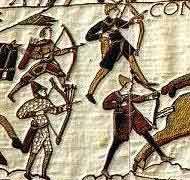 Norman archers were lightly clothed to allow rapid movement on the battlefield
and easy use of the bow. The standard weapon used was the short bow, about four
feet in length and drawn to the body rather than the ear as with later, more effective
longbows. Against chain mail, its effective range was only about 50 yards. The
Normans were also recorded to have used the crossbow, lethal at over 300 yards,
but none are depicted in the Beaux Tapestry and it is unclear if any were used
in the battle.
Norman archers were lightly clothed to allow rapid movement on the battlefield
and easy use of the bow. The standard weapon used was the short bow, about four
feet in length and drawn to the body rather than the ear as with later, more effective
longbows. Against chain mail, its effective range was only about 50 yards. The
Normans were also recorded to have used the crossbow, lethal at over 300 yards,
but none are depicted in the Beaux Tapestry and it is unclear if any were used
in the battle.
Infantry wore chain mail hauberks, (loose fitting knee length mail shirts split
at the front and rear for ease of movement with elbow length sleeves), leather
hauberks or no amour at all. Not all had access to mail which was expensive and
time consuming to make and hence, was much prized. Helmets were of a conical design
with a nose guard riveted to the front to provide facial protection. The basic
weapon was the spear and sword.
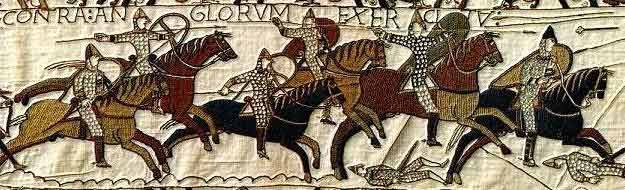
The cavalry were the elite of the Norman army, equipped with mail hauberks. Like
the infantry, their main weapons were the spear (a lighter version), and the sword
for closer fighting. Similar to the Viking sword, it was made for cutting rather
than thrusting. Blunt instruments such as the battle mace were also used. Infantry
and cavalry were both equipped with the kite shaped shield, measuring about 36
by 15 inches constructed from wood and leather with metal reinforcements. Its
longer length provided much more protection to the vulnerable leg area than the
round shield, particularly for mounted troops. The horses, however, were not armored.
This made them especially vulnerable when attacking a shield wall, as the Saxons
were to employ. The rider was forced to turn his mount side on to be able to use
his sword effectively. As a result, the flank of the horse was open to attack
by his opponent, a role for which the Saxon axe was well suited. If his horse
was cut from under him, a Norman knight in his heavy hauberk was defenseless until
he could regain his footing.

 The elite of the Saxon army was made up of the housecarls (the king's bodyguard),
formed by King Cnut 50 years earlier. In normal circumstances, Harold would
have had around 3000 to call on but after Stamford Bridge, just weeks earlier,
would be closer to 2000. His brothers Leofwin and Gyrth were estimated to have
command of about 1000 each. This gives Harold around 4000 highly trained and
armed troops, possibly the best fighting men in Europe. While mounted troops,
they fought on foot and were slow moving and vulnerable to missiles on the battlefield.
The elite of the Saxon army was made up of the housecarls (the king's bodyguard),
formed by King Cnut 50 years earlier. In normal circumstances, Harold would
have had around 3000 to call on but after Stamford Bridge, just weeks earlier,
would be closer to 2000. His brothers Leofwin and Gyrth were estimated to have
command of about 1000 each. This gives Harold around 4000 highly trained and
armed troops, possibly the best fighting men in Europe. While mounted troops,
they fought on foot and were slow moving and vulnerable to missiles on the battlefield.
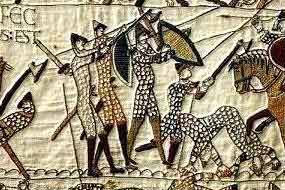
Their armor was chain mail, similar to that used by the Normans. While expensive
and prized, there was likely to be a substantial supply available from the plunder
of Stamford Bridge so most would have been similarly protected. The Saxon housecarls,
therefore could expect to be better protected than the Norman infantry. Each
would also wear a helmet, possibly similar to the Norman style with a nose guard.
The Beaux tapestry shows a mixture of shield types, the Norman kite design and
the traditional round shield. Captured round shields of the Norse may well have
replaced kite shields broken during the battle at Stamford Bridge.
The main weapon was the great two handed axe of Viking origin - a sharp curved
blade of one foot diameter on a handle over three feet in length. This weapon
could deliver a devastating blow which no shield or armor of its day could withstand.
As a two handed weapon, the user would have wedged their shield into the ground
before them for protection while wielding their weapon. Many were also armed
with lances and swords similar to the Normans.
The rest of Harold's army was made up of fyrdsmen, part time soldiers who were
called up for two months a year to defend their land. Under the Saxon system,
each five hides of land were to provide a man and 20 shillings for his wages
for defense of the realm.1. This compares to
the feudal system employed by the Normans who could call on full time professional
soldiers. Theoretically, up to 15-20,000 of these part time soldiers could be
called on but it is unlikely that anywhere near this were present at the battle.
It is estimated that around 4000 made the field giving Harold an army of around
8000, larger than Williams but with a lower percentage of full time professionals.
These fyrdsmen were less well armed than the housecarls, few possessed chainmail
with most wearing hardened leather and carrying a range of weapons from spears,
short axes, homemade swords and farm implements. Shields would have been round
shields or whatever could be improvised.
Few archers were available to the Saxons at Hastings. While present as Stamford
Bridge, the lightning rush south meant that few made it to the battle. Even
in the latter Middle Ages when the English archer ruled supreme, they were rarely
wealthy with access to horses. In his haste to meet William in battle, Harold
was forced to leave them behind and didn't delay in London long enough for others
to be raised. As a result, the Normans were strongest where the Saxons were
weakest, in mobile cavalry and archers.

Just after daybreak on the 14th,
at around 6:00, William's army broke camp and headed to battle. The Bretons
took the lead, followed by the Franco Flemish and the Normans brought up the
rear. The march to Senlac Ridge would have taken until around 7:30. Just out
of sight of the Saxon position, they would have put on their armor and mounted
their horses. William initially put on his armor back to front, seen as a bad
omen, which he laughed off and also hung the bones of the English saints Harold
had sworn on around his neck. When all was ready, William moved his army onto
the field.
Harold positioned his army atop the ridge behind a wall of shields approximately
700 yards in length.2. The heavily armed housecarls
were placed to the front while the less well-armed fyrdsmen were placed to their
rear. The densely packed formation would have been seven or eight ranks deep.
Their position was ideally suited to defense, unable to be outflanked due to
the steep, uneven ground on either side - any assault had to be frontal. To
the front, the ground sloped from 1/35 to the west, 1/15 at the center and about
1/22 to the east. This compared to around 1/4-6 to the flanks. Harold raised
his standards, the Wyvern of Wessex and his personal banner, The Fighting Man
on a slight rise near the center of the line. While there is no evidence of
any barricades being erected before their position, it is likely that a small
nearby stream was blocked to turn the ground at the base of the ridge into a
bog.
William formed his army about 150 yards away on slightly lower ground from the
Saxon position, just out of range of the few Saxon archers. The right division
was made up of approximately 1600 French and Flemish troops under the command
of Eustace of Boulogne. They straddled the London-Hastings road facing Harold's
left. William's left, on flat and boggy ground was made up of about 2100 Bretons
from Maire and Anjou commanded by Alan Fergent, the Count of Brittany. The center,
twice the size of the flanks, numbering 4300, was made up of the Normans under
the delegated command of William's half brothers Odo and Robert, Count of Mortain.
It was here that William raised his personal standard and the papal banner.
Each division was divided into three sections of similar composition. The first
rank was of archers, slingers and spearmen, the second of infantry, and the
third cavalry.
As they formed, the Flemish and French had to march before the Saxon line and
perform a sharp right turn to take up their position. Luckily for them, Harold
made no attempt to harass them. If he had attacked at this point, he could have
caused havoc but would have taken heavy losses from the Norman cavalry as he
regained his position on the ridge.
Williams plan was for a new type of mobile warfare. His archers were to shower
the Saxon line with arrows before falling back. His dismounted men at arms were
to move forward and clash with the Saxon line before the cavalry followed to
exploit any gaps created by the fighting. This was to be repeated until the
Saxon line broke.
Harold's plan was simpler - to remain in a defensive line which favored his
housecarls and fight a battle of attrition. The longer he held, the more reinforcements
he could expect to filter onto the battlefield. William, on the other hand,
on a foreign shore, could expect none. If the Saxon line held, victory would
be theirs.
1.Whitelock D. et.al. The Norman Conquest:
Its Setting and Impact, Eyre & Spottiswoode, London, 1966, pp.93-3
2.Poyntz Wright P. Hastings, The Windrush Press, Gloucestershire,
1996, p.85


