

At around 9.00, William's three divisions
began their slow advance up the ridge towards the Saxon line. As the thin line
of archers came within range, they loosed their volleys of arrows until their
supply was exhausted. This attack was ineffectual in thinning the Saxon line as
hoped as firing uphill, most arrows were expended on the shield wall or sailed
harmlessly overhead. This attack may have been over quicker than William had intended.
There would have been few arrows to be reused as the Saxons had few archers with
which to reply. Once their quivers were emptied, the Norman archers would have
to wait for new supplies to be brought up from the rear.
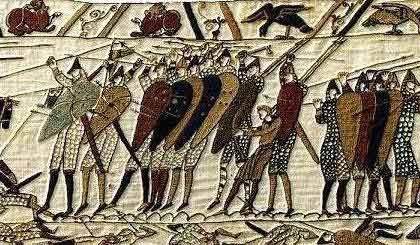
As they fell to the rear, the infantry began their struggle up the slope. Coming
within range, they were met by a murderous assault of spears, axes and stones
tied to sticks causing numerous casualties. Due to the shallower slope they faced,
the Bretons arrived at the Saxon line before the other divisions, unsupported
on their flanks and closely followed by an uncoordinated attack by their cavalry.
As they came against the intact shield wall, the Saxons threw themselves forward
and broke the Breton attack, routing them. As they fled, the Norman center division
was attacked on its now open flank forcing a disorderly retreat.
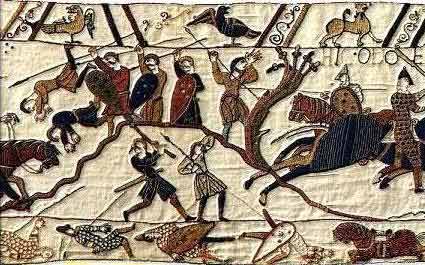
A section of the Saxon line pursued the Bretons, probably against Harold's orders.
It is likely that the less disciplined fyrdsmen did so, the Beaux tapestry showing
them as unarmored. It is often said that if Harold had ordered an all out attack
at this stage, he may have routed the Normans from the field entirely but this
is unlikely. His only advantage was in static defense behind his shield wall.
Attacking cavalry was forced to turn the unprotected flanks of their horses towards
the wall in order for the riders to bring their swords to bear. This in turn opened
them up to the Saxon axe men. If the slow moving infantry were caught on open
by cavalry with room to maneuver, particularly on the marshy ground at the base
of the ridge, they would throw away all their advantages. As it was, William was
able to rally his cavalry to counter the partial Saxon advance. Forced to form
a defensive cluster on a small mound at the base of the ridge, the unarmored fyrdsmen
were defenseless and were quickly dispatched with no survivors.
A small break in the fighting followed as William rallied his army's flagging
morale and the dead and wounded were seen to. The Beaux Tapestry shows hauberks
being removed from the dead for reuse in the next attack.

The Saxons meanwhile, plugged up any gaps in their defenses, moved their dead
and wounded to the rear and piled up any dead horses in front as an added obstacle.
The second phase of the battle, beginning around 10:30 to 11:001.,
was slower and much better coordinated. Again, it began with an ineffectual archery
barrage. Lasting up to two hours, attack after attack was repulsed by the Saxons
with the dead of both sides piling up before them causing a further obstacle to
the attackers. As casualties mounted, gaps began to appear in the shield wall
but were quickly filled. At around 1:00pm, the Franco-Flemish division began to
falter. William and Eustace of Boulogne holding the papal banner managed to halt
a rout and the flank division was reinforced with Norman knights from the center.
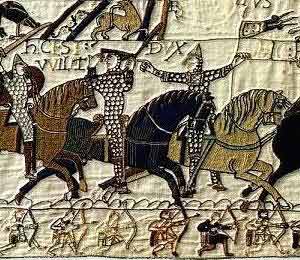
William, having been dehorsed, removed his helmet to show his face in order to
counter the rumor that he had been killed. During the battle, he had three horses
cut from under him.
William of Poitiers, chronicling the battle has described William as ordering
two feigned retreats to encourage the Saxons to break ranks. Given the difficulty
in coordinating such a tactic without causing a wholesale rout, this is highly
unlikely. It is more likely that as each attack was repulsed, William's army broke
ranks to be rallied by their leaders. A feigned retreat was the victor's way of
favorably describing the fact that their army ran away! It was only the strength
and ability of their leaders who were able to rally them to counterattack any
Saxons foolish to break ranks that prevented a wholesale rout. At this point,
William ordered another withdrawal, covered by cavalry.
Another lull followed as William and his commanders discussed a change in tactics
that might bring success. At this point, they would have been getting desperate
with up to one quarter of their force either killed or wounded. After five hours
of fighting, with losses mounting and the Saxon line still intact, the Norman
position was looking precarious. If the next attack failed, it was likely to be
the last. In a foreign land, defeat would mean almost certain death for the invaders.
Changes were also being made in the Saxon position. Due to their casualties, the
line was now too thin to adequately defend the entire ridgeline. As a result,
it was concentrated to the slightly higher positions to the center and east. While
this allowed the Normans to attack from even ground from the west, it would still
be no easy task.
 Forming a single group of infantry interspersed with cavalry and the archers placed
to the rear, they slowly approached the Saxon line for a third time. Just before
contact, the archers let loose volleys of arrows angled upwards as to fall on
the middle and rear ranks of the Saxon line from above. Earlier volleys had hit
the shield wall or simply sailed overhead. This provided the distraction and confusion
desired just as the two forces met.
Forming a single group of infantry interspersed with cavalry and the archers placed
to the rear, they slowly approached the Saxon line for a third time. Just before
contact, the archers let loose volleys of arrows angled upwards as to fall on
the middle and rear ranks of the Saxon line from above. Earlier volleys had hit
the shield wall or simply sailed overhead. This provided the distraction and confusion
desired just as the two forces met.
This wave of assaults was the fiercest of the day, each preceded by arrows. At
around 4:00pm, weaknesses began to appear in the Saxon line, which the Normans
began to exploit. In a final assault on the weakened left flank, they broke through
and possibly did so on the other flank, It may have been at this point that Harold's
brothers, Leofwin and Gyrth were killed, defending their brother. The Saxon line
broke and became a series of isolated groups fighting for survival. As the light
faded, fyrdsmen and some housecarls made off to escape while others fought to
the death.
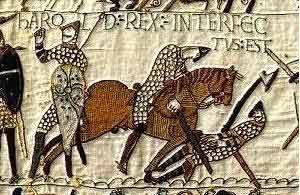 Tradition has it that an arrow through the eye killed Harold but this is more
a misinterpretation of the Beaux Tapestry than fact.2.
A group of 20 knights broke through in an attempt to kill Harold, four reaching
him: Hugh of Montford, Walter Giffard, Eustace of Boulogne and Ivo, the heir to
the Count of Ponthieu. Ivo was later sent home by William for mutilating Harold's
body after his death.
Tradition has it that an arrow through the eye killed Harold but this is more
a misinterpretation of the Beaux Tapestry than fact.2.
A group of 20 knights broke through in an attempt to kill Harold, four reaching
him: Hugh of Montford, Walter Giffard, Eustace of Boulogne and Ivo, the heir to
the Count of Ponthieu. Ivo was later sent home by William for mutilating Harold's
body after his death.
With the news of Harold's death, the Saxon army disintegrated. After a day of
fierce fighting, the Normans showed no mercy to the dying and wounded, slaughtering
them were they lay. Those unable to escape and hide in the forests were pursued
and cut down by cavalry.
One group fled towards Malhosse pursued by Eustace of Boulogne and 50 cavalry
in the fading light. In near darkness and unfamiliar with the terrain, they rode
straight into a steep gully and Saxon ambush. Eustace, uninjured in the initial
attack, was about to order a retreat when struck by an axe between the shoulder
blades, unable to see his attacker. He died shortly after being taken back to
the battlefield. William himself arrived to take command of the situation and
beat off the attack before returning to the battlefield. This action, however,
took place too late to change the course of the battle, which had already been
won.
1.Poyntz
Wright P. Hastings, The Windrush Press, Gloucestershire, 1996, p.89
2.ibid., p.99


