

January 5th, 1066 saw the death of
Edward the Confessor, setting in motion the chain of events that was to culminate
in the Battle of Hastings on 14th October 1066. As Edward had left no heir, Harold
Godwine, the Earl of Wessex, was chosen by the Witan to be his successor. Harold,
the first English monarch to be crowned in Westminster Cathedral, was also to
become the only English monarch to die defending his country.
While lawfully elected and enjoying the popular support of his subjects, Harold's
position was far from secure. His two main rivals for the English crown were Harald
Hardraade of Norway and Duke William of Normandy. His immediate concern, therefore,
was to strengthen his defenses. Having inherited a navy from Edward, he stationed
his ships to patrol the approaches to Southampton and Winchester in order to block
any crossing by William. The Fyrd, part time soldiers who served for two months
each year, were also mobilized to protect southeast England. The defense of the
north, the direction from which Harald Hardraade could be expected to attack,
was left to Edwin and Morcar, the earls of Mercia and Northumbria.
William in particular was outraged by Harold's coronation, having been promised
the crown by Edward the Confessor in 1051. By dying without an heir, however,
Edward in reality had no legal right to make such a promise. The issue of succession
was a matter to be decided by the Witan. They based their decision on ensuring
continuity of rule and Edward's dying wish that Harold succeed him.
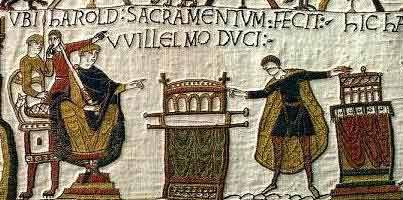 William's second grievance, and one which aggravated him the, was the fact that
Harold had broken an oath of allegiance made to him in 1064. Having been captured
by the Count of Punthieu when traveling to Normandy, he was handed over to William
on payment of a ransom. In order to gain his freedom, Harold was forced to make
the oath on the bones of the British saints Ravennus and Rasyphus. Harold knowing
that this oath was invalid, having been made under duress, never let it bother
him and never sought a papal dispensation for it. William, however, cleverly used
it to gain support and a papal blessing for his right to the English crown.
William's second grievance, and one which aggravated him the, was the fact that
Harold had broken an oath of allegiance made to him in 1064. Having been captured
by the Count of Punthieu when traveling to Normandy, he was handed over to William
on payment of a ransom. In order to gain his freedom, Harold was forced to make
the oath on the bones of the British saints Ravennus and Rasyphus. Harold knowing
that this oath was invalid, having been made under duress, never let it bother
him and never sought a papal dispensation for it. William, however, cleverly used
it to gain support and a papal blessing for his right to the English crown.
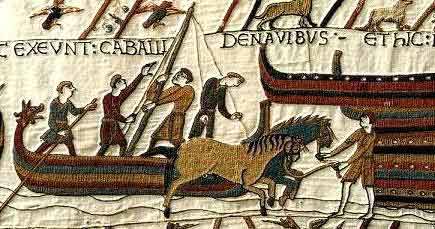
By offering the promise of lands in the event of a successful invasion, William
purchased support for his planned invasion. Ordering 752 ships be built to transport
his army, around 500 were estimated to have been delivered.1.
All was ready by 12th August when his fleet assembled at the mouth of the Dives
but was delayed by unfavorable weather. On the 12th September, possibly running
short of food, the fleet moved north to St-Valery at the mouth of the Somme, closer
to the English coast. The fleet was lashed by storms and some ships were lost.
With Harold's navy patrolling to block an invasion, the actual crossing would
be a risky undertaking.
A storm had, however, forced Harold's ships to return to port for repairs, leaving
the channel open. Believing that there would be no invasion that year, Harold
disbanded the Fyrd on 6 September in time for the harvest.

The exact date that Harald Hardraade
landed is unknown but Harold had learned of it by 15th September. On the 20th,
while marching on York, the Viking army was met by Edwin and Morcar at Fulford
who were only defeated after a hard fight which left many dead on both sides.
The city of York, now defenseless, surrendered without resistance. Harold quickly
assembled his army and left London between 18-20th, marching 180 miles in only
five days!
On 25th, Harold marched through York to the Viking camp at Stamford Bridge,
eight miles to the east. Achieving complete surprise, the first indication the
Vikings had that the Saxon army was in the area was when they appeared on the
crest of the hill above their camp at around midday.
At the time, up to one third of the Viking army was at Riccall, returning wounded
and plunder to their ships. The initial Saxon attack was beaten off but Harald
Hardraade was killed. Rallying, the Vikings fought bravely until the rest of
their army returned from Riccall. Late in the afternoon, the Saxons finally
overcame the Vikings. The Vikings sustained in the region of 5000 casualties
and the Saxons around 2000. Showing great magnanimity, Harold allowed the survivors
to return home.

After his lengthy delay, William
finally landed at Pevensy on 28th September with news reaching Harold by 1st
October. With Harold elsewhere, William was free to form a beachhead and set
about the usual Norman "terror campaign" aimed not only at cowering the local
population into submission but to provoke Harold into an early conflict before
he was fully ready.
Harold may have been already returning to London when he heard the news and was
back by the 6th after another lightning march. With the Normans devastating the
local countryside, Harold paused only five days to assemble his army before marching
on Hastings. Hoping to surprise William as he had Harald, he quickly covered the
58 miles to his assembly point at the "hoary apple tree", a well-known local landmark.
Exhausted, his army arrived on the evening of the 13th with troops filtering into
camp throughout the night. Surprise, however was not to be with William's scouts
keeping him well informed of Harold's movements.
1.Poyntz Wright P. Hastings, The Windrush
Press, Gloucestershire, 1996, p.89

