
Crossing the border unopposed on the 22nd July, Cromwell was met with a deserted
countryside, stripped of all sources of food between the river Tweed and Edinburgh.
Behind this scorched land, his foe, Leslie, had entrenched his army in a line
of fortifications. The Scots, in their own backyard, subjected the English to
guerrilla attacks at every opportunity, hitting without warning before melting
back into the heather. Unable to draw the Scots into open battle, English morale
began to sag.
Having sent Lambert ahead with 1,400 cavalry to secure Musselborough, Cromwell's
forces finally drew up on the outskirts of Leith on the 29th. He then proceeded
to bombard the town with the support of four men-of-war but the attack was prevented
from being driven home by heavy rain. After standing in battle order all night,
and having eaten nothing but bread and water for the past six days, they withdrew
to Musselburgh.
The Scots followed and overpowered the small English rearguard of 200 from the
11th Horse. A counter attack by the 1st horse drove them back before the Scots
attacked again. The Scots were eventually driven off after a fierce battle when
Whalley, commanding the rest of the 11th horse and Lambert leading the 13th
joined the fray. During the battle, Lambert was wounded three times and briefly
captured before being rescued by elements of the 1st horse.
Having eventually regained Musselburgh, the English were again harassed, this
time by a force of 800 cavalry commanded by Major General Montgomery that raided
the town at around 3 o'clock in the morning. After initially driving in the
English pickets, they were beaten off with heavy losses. Englishmen serving
in the Scots army aided the surprise of the attack, their voices being mistaken
for a returning patrol.
With Musselburgh considered too exposed, Cromwell fell back on Dunbar to re-supply.
There he began a psychological war in order to win the hearts and minds of the
Scottish people, branding their alliance with Charles II as "a covenant made
with Death and Hell."
On hearing that the Scots were running short of food in their positions, Cromwell
left Dunbar with the aim of outflanking the Scots and cutting their lines of
communication with Stirling. By the 13th, he had taken Braid Hill, due south
of Edinburgh. He then wasted two days communicating with Leslie before returning
to Dunbar to re-supply.
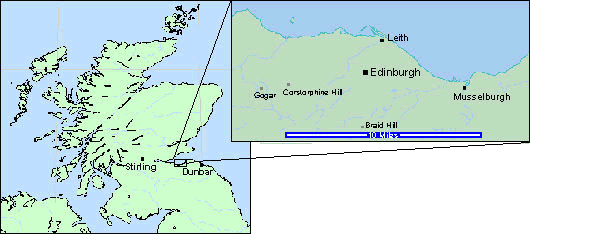
He was back at Braid Hill by the 18th, only to discover that in the meantime,
the wily Leslie had occupied Corsorphine Hill, placed a strong detachment in
a house called Redhall and had deployed his main army for battle blocking the
way to Stirling. Storming Redhall on the 26th, it was taken but the position
on Corstorphine was considered too strong to assault. Edging to the west, to
advance on Leslie's western flank, they were matched by the Scots meeting at
Gogar. Both armies deployed for battle but the Scots had formed their lines
behind a bog making an English attack impossible. After a brief artillery skirmish,
the English once more withdrew exhausted to Dunbar.
On this occasion, the Scots closely shadowed them, and only a severe thunderstorm
prevented a severe mauling. The campaign had taken its toll on the English army.
Leslie's two allies, disease and hunger, together with the cold and wet of the
late Scottish summer had played their part well. Of the 16,000 English who had
begun the campaign, only 11,000 were considered fit for duty and of these, all
were exhausted and hungry. Cromwell, having been well and truly out generalled,
turned his thoughts from victory towards how to get home. September 1st saw
the Scot army, twice the size of that of the English, made up of 6,000 cavalry
and 16,000 infantry, draw up on Doon Hill overlooking Dunbar. That evening detachments
were placed blocking the road to Berwick, known as the Cockburnspath, as the
English worked frantically to fortify the town against the coming attack. With
the only road to England blocked, Cromwell had two options, fight with his back
to the sea against overwhelming odds or attempt to escape by sea.
As those too sick to fight were loaded onto ships, Leslie took this to mean
the English were preparing to evacuate. This firm belief is confirmed by a conversation
with a captured English veteran who was led before him. "How will you fight,
when you have shipped off half your men, and all your great guns?" The veteran
replied that if Leslie attacked, he would "find both men and great guns too!"
Assuming that the English would evacuate their infantry by sea and let the cavalry
attempt to break out along the Cockburnspath, Leslie positioned forces to block
the way.



