

September 2nd dawned dark and stormy. The wind had been so severe the previous night that the
English had been unable to pitch their tents, forcing them to sleep in the open. Exposed atop
Doon Hill, the Scots had it even worse as the wind blew in unhindered from the North Sea. While
impregnable to attack, the Scot position was out of artillery range of the English and difficult
to re-supply. If they were to attack, they would have to move.
Cromwell was in a quandary. He knew that the Scottish position was impregnable, that he could
not safely evacuate by land or sea and as time passed, his men grew weaker. "Our lying here
daily consumeth our men, who fall sick beyond imagination." If a solution was to be found, it
must come soon.
In the end, it was the Scots who provided the answer. Leslie was content to sit and wait while
the English grew weaker and so gain victory without firing a shot. The Kirk ministers attached
to his army, however, saw themselves as far superior at military strategy than the man who had
used his allies, hunger and disease to bring the English to their knees, and ordered that they
attack. To do so, they would have to reform at the base of Doon Hill in preparation for
crossing Spott Burn.
Leslie's plan was one of envelopment. His infantry was placed at the center with cavalry on
either flank, two thirds on the right blocking the road to England and one-third to the left.
The infantry was to engage the English center while the cavalry would move around the flanks to
surround the English. While a sound plan, its flaw was that it assumed that Cromwell would be
content to sit and wait for the attack. Moreover, the movements were made in daylight allowing
Cromwell full view of what was planned.
Cromwell couldn't believe his luck. Watching the Scottish preparations with Lambert and Monck
from Broxmouth House, he quickly formulated a daring plan. While the Scottish position was
ideal from which to launch an attack, it was poorly suited to meeting one. Their line was a
great arch, close to two miles in length with little room to maneuver between Doon Hill and
Spott Burn. If the English attacked on a flank, the Scots would not be able to reform in time
to meet the threat.
As the Scottish artillery rumbled down the hill to take up position, Cromwell called his
council of war. A number of English officers pressed that they should evacuate the infantry by
sea and let the cavalry break out along the Cockburnspath to England. While the baggage and
artillery would be abandoned and losses would be high, at least some would escape. As it was,
it was too late to embark the infantry and there were too few ships. Cromwell laid out the plan.
Before the Scots army lay Spott Burn, steep sided and swollen by rain. While fordable,
it presented a formidable obstacle. The Scot left, wedged between it and Doon
Hill had no room to move and assist the rest of the army if needed. The English
artillery could pin them down while the rest of the army attacked the Scottish
right. As the stream approached the ocean, its banks grew flatter and there was
room for troops to maneuver. This was where Cromwell saw the Scots as most vulnerable.
Lt. General Fleetwood and Lambert commanding six regiments of horse and Colonel
Monck, commanding three and a half regiments of foot were to attack this flank.
The remainder of the infantry was formed into two brigades under Colonels Pride
and Overton. Pride's regiment and two regiments of horse commanded by Cromwell
himself were to be held in reserve while Overton's regiment and the dragoons were
kept in place to support the artillery. By concentrating the attack on the flank,
the whole Scottish army, unable to maneuver, could be rolled up. Lambert spoke
warmly of the plan and it was enthusiastically adopted. The officers asked that
Lambert be given the honor of leading the assault to which Cromwell agreed.
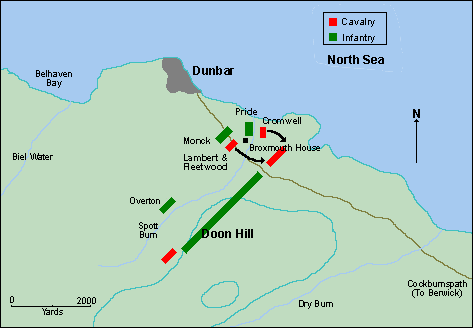
Knowing that Leslie didn't expect to be attacked, Cromwell moved his army during
the night to allow a surprise attack at dawn. With the noise of their movements
screened by wind and hail, Cromwell rode from regiment to regiment, carefully
positioning each. So great was his concentration that biting his lip until blood
ran down his chin, he didn't seem to notice. Twice during the night, the alarm
was raised in the Scot camp but they were ordered to stand down. As dawn approached,
everything was ready but Lambert was nowhere to be found. Busy positioning the
artillery, he eventually gained his position at around five to six o'clock as
the Scots began to rise.
Despite standing in battle order throughout the night, many Scottish officers, political
appointees unused to the rigors of a military campaign, had retired behind the lines to stay
in tents and nearby farmhouses. Their soldiers, left without any officers, set about finding
whatever shelter was to be had from the weather. Many covered themselves with corn storks to
keep off the rain while horses were allowed to forage. At around two o'clock, the order was
given allowing the musketeers to extinguish their matches and stand down.
With a mighty cry of "The Lord of Hosts," the English cavalry fell on the Scottish right wing.
Although taken completely by surprise, the Scots outnumbered the English by around 4,000-5,000
to 2,700. As they crashed into the sleeping camp, the Scots scrambled to gain their positions,
fighting desperately. Lambert's cavalry ploughed on until halted by a fierce downhill charge
by Colonel Strachan's cavalry, many of whom carried lances.
Monck moved his infantry up on Lambert's right and attacked the Scot's infantry. A desperate
battle ensued as both sides traded musket fire and moved in for "the push of the pike." The
Scots, fighting downhill, had the advantage halting the attack which then seesawed with charges
and countercharges.
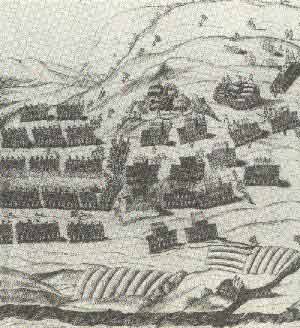 Cromwell, unlike his adversary Leslie, had maintained the ability to maneuver his forces.
Seeing that committing his reserves could swing the battle, he moved his regiment of horse and
Pride's infantry between Broxmouth House and the sea to come up on the extreme right of the
Scottish line. Moving Monck's forces to the left to gain a clear run at the Scot infantry, he
burst through the gap between Lambert and Monck followed by Pride's infantry. As Lambert and
Monck rallied their forces once more, Cromwell swung into the flanks of the Scottish cavalry.
At this point, the sun burst through the clouds and Cromwell exclaimed, "Now let God arise, and
His enemies shall be scattered!" Faced by the entire English army on its front and flank, the
Scottish right collapsed, its survivors fleeing down the Cockburnspath.
Cromwell, unlike his adversary Leslie, had maintained the ability to maneuver his forces.
Seeing that committing his reserves could swing the battle, he moved his regiment of horse and
Pride's infantry between Broxmouth House and the sea to come up on the extreme right of the
Scottish line. Moving Monck's forces to the left to gain a clear run at the Scot infantry, he
burst through the gap between Lambert and Monck followed by Pride's infantry. As Lambert and
Monck rallied their forces once more, Cromwell swung into the flanks of the Scottish cavalry.
At this point, the sun burst through the clouds and Cromwell exclaimed, "Now let God arise, and
His enemies shall be scattered!" Faced by the entire English army on its front and flank, the
Scottish right collapsed, its survivors fleeing down the Cockburnspath.
The ungainly Scot line, with no room to maneuver, was met by an English onslaught on its
unprotected flank. Many Scots simply panicked and fled or surrendered where they stood as the
English cavalry swept from one end of the line to the other. The Scot cavalry on their left
flank fled the battle they had never even joined. Two regiments of foot bravely stood their
ground until overwhelmed and were cut to pieces. By seven o'clock, as the sun burned away the
last of the morning mist, Leslie's army had ceased to exist.
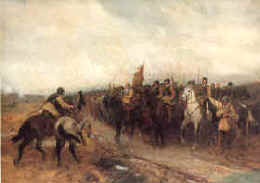
Amid the cries of the wounded, Cromwell was overcome with laughter, described by a puritan
minister as "drunken with the Spirit and filled with holy laughter." The English cavalry,
singing Psalm 117, quickly reformed before riding down the fleeing Scots, pursuing for up to
eight miles.


