
 |
 |
 |
|
|
|


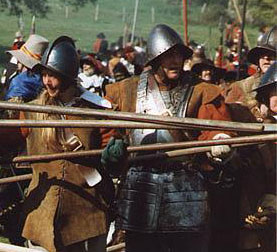 Pikemen were chosen from the physically larger and stronger recruits, as they
were required to wield the heavy and cumbersome pike. Their weapons consisted
of the 12-18 foot long pike, essentially a long pole with an iron point. The
difference in lengths was due to the practice of pikemen cutting down the lengths
during a campaign to make them more manageable, a practice discouraged by their
officers. More than one battle was lost due to the pikes of one side being shorter
than the others! Many also wore a sword although this was seldom used in favor
of the pike. Sergeants were armed with halberds, a shorter pike with an axe
head near the point. Defensively they wore an armored corselet (front and breast
plate) although by this time, they had often been discarded to allow freer movement
and a combe cap, an iron helmet ridged along the top.
Pikemen were chosen from the physically larger and stronger recruits, as they
were required to wield the heavy and cumbersome pike. Their weapons consisted
of the 12-18 foot long pike, essentially a long pole with an iron point. The
difference in lengths was due to the practice of pikemen cutting down the lengths
during a campaign to make them more manageable, a practice discouraged by their
officers. More than one battle was lost due to the pikes of one side being shorter
than the others! Many also wore a sword although this was seldom used in favor
of the pike. Sergeants were armed with halberds, a shorter pike with an axe
head near the point. Defensively they wore an armored corselet (front and breast
plate) although by this time, they had often been discarded to allow freer movement
and a combe cap, an iron helmet ridged along the top.
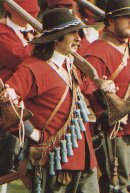 Musketeers provided the infantry with its firepower, armed with matchlock muskets.
A muzzle loading weapon, to be loaded, gunpowder was poured down the barrel
and a bullet dropped after it. Wadding was then rammed down the barrel to keep
it all in place. The weapon was then primed by filling the flash pan with finer
gunpowder and a short length of lighted match was inserted to ignite the powder
when the trigger was pulled. An experienced musketeer may be able to fire two
to three rounds a minute and hit a target at 60 yards if he was lucky. It was
an unreliable weapon at best but in high winds and rain, it was almost impossible
to use effectively. Many also carried swords although in close combat, the butt
end of a musket was found to be more effective. Wearing no defensive armor they
carried a bandoleer holding a number of powder containers, a priming flask and
a bullet pouch slung over their shoulders and a length of cord used as a match
hung from their belts. Headwear was mainly broad brimmed felt hats often displaying
plumes. They fought in ranks three to six deep so that one could fire while
the others reloaded. In front of the regiment, there would be a "forlorn hope",
a loose line of musketeers acting as skirmishers.
Musketeers provided the infantry with its firepower, armed with matchlock muskets.
A muzzle loading weapon, to be loaded, gunpowder was poured down the barrel
and a bullet dropped after it. Wadding was then rammed down the barrel to keep
it all in place. The weapon was then primed by filling the flash pan with finer
gunpowder and a short length of lighted match was inserted to ignite the powder
when the trigger was pulled. An experienced musketeer may be able to fire two
to three rounds a minute and hit a target at 60 yards if he was lucky. It was
an unreliable weapon at best but in high winds and rain, it was almost impossible
to use effectively. Many also carried swords although in close combat, the butt
end of a musket was found to be more effective. Wearing no defensive armor they
carried a bandoleer holding a number of powder containers, a priming flask and
a bullet pouch slung over their shoulders and a length of cord used as a match
hung from their belts. Headwear was mainly broad brimmed felt hats often displaying
plumes. They fought in ranks three to six deep so that one could fire while
the others reloaded. In front of the regiment, there would be a "forlorn hope",
a loose line of musketeers acting as skirmishers.
To be effective, pikemen and musketeers needed to work together. An infantry
regiment attacking another would steadily advance. The "forlorn hopes" would
trade a few rounds before retiring to the flanks as the main bodies clashed.
Drawing up, the musketeers would fire a few volleys before the pikemen would
lower their pikes and charge forward for "the push of the pike". Musketeers
would reverse their muskets and join the fray, clubbing down the enemy. If both
sides held, they may draw back a few paces, trade more musket fire before repeating
the process until one side broke.
An infantry regiment faced with cavalry would form a square with pikemen in
the center facing outwards with lowered pikes to keep the cavalry at a distance.
Musketeers would crouch two deep, below the pikes to fire on the enemy.

By the mid 17th Century, heavily armored cavalry of many different types was
a thing of the past. Cavalry was made up of two main classes, harquebusiers
and dragoons.
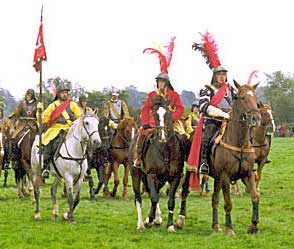 The most numerous type was the harquebusier. Originally foot soldiers armed
with crossbows, as time passed, they were given firearms and mounted to become
light cavalry. They were armed with a harquebus (carbine), a sword and a pair
of pistols. Some Scottish cavalry were armed with lances. Defensively, they
wore a light open-faced helmet and a cuirass (breast plates protecting their
front and back). Underneath this was worn a heavy buff coat of leather for added
protection. In the latter stages of the civil wars, the cuirass was often discarded
as the buff coat was found to allow much freer movement and still provide enough
protection to turn a sword blow.
The most numerous type was the harquebusier. Originally foot soldiers armed
with crossbows, as time passed, they were given firearms and mounted to become
light cavalry. They were armed with a harquebus (carbine), a sword and a pair
of pistols. Some Scottish cavalry were armed with lances. Defensively, they
wore a light open-faced helmet and a cuirass (breast plates protecting their
front and back). Underneath this was worn a heavy buff coat of leather for added
protection. In the latter stages of the civil wars, the cuirass was often discarded
as the buff coat was found to allow much freer movement and still provide enough
protection to turn a sword blow.
Battle tactics varied according to the commander but generally they advanced
three deep at a fast trot, holding their fire until at close quarters before
falling on the enemy with their swords. The first line of Scottish cavalry was
often lancers, who using long spears, could charge with devastating effect.
The second type of cavalry were dragoons, essentially mounted infantry. Armed
with a short firelock musket that could be fired from horseback and a sword,
they had the mobility of cavalry but fought on foot. In action, it was expected
that every tenth dragoon would stay behind the battle to hold the horses of
the others. They wore no defensive armor and were dressed similar to musketeers.
Due to their versatility, the tasks of a dragoon were wide and varied. They
could be used in advance of an army to secure passes and bridges or to hold
defensible positions when in retreat. In enclosed country, they fought hedge
to hedge as skirmishers whereas in open country they may even be used as normal
infantry.

The command of the English invasion army was initially given to England's military
commander-in-chief, Lord General Thomas Fairfax. Uneasy with the preemptive
nature of the campaign against their former allies, Fairfax declined the position
so Parliament appointed their Lieutenant General of Cavalry, Oliver Cromwell
in his place.
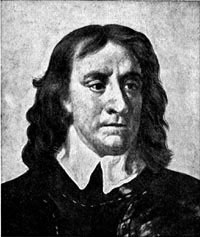 Cromwell, born of minor nobility, had served in Parliament before the civil
wars. With no formal military training, he quickly established a formidable
reputation as an aggressive master tactician, commanding the "Ironsides", a
cavalry regiment noted for its discipline and tenacity. His second in command
was Lt. General Fleetwood, who owed his appointment more to seniority than any
real military ability. Thoughout the campaign, his roll was carried out by more
able officers. Cromwell was, however, well supported by Major General John Lambert
as his cavalry commander and Colonel George Monck commanding the infantry.
Cromwell, born of minor nobility, had served in Parliament before the civil
wars. With no formal military training, he quickly established a formidable
reputation as an aggressive master tactician, commanding the "Ironsides", a
cavalry regiment noted for its discipline and tenacity. His second in command
was Lt. General Fleetwood, who owed his appointment more to seniority than any
real military ability. Thoughout the campaign, his roll was carried out by more
able officers. Cromwell was, however, well supported by Major General John Lambert
as his cavalry commander and Colonel George Monck commanding the infantry.
During the Civil War, Fairfax and Cromwell had molded the Parliamentarian army
from a poorly trained and equipped militia into a well drilled and disciplined
fighting force. It was comprised of veteran soldiers commanded by experienced
and able officers with an excellent esprit-de-corps. At this time, the "New
Model Army" was probably the finest fighting force in all of Europe.
Not all of the "New Model Army" could be sent to Scotland. Some regiments were
needed to police England and Ireland against potential royalist uprisings. A
force of eight regiments of horse, the 1st, 3rd, 8th, 11th, 13th, 14th, 15th,
and 16th and nine regiments of infantry, the 1st, 4th, 6th, 6/12th, 10th, 13th,
14th, 15th, 17th together with two companies of dragoons were assembled. Altogether
the army was made up of around 5,000 cavalry and 11,800 infantry. One of the
infantry regiments had been left leaderless when its commander, Colonel Bright,
resigned due to a disagreement with his General. In an interesting exercise
in army democracy, Cromwell, instead of simply appointing a new commander, consulted
with the regiment. Cromwell's choice, Colonel Monck, was rejected and Lambert
was given the command in addition to his cavalry regiment. To ease Monck's hurt
pride, a new regiment was formed from the garrisons of Newcastle and Berwick
and assembled at Coldstream - the regiment was to become the famous Coldstream
Guards.
Accompanying the army was an artillery train of 50 pieces and a fleet of 140
supply ships. By transporting supplies by sea, Cromwell planned to avoid relying
on vulnerable overland supply lines and the need to disperse his army to forage
for food.

At this time, the Scots had only a small standing army of around 6,000 regulars
due to sickness and desertions. This was quickly raised to over 25,000 by the
mobilization of the militia who were formed into new regiments. With some military
training, they were poorly equipped and extremely poorly commanded in comparison
to the English. While the English were able to absorb new recruits into existing
regiments with strong morale, the Scots were forced to form whole new ones.
Many were understrengh at Dunbar, their army made up of around 40 depleted regiments
cobbled together to form an army.
During the campaign, the Scots proceeded to shoot themselves in the foot. Charles
II, by refusing to publicly condemn his mother for her "Popery" and father for
"bad counsel" had infuriated the Kirk Party. They responded by dismissing 80
veteran cavalier officers and 3,000 men not seen as enthusiastic enough in their
support for the Covenant. One experienced Scottish colonel lamented that their
army had been left with officers who were "nothing but useless clerks and ministers
sons, who had never seen a sword, much less used one." The loss of this number
of veteran troops was to have dire consequences later in the campaign.
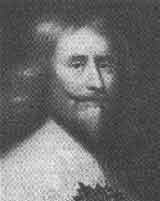 While inferior to the English army, they were well commanded by David Leslie,
the 1st Lord of Newark. A professional soldier, he had fought with the Swedish
army during the 30 Years War and had led the successful Scottish cavalry attack
at the Battle of Marsdon Moor and recently destroyed Montrose's army. His uncle,
Alexander Leslie, another able soldier with experience in the 30 years War,
advised him.
While inferior to the English army, they were well commanded by David Leslie,
the 1st Lord of Newark. A professional soldier, he had fought with the Swedish
army during the 30 Years War and had led the successful Scottish cavalry attack
at the Battle of Marsdon Moor and recently destroyed Montrose's army. His uncle,
Alexander Leslie, another able soldier with experience in the 30 years War,
advised him.
Realizing the superiority of the English army, Leslie sought to avoid open battle
but rather wage a war of attrition using what he termed his two favorite allies,
hunger and disease. By drawing up in a defensive line of fortifications between
the coastal town of Leith and Edinburgh and destroying all food supplies to
the south, he hoped to defeat the English through starvation rather than battle.
While the English became frustrated, not being able to meet him in open battle,
Leslie would harass them using guerrilla tactics to further weaken their resolve.
|
|
|