

The nine tumultuous years of the English Civil War, actually three separate wars,
resulted from a range of factors, economic, constitutional and religious, all
inextricably interwoven. At a time when religious differences were more often
debated with cannon balls than words, radical leaders with strong held beliefs
thought nothing of deciding the issues in battle.
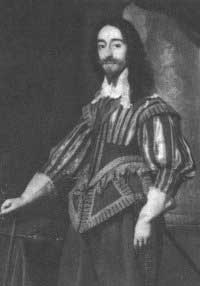 Charles I, attempting to rule as an absolute monarch, quickly came into conflict
with the English Parliament, suspicious of his "Popery" and desire for absolute
rule. Likewise, the Scots resented his attempts at reforming their Presbyterian
system of religion, formulating the "National Covenant" in 1638 to resist his
efforts. The English Parliament and the Scots, therefore, combined to defeat Charles
in the first of the English Civil Wars. An attempt by Charles to regain power
was crushed by Parliamentarian forces at Preston in August 1648 and he was put
on trial for treason.
Charles I, attempting to rule as an absolute monarch, quickly came into conflict
with the English Parliament, suspicious of his "Popery" and desire for absolute
rule. Likewise, the Scots resented his attempts at reforming their Presbyterian
system of religion, formulating the "National Covenant" in 1638 to resist his
efforts. The English Parliament and the Scots, therefore, combined to defeat Charles
in the first of the English Civil Wars. An attempt by Charles to regain power
was crushed by Parliamentarian forces at Preston in August 1648 and he was put
on trial for treason.
A simmering resentment had long been developing between the two allies, however. Parliament, in order to gain Scottish support, had promised to implement the Presbyterian church system in England. After Charles' defeat, they had been slow and lackluster in their efforts at implementation. Moreover, the promised payments for keeping the Scottish army in the field had not been forthcoming and the Scots were worried by the religious and social radicalism displayed by Parliament's "New Model Army." The Puritans, in power in England, wished religious tolerance for all Protestants whereas the Kirk Party, the radical religious group in power in Scotland desired to convert England to Presbyterianism. Any deviation from their official church line was considered heresy. The English, for their part, were aggrieved that apart from the Battle of Marsdon Moor, the Scots has contributed little to the war effort.
 Matters came to a head on the 30th January 1649 with the execution of Charles
I for "High treason and other high crimes." Subsequently, the monarchy and the
House of Lords was abolished and it became a treasonable offense for any Englishman
to proclaim Charles' son, Charles Stuart, The Prince of Wales, to be king. While
England became a republic, Charles had also been king of Scotland and they had
no plans to follow England's lead. Counter revolutionary feelings grew and the
Kirk Party saw inviting the Prince of Wales, currently exiled in Holland, to become
King of Scotland as a way of securing their position. In return, the new king
would have to support the "Covenant" and agree to enforce it in all of his domains.
With the defeat of the Marquis of Montrose by the Scots, the last royalist commander
in the field, he had no choice but to submit and was crowned Charles II on 5th
February 1649.
Matters came to a head on the 30th January 1649 with the execution of Charles
I for "High treason and other high crimes." Subsequently, the monarchy and the
House of Lords was abolished and it became a treasonable offense for any Englishman
to proclaim Charles' son, Charles Stuart, The Prince of Wales, to be king. While
England became a republic, Charles had also been king of Scotland and they had
no plans to follow England's lead. Counter revolutionary feelings grew and the
Kirk Party saw inviting the Prince of Wales, currently exiled in Holland, to become
King of Scotland as a way of securing their position. In return, the new king
would have to support the "Covenant" and agree to enforce it in all of his domains.
With the defeat of the Marquis of Montrose by the Scots, the last royalist commander
in the field, he had no choice but to submit and was crowned Charles II on 5th
February 1649.
His real ambition, however, was to regain the English throne with the help of
the Scots. Having done so, he would repudiate his pledge on the grounds that it
was made under duress. Both the Scots and the English, realizing this, began to
gather their forces.

