| Summary of info from kyffran here: http://www.pechemaniac.com/forums/viewtopic.php?pid=129819 translated, with additions. | ||||
Smartcast RF15e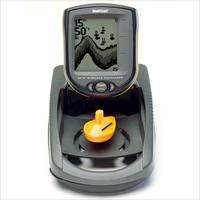 the advantage of this last is that it functions with a probe without wire with a range of 30-40 meters. The disadvantage, it is that when the probe is hung behind the baitboat, the 30 meters is insufficient. Luckily only a small modification is essential to reach the 100m of range ! |
Let us inspect it more closely and figure out how to open it up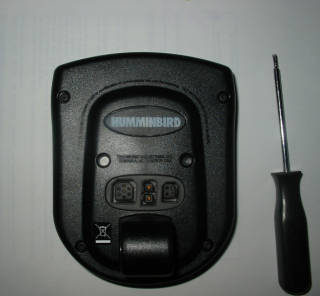 |
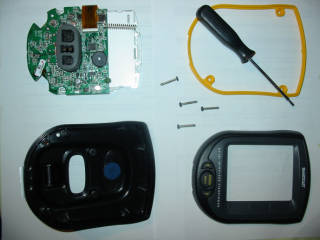
It is necessary to remove the 4 screws and delicately to carry
out disassembling without forcing on electronics by paying
attention well not to tear the sticker in top of the apparatus! So take out the retaining screws.
Here it is opened up. |
||
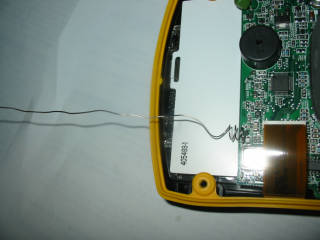
This spring welded onto the printed circuit is the receiver
antenna!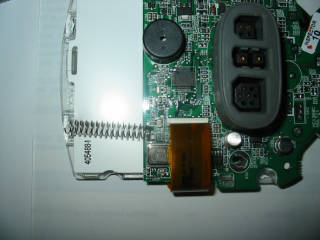 Delicately and by paying attention well nothing to unsolder or break, it is necessary to slacken the whorls of the spring in order to obtain a good length of metal, in fact one lengthens the antenna! |
When making the mods is the aerial has to be "tuned" to the
frequency being used. Like a music tuning fork, the length
decides the sound it produces or listens to. High frequencies,
have short waves, and short antennas. Thats why hobby FM radio
aerials are longer than mobile phone aerials etc .......get the
length right and the range will be right ! So for the 2.4 ghz wavelength equipment it is important to have an aerial length of 6.13 inches long for 1/2wave and if you have 7 inches all ready then you cant have a external aerial unless you try a fullwave which the total length of the aerial would need to be 12.26 inches which means 7 under deck,allow 1/2 inch for the plug and socket and you would then need an external aerial length of 4.76 inches |
You can make your own aerial antenna no problem, since it is
basically a piece of copper wire of a certain specified length.
Twisted core is more flexible than single strand wire core, and
being flexible, will be less prone to break at a later time
during use. For this job we will merely extend the coiled up half wavelength antenna, to expose it better than when it was coiled up for compactness.
|
||
|
To take rivet-pop and to separate it into two! 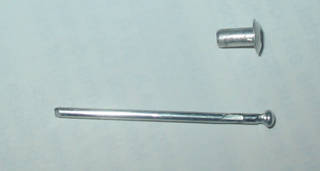 |
With a drilling machine and a drill with the diameter of
rivet-pop, to bore the surperior part of the case!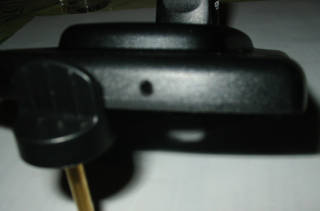 |
To pass the rivet in the hole and to stick it with super glue!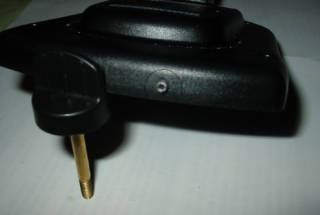 |
||
To pass the antenna in the hole by the interior and to
reassemble the case and the 4 screws!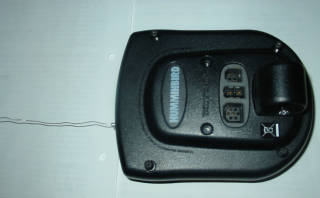 |
To take a piece of stiff poly receiver tube from the local hobby
shop rigid same length as the wire of antenna which sticks out
from the case,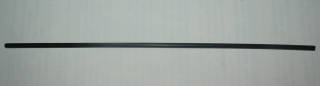 |
To take rubber seal and push onto the antenna tube!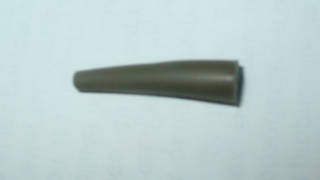 |
||
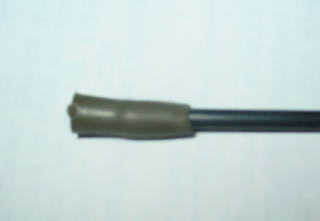 Ready |
Twirl the antenna into the tube (it won't go if you simply
push). Add some silicone sealer to the rivet at point of
attachment to the case.
Add a small bead out of rubber (from hobbyshop) at the end of the antenna so you can't poke your eye out later. |
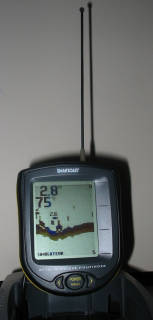 Now, here it is, finished! |
||
|
In this way, the antenna of the receiver is extended to the
outside of the handheld case and due to this fact its range
increases! Next stage, modification of the probe! |
||||