|

|
|
|
|
General objective:
To encourage a responsible and sustainable enterpreneurship, build people's capacities as a source of possibilities from which solutions can be developed to answer the fundamental problems in society. Sustainable development shall be promoted as the underlying principle for the active participation of individuals in the BOND program.
Specific program objectives:
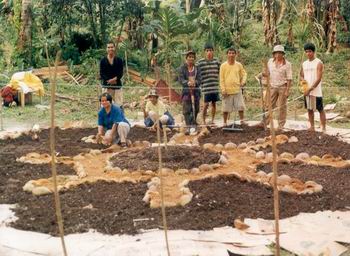
1. To teach and make use of design systems and creative techniques in order to set up sustainable projects within the partner communities.
2. To interact with and learn to appreciate valuable connections among elements and aspects of our environment in order to discover and analyse the natural patterns as potential keys for solving problems.
3. To make use of natural patterns (universal language) in order to start sustainable projects.
4. To empower communities to manage the means and fruits of production by making use of their community resources. (human, financial, natural resources)
5. To set up practical and small-scale economies (human scale)
6. To promote more independence and empowerment within the context of the greater society.
The form of cooperation will allow a more honest partner relationship wherein both parties can equally contribute towards the achievement of the objectives. The cooperation is based on mutual learrning and promotion of a better working environment among the partners. To facilitate this, exposures, travels and exchanges from both sides of the partnership will be the means to give people a chance to learn from each other's skills and knowledge which are the basis of the cooperation.
|
|
|
|
1. BOND has organized an inclusive network of partner organisations and individuals, who will be responsible in promoting and ensuring sustainable development within the connected community through appropriate designs and creations.
2. The BOND program improved human development within a sustainable ecological framework. BOND executed do-able actions on both sides of the partnership, which will lead to a sustainable use of human and natural sources (means).
3. Promotion of appropriate technologies, designing, self-determination and a unique identity that are the basic principles for a sustainable enterpreneurship (undertaking) have been imbibed by partner communities and individuals.
4. The BOND program has achieved a more communal management of the means and ensured that the fruits of production are balanced with the earth and all living beings. BOND encouraged independent positions from partners that promotes healthy and equal cooperation among them.
5. BOND has stimulated a sustainable sense of enterpreneurship, which is woven in the unique identity of partner organisations and their individual members.
6. People within the BOND partnership will strive for a more holistic meaning of life harmoniously combining integration, environmental aspects and human capacities in its concept.
At the Philippine level, BOND is/ has:
1. A group of organisations and individuals who organized as a network.
2. An umbrella network which is registered with the SEC as a non-profit organisation.
3. An e-mail address, website and a secretariat (possibly shared or in a rotating system between partners)
At the Belgian level, BOND is/ has:
1. A group of organisations and individuals who organized as a network.
2. A Network registered as non-profit organisation or will find a connection with an existing network (e.g. Volens)
3. An e-mail address, website and secretariat which will be housed by a willing host organisation (e.g. Volens)
|
|
|
|
To teach and make use of design systems and creative techniques in order to set up sustainable projects within the partner communities
- Practical design courses are developed within the partnership.
- Information exchange on aspects of sustainability, fair trade and environmental awareness and appraisal
To set up practical and small-scale economies (human scale)
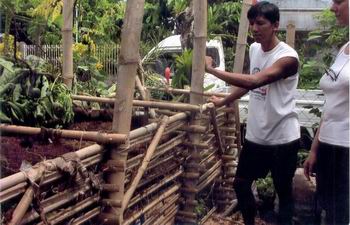
- Systems and permaculture projects will be set up in and around the work place.
- Partners will be assisted to integrate waste disposal and re-cycling in their environment.
- Identification and start of small livelihood projects within the community which will be rooted in local human and natural resources.
- To promote more independence and empowerment within the context of the greater society
- Introduce social salaries and support mechanisms for people in the partnership.
- Set up producer-consumer networks which will allow an independent economy.
- Food for work initiatives with long term goals are stimulated.
- Initiate campaigns in order to achieve a more ecological responsible society.
Interact with and learn to appreciate more and valuable connections with elements and aspects from our environment.
- Make feasibility [mapping ?] studies of the available natural and human resources.
- Organize courses to strenghten and improve the potential of each partner.
To be able to analyse natural patterns as potential keys for solving problems.
- Learn to read and analyse natural patterns in our environment.
- Share design skills for the setting up of feasible livelihood alternatives.
- Setting up of exchange programs which will encourage learning from each others skills.
- Identification of the locally available human and natural resources.
- Organize courses on sustainable development methods and learning from local success initiatives.
- Teach design techniques and diverse skills in relation to an identification process unique to each community.
To make use of natural patterns (universal language) in order to start sustainable projects.
- Organising technical and practical courses.
- Working actively on a better environment for the community members within the partnership.
- Learning to deal with markets and study the dynamism between people and their economic activities.
- Learn diffferent marketing techniques.
|
|
|
The program foresees logistics support which will function as a platform for all activities. In both partner countries, there will be a partner secretariat.
- A partner secretariat in the Philippines
A small core group will be responsible for the operational aspects in the Philippines. An office with (ideally) two cooperators will form the link between support groups and individuals, and takes care of the communications with Belgium. The secretariat will also be responsible for possible regional expansion during the later phase. At the initial phase of the project, it is preferred to have a simple support system which can be operational without need of much funds.
- A partner secretariat in Belgium
Some individuals or groups with financial capacities (e.g. Volens-itinerans) will provide seed capital, a space (for files) and a contact person who will maintain the link between Belgium and the Philippines. This does not need to be a full-time job but could be an additional task of an employee of another organisation (e.g. Volens).
The relationship between these partner secretariats will allow:
- Travel of people from north and south for short periods and for specific activities.
- Students and/ or others can attend exposure trips in the north or the south.
- People can travel to projects within the BOND partnership.
- The mobilisation of volunteers for cooperation in the projects of the partner agencies.
- Organising of special exchanges for people on both sides of the cooperation structure.
Other means will be gotten from the following dynamics:
- Partners will turn over a certain social contribution to the network responsible for a certain activity. This can be individual contributions of sympatizers, or income from special actions organised by youth groups or other local movements, or a special percentage of own funding activities.
- Both sides of the partnership will maintain a organizational structure, which will be responsible for communication and coordination within the network.
- Both sides of the partnership will maintain seperate legal identities, recognized by proper government agencies.
- Monthly solidarity contributions on the basis of personal financial capacities.
- Regular fundraising activities from each of the support groups.
- In cases of technical support, the community will provide food and accommodation to the concerned persons.
- Visitors will provide a counterpart contribution during their stay in the community. As a fair contribution, the community will provide for food and accommodation.
- Exposurists, exchange workers or visitors will also make a contribution to the network that is responsible in the country.
- A one time contribution for a concrete project and/ or for the community. This could be possible through traders support (per region) for specific projects.
- Funds from schools (with exchange workers, students,...) which will engage in a long term relationship with BOND.
|
|
|
At a structural level
-The BOND structure faciltates alternative travels between partners (z-n,z-z,n-z,n-n)
-Organisations will make use of the BOND structure in order to contact partners and communities.
-BOND operates independently and provides mainly for its own means, which will be generated from people and groups who want to engage in an alternative development dialogue and who will agree with the principles of BOND.
With regard to the content
-BOND partners will work according to the principles of the cooperation agreement and execute activities based on the agreement.
-Financial self-sufficiency totals at least 50%
-Projects are mainly small and feasible
-Support comes from several partners and is based on the principles of sustainable development
- Locally available natural and human resources are always being maximized in any activity undertaken.
-The transferred knowledge and/ or technology should be simple and will be characterized by its immediate usefulness
Strategically
-A dynamic and self-sufficient development dialogue will be set up by the BOND secretariats.
-The BOND network is a platform for information exchange and will be used by students and researchers.
-Motivated groups, composed of people who will organize themselves around the Philippines are responsible for its own dynamics and project proposals.
-The project results are known, speak for themselves and show the areas that still need attention. - - Partners learn from each others on a S-S or N-S-N level.
|
|

|
Related Articles |
|
|
|