|
Asad
Qizilbash The Sarod
| |
|
Ustad Amjad
Ali Khan, the present dignified sarod
player musician of India, credits the
sarod's invention to his ancestors. They
were famous musicians for already five
generations. Approximately two hundred
years ago, his great grandfather, Mohamad
Hashmi Bangash, migrated from Afghanistan
to Gwalior (India) with a stringed
instrument called rabab. And it is Amjad's
Grandfather, Ustad Ghulam Bandegi Khan,
who shaped it into the present sarod. The
word sarod seems to be derived from an
ancient Persian word (saroodh) meaning
music. This gives credibility to the
geographical origin of the sarod.
|
|
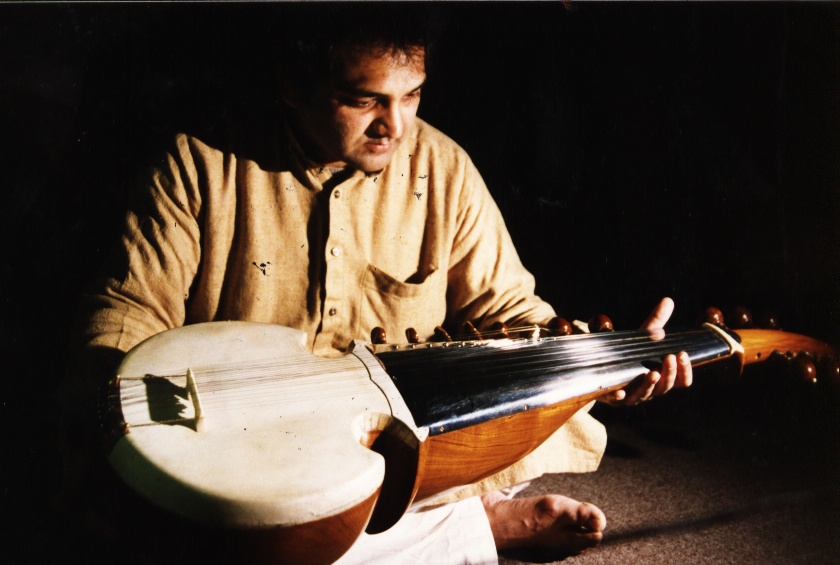
The Sarod
|
The sarod's structure remains distinctive
from any other string instrument such as:
sitar, surbahar or veena etc. The sarod is
made of teakwood. It has a broad base
which is covered with a goat skin. The
fingerboard is unfettered (like a violin)
and it is protected by a metal plate
facilitating the fingers to slide smoothly
over the strings on the board. The
instrument has nineteen strings, according
to the design of Ustad Amjad Ali Khan. It
has four strings to create the melody,
four to make the rhythm, and eleven cords
which are called sympathetic as they enter
into resonance while he play goes. A
plectrum held in the right hand is used to
play the instrument, while the fingers of
the right hands slide up and down on the
strings, with the nails (not the
fingertips). Connoisseurs know that sarod
is a most difficult instrument to play
with. Indeed it is a blind instrument, but
contrary to the violin, notes are at much
distance from each other. Then, the nail
pressing approach makes it more difficult
to give accurate notes. In addition, the
sarod player has to play melody and
rhythm, at the same time. And finally, as
movements of the rigt-arm specially have
to be fast, then crops up the difficulty
to hold the plectrum
firmly
enough without breaking a string. It makes
the sarod a demanding instrument, and
gives rightly admiration and respect to
its good player.
For his
present sarod, Asad Qizilbash received
full support from Ustad Amjad Ali Khan who
supervised the making of it, and from
Mikko Pyhala, the Charge d'affaire a.i. of
the Finish Embassy in Pakistan, who
managed for the funding of it. |
|
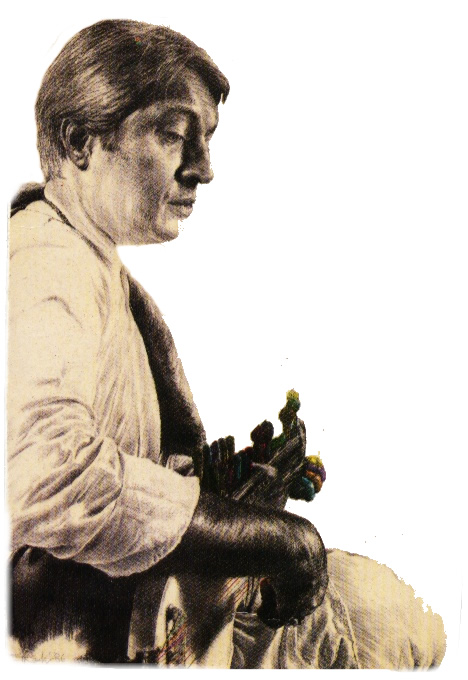
Ustad Amjad Ali Khan
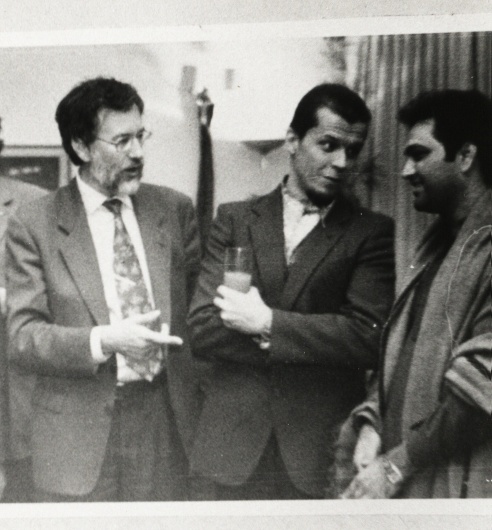
Left-Mikko
Pyhala (the charge d' affairs, Middle-
Finnish Musician, Right- Asad Qizilbash.
|
| |
|
|

| | | | | | |