

Network – A collection of computers and mobile devices connected together via communications devices and transmission media, often wirelessly allowed computers to share resources (hardware, software, data & information).
Any type of hardware capable if transmtting data, instructions, and information between a sending device and a receiving device.
Modem : A device that enables a computer to communicate over analog networking media such as connecting the Intervet via telephone lines.
Wireless Modem : Modem that connects to the serial port but does not connect to telephone lines. It receives through the air.
Wireless Access Point : A device on a network that connects wireless devices to that network.
Router : A device that connects multiple networks together; routes packets to their next locationn in order to efficiently reach their destination.
Hub : The device that provides a common central connection point for nodes on network.
Switch : A device used to connect multiple devices on a single (typically wired) network, forward packets to only the intended recepient.
Network Interface Card : An adapter card that connects a computer to a network.
Wireless Network Interface Card : An adapter card through which a computer can connect to a network that provides wireless data transmission.
Repeater : A device that enhance the weaken signal and repeat it at its original strength,
The materials or substances capable of carrying
one or more signals.
Physical : send signals through cable, wire or tangible materials.
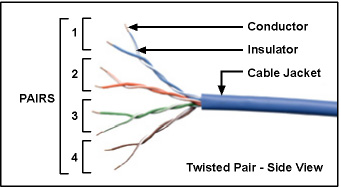
 Twisted-pair cable - physical transmission
media which the cable consisting of pairs of copper wire that are twisted together.
Twisted-pair cable - physical transmission
media which the cable consisting of pairs of copper wire that are twisted together.

Coaxial cable - A networking cable consisting
of center wire inside a grounded, cylindrical shield, capable of sending data
at high speeds.
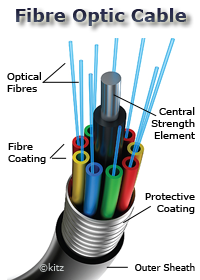
Fibre Optic cable - Physical transmission
media that consists of dozens or hundreds of thin strands of glass or plastic
that use light to tansmit signals.
Wireless : send signals through the air or
space.
Infrared - Send signals using infrared
light waves from one device to another.
Microwaves - waves that provide a
high-speed signal transmission using electromagnetic radio wave (P1 WiMax)
Cellular Radio - a form of broadcast radio
that is in wide use for mobile communication
Broadcast radio - distributes radio signal
through the air over long distances
Communication satellite - A space station
that receives microwaves signals from an
earth-based station.
bluetooth - a networking standard for every short-range wireless connections ; the devices are automatically connected once they get within the allowable range.
|
ADVANTAGES OF NETWORK HARDWARE
SHARING – Network facilitate the sharing of hardware devices such as
printer DATA
AND INFORMATION SHARING – Enable many people to access and share the same
data such as database and group software development FACILITATE
COMMUNICATION – People communicate efficiently and easily via e-mail INTERNET ACCESS SHARING – Small computer networks allow
multiple users to share a single Internet connection. |
|
DISADVANTAGES OF NETWORK UNDESIRABLE
SHARING – Viruses are easily spread over network and the Internet. SECURITY
ISSUES – A computer hacker can get unauthorized access by using different
tools. NETWORK
HARDWARE, SOFTWARE, AND SETUP COSTS – Setting up a network requires an
investment in hardware, software of network. INTERNET ACCESS SHARING – Small computer networks allow
multiple users to share a single Internet connection. |