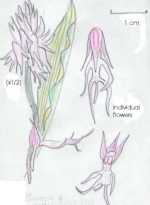
 Naked-man Orchid
Milky Orchid
Dull Orchid
Mirror Orchid
Yellow Bee Orchid
Bumblebee Orchid
Man Orchid
|
After the Compositae (the Daisy Family) the orchids form the second largest group of flowering plants. In Europe the native orchids are ground orchids.
Their characteristic feature is that the male and female reproductive organs (the stamens and the pistil of other flowers) are fused to form a column.
View this page for diagrams of the structure of the column and of the two main genera
The naked man orchid, Orchis italica is the most common and in March flowers profusely in grassy areas.
Look at one of the tiny flowers in the inflorescence with a magnifying glass. The petals are striped with a darker shade of pink and those forming the lip of the flower are faintly specked. Each flower is shaped like a man with a tail and a divided helmet on his head! There is an albino form: pure white with a faint green line on some of the petals.
A sub-species of the Green Winged Orchid, Orchis morio is a small orchid with a basal rosette of leaves. The flower is a bright purplish-violet, the lateral sepals are very faintly green and the lip is vivedly spotted with dark pink.
The Milky Orchid is a small orchid, rarely exceeding 20 cm in height. It has a dense spike of pale whitish or greenish-pink flowers with a spur a little longer than the ovary.
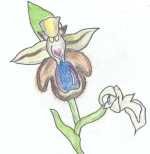
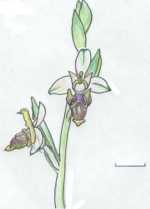
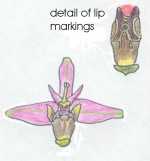
The Ophrys species are highly adaptive for insect pollination particularly by bees and wasps of different species. A good example is Ophrys speculum, the Mirror Orchid, so called because of the shiny dark blue patch on the lip of the flower. The lip looks like the bluish shimmer of the folded wings of a female wasp. This, and its scent which mimics the sex pheromes of the female wasp, attract the male. They develop a month or so before the females and attempt to copulate with the flowers carrying off the pollinium from one flower to another. Each species will attract a different insect. The flowers and the insects evolved and are still evolving together.
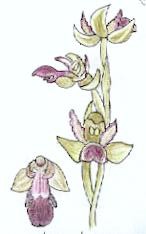
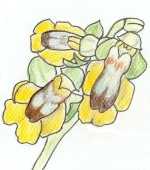
The Ophrys spp are typically found in highly grazed barrocal fields. I have a favorite area where I return each year to see the orchids. It is a heavily grazed bank above a minor road. It pays to return on a weekly basis. Last week, the 18th March 2002 the bank had numerous Mirror Orchids. A week later on the 27th March they had all but disappeared but the area was covered with Ophrys lutea the Yellow Bee Orchid. What a delightful orchid that is, mimicking a bee with pale wings resting on a bright yellow flower!
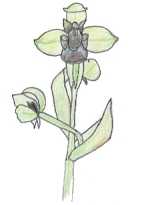
Ophrys fusca is a dull coloured orchid easily overlooked.
The Sawfly Orchid Ophrys tenthredinifera is another short to medium bee orchid.
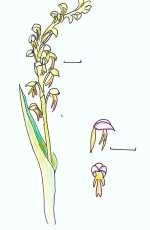
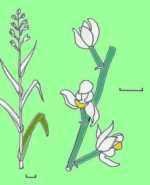
Towards the end of March in a shady spot under some Holm Oaks in a river valley we found a pure white orchid with a bright yellow lip patch. The Sword-leaved Helleborine Cephalanthera longifolia is an orchid which is widespread in Southern Europe and across Iran as far as the Himalayas.
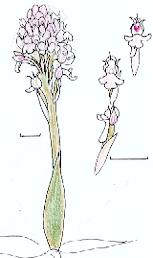
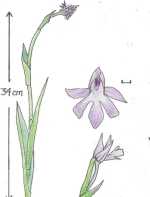
About the same time, in a grassy field, the budding cone shaped inflorescence of the Pyramid Orchid, Anacamptis pyramidalis stood above the grass. Later on the inflorescence burst into a cone of tiny violet to pink orchids. Each small flower has a three lobed lip and a long spur.
Aceras anthropophorum, the Man Orchid has a long (12-15 mm) lip which hangs beneath a tiny helmet of petals and sepals. It is inconspicuous because of its pale greenish colour. It is rarely more than 40 cms high.
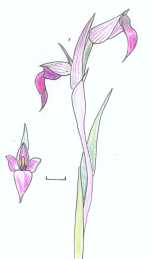
the Tongue Orchids Serapias are more typical of the Mediterranean region than elsewhere in Europe. A common species of the barrocal is Serapias lingua a small orchid whose long tongue like lip is painted from palest pink to dark maroon.
|
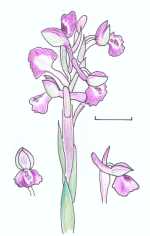 Orchis morio
Bee Orchid
Ophrys scolopax
Cephalanthera longifolia
Anacamptis pyramidialis
Serapias lingua
|

© (Text and Artwork) Irene Shepard 2002 .