| Construction
of the ADR Protect® Energy Stimulator
The ADR Protect® Energy Stimulator is made of flexible magnetic
foil, which has the specific spatial distribution of a magnetic
field. Precisely located, mathematically defined points are
covered with a gelatin paste, which is a composite of ceramic
substances, and metal oxides showing specific infrared radiation
absorption/emission properties. All materials and components
used in the manufacture of ADR Protect® are the result of
extensive scientific research.
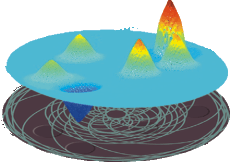
ADR Protect® Energy Stimulator strengthens
proper functions of the body, which in turn counteracts the
stressful effects of electromagnetic pollution.
|
|
Recommended product placement
|
|
| |
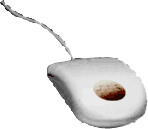
| The ADR Protect Energy Stimulator has an
adhesive backing so that it can be affixed to the outer
surface of an electrical appliance (e.g. on the casing
of cellular telephone or computer mouse). |
| |
| |
|
| Mean results of investigation of mononucleus
blood cells' proliferation (immunological cells) in in vitro
cell culture. B. Proliferation after 15-minute medium exposure
to ADR-protect, which was further used in cell culture.
Thermographic research results
Before Usage
|
|
During
Usage |
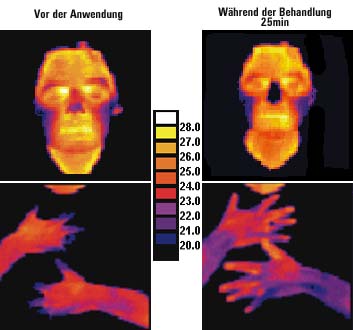 |
Thermographic testing results of
before and after use of ADR Protect® are shown at the
bottom of the previous page. Research was conducted at Karol
Marcinkowski University of Medical Sciences, Institute of
Radiology Radiophysics Department in Poznan, Poland.
According to thermographic criteria, a slight decrease of
facial temperature, with simultaneous reduction of nose
temperature, suggests an increase of internal carotid blood
flow (i.e., brain perfusion improvement). The distinct increase
in finger temperature (up to 2-C) suggests clear blood perfusion
improvement.
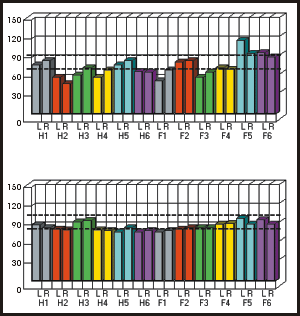
Research finding of meridians by means
of the Nakatani (RYODORAKU) method: under the influence of ADR
Protect® , there is an equalization of energy in meridians
between the left and right sides of the body, which indicates
restoration of disordered balance (see lower graph). Subsequent
pairs of bars correspond to different organs of the body. |