Main: The Wave equation

Waves in one space dimension

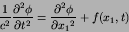
The one dimensional wave equation, with a source term, is
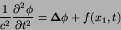
\begin{displaymath}
{1\over c^{2}}{{\partial^2 \phi}\over{\partial {t}^2}} = {{\partial^2 \phi}\over{\partial {x_{1}}^2}} + f(x_{1},t)
\end{displaymath} (44)

We can think of this as a three dimensional equation

\begin{displaymath}
{1\over c^{2}}{{\partial^2 \phi}\over{\partial {t}^2}} = {\hbox{\boldmath $\Delta$}}\phi + f(x_{1},t)
\end{displaymath}

where, since the source term depends only on x1 and t, $\phi$ depends only on x1 and t. Thus the solution can be written as

\begin{displaymath}
\phi(x_{1},t) = \int^{\infty}_{-\infty} \kern 4pt
\int\lim...
...y$}},\tau) f(y_{1},\tau)\,dy_{1}dy_{2}dy_{3}
\kern 4pt d\tau.
\end{displaymath}

where $G_{3}({\hbox{\boldmath$x$}},t;{\hbox{\boldmath$y$}},\tau)$ is the three dimensional Green's function (8.3);

\begin{displaymath}
G_{3}({\hbox{\boldmath $x$}},t;{\hbox{\boldmath $y$}},\tau)...
...ox{\boldmath $x$}}-{\hbox{\boldmath $y$}}\right\vert/c\right).
\end{displaymath}

Now, since f depends only on y1 and $\tau$ we can write

\begin{displaymath}
\phi(x_{1},t) = \int^{\infty}_{-\infty}\kern 4pt
\int\lim...
...u)\,dy_{2}dy_{3}\right)
f(y_{1},\tau)\,dy_{1}\kern 4pt d\tau.
\end{displaymath}

If we define $G_{1}(x_{1},t;y_{1},\tau)$ by
\begin{displaymath}
G_{1}(x_{1},t; y_{1},\tau) = \int\limits^{\infty}_{y_{2}=-\...
...boldmath$x$}},t; {\hbox{\boldmath$y$}},\tau) \,
dy_{2} dy_{3}
\end{displaymath} (45)

then we have

\begin{displaymath}
\phi(x_{1},t) = \int^{\infty}_{-\infty}\kern 4pt
\int\limi...
...}(x_{1},t; y_{1},\tau)
f(y_{1},\tau)\,dy_{1}\kern 4pt d\tau,
\end{displaymath}

so that $G_{1}(x_{1},t;y_{1},\tau)$ must be the Green's function for (8.6), that is

\begin{displaymath}
{1\over c^{2}}{{\partial^2 G_{1}}\over{\partial {t}^2}}-{{\...
...er{\partial {x_{1}}^2}} =
\delta(x_{1}-y_{1})\delta(t-\tau).
\end{displaymath}

This observation is known as the method of descent; we descend from the solution of the three dimensional problem to the solution of the one (or two) dimensional problem. It is equally valid for the Poisson, Helmholtz and Diffusion equations, although it is rather pointless in the case of the Diffusion equation (where we use the one dimensional Green's function to find the three dimensional one).

In order to find $G_{1}(x_{1},t_{1}; y_{1},\tau)$ we have to find the integral

\begin{displaymath}
G_{1}(x_{1},t; y_{1},\tau) = \int\limits^{\infty}_{y_{2}=-\...
...boldmath$x$}},t; {\hbox{\boldmath$y$}},\tau) \,
dy_{2} dy_{3}
\end{displaymath}

First we write ${\hbox{\boldmath$z$}} = {\hbox{\boldmath$x$}}-{\hbox{\boldmath$y$}}$ and $T=t-\tau$ to that the problem becomes

\begin{displaymath}
G_{1}(z_{1},T) = \int\limits^{\infty}_{z_{2}=-\infty}
\int...
...\vert{\hbox{\boldmath $z$}}\right\vert/c\right)\,dz_{2}dz_{3},
\end{displaymath}

where z1=x1-y1 (and z2=x2-y2, z3=x3-y3, but since all of x2, x3, y2 and y3 are going to be integrated away, this is not particularly important). Now introduce cylindrical polar co-ordinates in which z1 is the axial direction and

\begin{displaymath}
z_{2}=r\cos\theta,\quad z_{3}=r\sin\theta
\end{displaymath}

so that

z12+z22+z32 = z12+r2

and

\begin{displaymath}
dz_{2}dz_{3} = rd\theta dr,\quad dz_{1}=dz_{1},
\end{displaymath}

with $-\infty<z_{1}<\infty$, $0\le r<\infty$ and $0\le\theta<2\pi$. Then

\begin{displaymath}
\left\vert{\hbox{\boldmath $z$}}\right\vert = \sqrt{z_{1}^{2}+z_{2}^{2}+z^{2}_{3}} =
\sqrt{z_{1}^{2}+r^{2}}
\end{displaymath}

and hence

\begin{displaymath}
G_{1}(z_{1},T) = \int^{\infty}_{r=0}\int^{2\pi}_{\theta=0}
...
...eft(T-{1\over c}\sqrt{z_{1}^{2}+r^{2}}\right)
r\,d\theta\,dr.
\end{displaymath}

As the integrand does not depend on $\theta$ and as

\begin{displaymath}
\int^{2\pi}_{0}d\theta = 2\pi
\end{displaymath}

this becomes

\begin{displaymath}
G_{1}(z_{1},T) = {1\over 2} \int^{\infty}_{0}
{1\over\sqrt...
...}
\delta\left(T-{1\over c}\sqrt{z_{1}^{2}+r^{2}}\right) r\,dr
\end{displaymath}

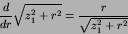
Now note that

\begin{displaymath}
{d\over dr} \sqrt{z_{1}^{2}+r^{2}} = {r\over \sqrt{z_{1}^{2}+r^{2}}}
\end{displaymath}

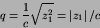
so that if we put

\begin{displaymath}
q = {1\over c}\sqrt{z_{1}^{2}+r^{2}},\quad
dq = {1\over c} {d\over dr}\left(\sqrt{z_{1}^{2}+r^{2}}\right)dr
\end{displaymath}

and note that when r=0

\begin{displaymath}
q = {1\over c}\sqrt{z_{1}^{2}} = \left\vert z_{1}\right\vert/c
\end{displaymath}

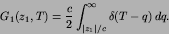
this becomes

\begin{displaymath}
G_{1}(z_{1},T) = {c\over 2} \int^{\infty}_{\left\vert z_{1}\right\vert/c}
\delta(T-q)\,dq.
\end{displaymath}

If $\left\vert z_{1}\right\vert/c > T$ the integral is zero (since T-q is always negative in the integral) and if $\left\vert z_{1}\right\vert/c < T$ the integral is one (since we are integrating the delta function across a zero of its argument $T-\left\vert z_{1}\right\vert/c$. Thus

\begin{displaymath}
G_{1}(z_{1},T) = {c\over 2}H(T-\left\vert z_{1}\right\vert/c)
\end{displaymath}

and since z1=x1-y1, $T=t-\tau$ we find that
\begin{displaymath}
G_{1}(x_{1},t; y_{1},\tau) = {c\over 2}
H(t-\tau-\left\vert x_{1}-y_{1}\right\vert/c).
\end{displaymath} (46)


Main: The Wave equation

Hosted by www.Geocities.ws

1