Language Origins
Return to main Prehistory of Memory Page.
On this page:
The Greeks and their Alphabet
The Minoan Culture and Scripts
The Semitic Alphabet
Conclusions
More on language origins.
Hebrew and Greek
What is known about the myths of the
pre-literate peoples who were the foundation of Western Culture? Most of
what we know comes to us by way of language
and a few precious physical artifacts. We try to reconstruct the past from
the clues we have, but does anyone really understand the ancient past?
Many of us would like to be able to get in a time machine and go back to
experience what the world was really like. But for the most part we are
stuck having to reconstruct the past from written accounts of ancient myths;
writings that were usually produced by people living long after the
myths were born in pre-literate cultures.
Western Culture is fundamentally rooted in the Judeo-Christian and Greek
cultures. We have to understand the origins of languages like Hebrew and
Greek if we are to understand these ancient people and the formation of
Western Culture. As we explore the past, we can keep this question in mind:
Why did Modern Science arise out of the cultural heritage of the Hebrews
and the Greeks?
 The Written Word
The change from language that was only spoken and heard to language
that was also written and read has been proposed to have had important effects not only on human culture but also on the functioning
of the human mind. We might speculate that some early human brains were
better suited for dealing with written language than others. Did some peoples
thrive on the written word while others simply could not make good use
of this amazing new tool? Did some elements of the modern alphabet suit
the minds of people who spoke one type of language while different elements
matched the ways of other groups of people who spoke different languages?
Investigation of the impact of this mind amplifying tool, writing, on the
human mind is a large field of study that is just starting to be explored
in an organized way. In ancient Akkadia (a site of use of one of the first
syllabic scripts) a popular metaphor
for getting someone's attention was "to turn their ear". This reminds us
of our primate origins and alarm calls used to attract the attention and
cooperation of the troop. What happened to the mental habits of people
who began to learn a written script at an early age? How does writing alter
the human mind? (source)
have had important effects not only on human culture but also on the functioning
of the human mind. We might speculate that some early human brains were
better suited for dealing with written language than others. Did some peoples
thrive on the written word while others simply could not make good use
of this amazing new tool? Did some elements of the modern alphabet suit
the minds of people who spoke one type of language while different elements
matched the ways of other groups of people who spoke different languages?
Investigation of the impact of this mind amplifying tool, writing, on the
human mind is a large field of study that is just starting to be explored
in an organized way. In ancient Akkadia (a site of use of one of the first
syllabic scripts) a popular metaphor
for getting someone's attention was "to turn their ear". This reminds us
of our primate origins and alarm calls used to attract the attention and
cooperation of the troop. What happened to the mental habits of people
who began to learn a written script at an early age? How does writing alter
the human mind? (source)
The Origins of Written Language in the Modern Form.
One example of the importance of consilience
within cultural anthropology between physical and linguistic evidence is
the search for the origins of the alphabetic mode of writing. We need to
explore the origin of the modern alphabet because the great flowering of
Greek thought was made possible by the complete alphabet that was invented
by Greek speaking people. How did this important inovation come about where
and when it did?
Another example of the search for consilience is the quest for physical
evidence of mythical objects such as Noah's Ark. Knowing how to decide
which myths are worthy of archeological invenstigation is a subtle art
that eludes many enthusiasts of the stdy of the past. There is no discussion
of the search for Noah's arc at this web site, but I do take seriously
the Atlantis myth. The discovery of an archeological site in Asia minor
that may be Homer's Troy was a stimulous to other investigations that resulted
in discovery of the important scripts of Crete. How were the Minoan scripts
related to the cultural development of Greece?
A good example of consilience between myth and archeology relates to
legends about an advanced culture of sea-faring people, often labeled by
our modern culture as the Atlantians. What is the cultural relevance of
the Atlantian myth?
 I
am going to explore the Atlantis myth as an example of a cultural memory
that spans the gap between the ancient world of humanity before the development
of a complete alphabetic script and
the origins of our modern Western Culture in Ionian Greece. Although I
will mention other examples of such bridges to the past (such as Homer's
Trojan War, The Gilgamesh Legends, and the Biblical stories), I want to
emphasize Atlantis because of the central role of Plato in bringing us
the Atlantis legend, and the possibility that the Atlantians provided Western
Culture with half of the solution to the problem of how to construct the
modern alphabet. If we follow the Atlantis myth to its likely source, we
will be will be led to explore how Plato and other Classical Greek philosophers
came to be culturally linked to the other main root of Western Civilization,
the Judeo-Christian root.
I
am going to explore the Atlantis myth as an example of a cultural memory
that spans the gap between the ancient world of humanity before the development
of a complete alphabetic script and
the origins of our modern Western Culture in Ionian Greece. Although I
will mention other examples of such bridges to the past (such as Homer's
Trojan War, The Gilgamesh Legends, and the Biblical stories), I want to
emphasize Atlantis because of the central role of Plato in bringing us
the Atlantis legend, and the possibility that the Atlantians provided Western
Culture with half of the solution to the problem of how to construct the
modern alphabet. If we follow the Atlantis myth to its likely source, we
will be will be led to explore how Plato and other Classical Greek philosophers
came to be culturally linked to the other main root of Western Civilization,
the Judeo-Christian root.
Western Culture is largely, although not exclusively, built on Greek
and Hebrew origins. The Greek and Hebrew cultures both developed at the
great cultural nexus between Europe, Africa, and Asia. This historical
example illustrates the importance of bringing together ideas from isolated
sources, and so provides us with motivation towards other acts of synthesis
within the Science of Mind. The development of the modern alphabet was
made possible by a kind of slow and unconscious conglomeration of ideas
from different cultures. If we learn such lessons, then we can consciously
work to bring together isolated ideas and in so doing speed progress along
faster than would be possible by unconscious bumbling.
The Hebrew culture grew out of ancient Semitic culture, which has closer
ties to Africa while Greek culture is thought to have Asian origins. There
are many languages related to Hebrew, allowing us to fit Hebrew into a
broad cultural context. Ancient Greek is generally taken to be the only
representative (though there are different dialects) of the Greek or Hellenic
branch of Indo-European (source).
We are mainly restricted to examination of the development of Greek and
its modifications through interactions with other languages. My exploration
of the origins of the Greek alphabet will show that while the Indo-European
Greeks and the Semitic peoples are usually credited as the great inovators
in the development of written language, another less appreciated culture
of the ancient world probably also contributed to the pillar of the foundation
of Western Culture that is our heritage of written language. We are led
to this interesting possibility by way of exploration of myths and legend
such as Homer's Troy and Plato's Atlantis.
Origins of The Greeks and their Alphabet.
We can explore the development of the Greek Culture in terms of interactions
of Greek speaking peoples with three other groups of ancient humans who
inhabited the Eastern Mediterranean region:
1) First, the Greek tribes interacted with other members of the Indo-European
super-family of tribes. Homer's Troy was probably controlled for much of
its history by other tribes of Indo-Europeans that had at least some their
gods and the language form in common with the Greek tribes. The city of
Troy may have been mostly assimilated into early Greek culture at the time
of the Homeric Trojan war.
2) Second, the Greeks interacted with a group of indiginous Mediterranean
people. We know very little about these native Mediterraneans because they
were essentially removed from existence by other people like the Indo-Europeans;
their culture was absorbed and obliterated. These "lost" people have no
surviving descendants who retain the original language of the East Mediterranian,
so we do not have a good name for them. I am going to invent a name for
these people and call them the Sea People. The only other romantic alternative
is to simply call them the Atlantians, but "Sea People" has the advantage
of being a term that has previosly been linked to the Hebrew side of our
cultural heritage, and I want to emphasize links between the Greeks and
the Hebrews who provided the two major cultural currents that formed Western
Civilization. I will explore the idea that the inclusion of a full set
of vowel characters in the Greek alphabet was an important inovation provided
by the Sea People.
3) Third, the Greeks had an important interaction with Semitic people.
In particular, the Greeks got the characters of their alphabet from the
Semitic Phoenicians who were closely related to the Hebrews. When Alexander
the Great later swept through the Mideast, Classical Greek returned to
the Hebrews in a dramatic way and greatly impacted on the formation of
Christianity. If Hebrew literacy can be said to have saved our Western
cultural memory of Moses, it can also be argued that Greek Literacy brought
to Western Civilization a cultural memory of Jesus. Our probes into the
origins of Greek and Hebrew will get us started on the road to understanding
how our Greek and Hebrew herritage led to Modern Science.
The study of languages.
There are thousands of human languages that have their roots in the
early human past. Chimps are able to make excellent vowel sounds. We might
call these sounds "hoots" in the same sense that humans still hoot in order
to attract attention or participate in a group noise making event (Hey!
Ha! Yeah!). Humans evolved the delicate motor control that allows us to
consciously make fine tools by hand and produce tricky consonant sounds
with our lips and and other mouth parts. If you look inside the human brain
you find commitment of large regions of the brain to the fine control of
the muscles of the hands and in the mouth region. These changes in brain
structure related to fine motor control are part of the major biological
difference between humans and chimps that makes it possible for humans
to have language while chimps cannot. Our ability to control our breathing
and our mouth muscles allowed us to evolve human language.
A key question is: how old is human language? I suspect that human language,
as a form of communication distinct from chimp calls, started developing
about 5 million years ago. Human language probably reached the form in
which we know it about 100,000 years ago. My guess is that human
language evolved along with the human brain. There has been pleanty
of time for humans to migrate around the world and produce the great diversity
in human languages that now exists. The study of linguistic diversity in
human cultures goes hand-in-hand with the study of our purely biological
diversity, our genetic endowment. Much work remains to be done in reconstructing
the relations between our genes and the geographical origins of the various
peoples of the world such as the Greeks and the Hebrews. In the future,
new tools of genetics and new archeological finds will greatly clarify
our understanding of the past. For now, we must make do with what we have.
Starting about 5,000 years ago, a few human civilizations obtained enough
stability and wealth to start exploring writing in a systematic way. It
was natural for people to use little pictures to represent spoke words,
but what is the fundamental unit of language? An idea, a word, a syllable,
a distinct sound? Initially, in places like Mesopotamia and Egypt, ideas
and words dominated the meanings of pictographic representations and symbols.
These first written scripts were pictographic
systems.
Syallabic scripts were an advance in that the number of symbols in the
system was reduced to just those needed to represent the major sounds of
the spoken language. A syllabic script will typically have about 100 characters.
Alphabetic scripts have even fewer characters (about 25) because each symbol
represents a sound that is not necessarily an entire syllable; syllables
are produced by combinations of letters. The Greek alphabet was the first
complete alphabet. Where did it come from?
 The
four colors in this map indicate the locations of the four types of languages
now spoken in the northeast Mediterranean region. The redish-brown af this
map indicates locations where Indo-European languages are now spoken. Greek
is classified as a member of the Indo-European languages. (But see
this for some evidence and an alternate
view.) Greek has some similarities to Armenian and Indo-Iranian, but the
general consensus is that these connections are not so strong as to warrant
grouping these languages as part of a subgroup within Indo-European. There
were close ties between speakers of Greek and speakers of Latin, but beyond
some borrowing of words there is no special linguistic relationship between
Greek and Latin within Indo-European. (source)
The
four colors in this map indicate the locations of the four types of languages
now spoken in the northeast Mediterranean region. The redish-brown af this
map indicates locations where Indo-European languages are now spoken. Greek
is classified as a member of the Indo-European languages. (But see
this for some evidence and an alternate
view.) Greek has some similarities to Armenian and Indo-Iranian, but the
general consensus is that these connections are not so strong as to warrant
grouping these languages as part of a subgroup within Indo-European. There
were close ties between speakers of Greek and speakers of Latin, but beyond
some borrowing of words there is no special linguistic relationship between
Greek and Latin within Indo-European. (source)
The earliest stages of the prehistory of Greek, extend back towards
the estimated date of reconstructed Proto-Indo-European, at least 6500
years ago. The first Greek writing dates from the Mycenaean period about
1400 BCE. It is thought that Proto-Greek speakers first entered Southeastern
Europe, (the Balkans) sometime between 2200 BC and 1600 BCE. Several Greek
dialects that still exist today reflect a series of migrations of Proto-Greek
speaking tribes into the region where modern Greek is still spoken. One
such wave brought Ionic speakers into Attica as well as other parts of
central Greece and the Peloponnesos in the second millennium BCE. Much
latter, at the dawn of the Classical Greek period, Ionian Greeks of Asia
Minor assembled the modern Greek alphabet.
 When
the Proto-Greek spreaking tribes reached the Mediterranean, they found
a people with a high culture already present in the region, that I will
call the Sea People. Examples of sophisticated writing belonging to the
Sea People have been dated to as far back as 1700 BCE; when these mysterious
Mediterranians first started to write is not known.
When
the Proto-Greek spreaking tribes reached the Mediterranean, they found
a people with a high culture already present in the region, that I will
call the Sea People. Examples of sophisticated writing belonging to the
Sea People have been dated to as far back as 1700 BCE; when these mysterious
Mediterranians first started to write is not known.
By about 1450 BCE Greek speaking people known as the Myceneans had adapted
the Sea People script for the representation of spoken Greek. This early
Greek script is called Linear B,
and examples have been found associated with administrative centers throughout
the Greek islands and on the mainland. Linear B was a syllabic script with
about 90 symbols. Of most interest is the fact that Linear B has a complete
set of symbols for vowels. Although the Ugartic alphabetic script (see
below) dates back to about 1500 BCE, it did not have a vowel set.
Another major movement of Proto-Greek speaking tribes was the Dorian
invasions of 12th century, in which West Greek speakers from the northwest
moved into the Peloponnesos, leading to end of the Mycenaean civilization.
The Dorians moved as well into many of the Aegean islands, including Crete.
At about this time, Greek settlers arrived in Cyprus. From about 1100 BCE
until as late as 300 BCE, a script related to Linear B was used in Cyprus.
This script is known as Cypro-Minoan. It appears that use of Linear B died
out and Greece entered into a dark age until the Classical period.
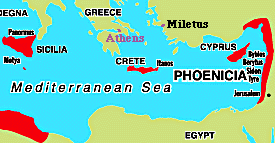 By
the 9th century BCE there were Greek settlements in what we now call Syria.
This is where the early alphabetic scripts that became Phoenician and Hebrew
developed. From aound 1000 BC, the Phoenicians had replaced the Myceneans
as the dominant traders of the Mediterranean. As shown in this map, Phoenician
influence spread to Cyprus and Crete. Thus, by 900 BCE the Eastern Mediterranean
was a region of over-lap between the Greek and Phoenician cultures. By
the 8th century BCE several versions of Greek scripts were in use that
used Phoenician characters. The Ionian version from Miletus had seven symbols
for vowels. This inovation was possible because after assigning Phoenician
alphabetic symbols to the common Greek consonant sounds, there were characters
left over that could be assigned to vowels. There was no specified set
of vowel characters in Phoenician script as in its closely related Hebrew
script. Where did the idea of adding vowels to the Greek alphabet come
from? Since Cypro-Minoan was used on Cyprus and elsewhere during this time,
it seems logical to assume that the Ionians simply combined the Minoan
script idea of a vowel set with the Phoenician alphabet, resulting in the
first complete alphabet.
By
the 9th century BCE there were Greek settlements in what we now call Syria.
This is where the early alphabetic scripts that became Phoenician and Hebrew
developed. From aound 1000 BC, the Phoenicians had replaced the Myceneans
as the dominant traders of the Mediterranean. As shown in this map, Phoenician
influence spread to Cyprus and Crete. Thus, by 900 BCE the Eastern Mediterranean
was a region of over-lap between the Greek and Phoenician cultures. By
the 8th century BCE several versions of Greek scripts were in use that
used Phoenician characters. The Ionian version from Miletus had seven symbols
for vowels. This inovation was possible because after assigning Phoenician
alphabetic symbols to the common Greek consonant sounds, there were characters
left over that could be assigned to vowels. There was no specified set
of vowel characters in Phoenician script as in its closely related Hebrew
script. Where did the idea of adding vowels to the Greek alphabet come
from? Since Cypro-Minoan was used on Cyprus and elsewhere during this time,
it seems logical to assume that the Ionians simply combined the Minoan
script idea of a vowel set with the Phoenician alphabet, resulting in the
first complete alphabet.
The 8th century BCE was a period of active Greek colonization, strengthening
Greek all over the eastern Mediterranean, with colonists from different
source localities transplanting their dialect abroad, sometimes with different
dialects in neighboring settlements (as in Southern Italy, for instance).
Initially, as in the Mycenean period, the new Greek scripts allowed trade
and administration. Writing allowed for record keeping and communication
about a small set of familiar trade and tax items. Eventually, new uses
were found for the new alphabetic script, including uses that were impossible
for the older syllabic scripts. When vowels were not used in the earlier
alphabets (such as Phoenician script), a reader had to be able to guess
the identity of words based on the clues provided by ambiguous consonantal
spellings. A limited vocabulary of common items and contexts as well as
pictographic hints made this a workable system. Consonant-only spelling
had the advantage of brevity, which was important given the limitations
of available writing materials. Incorporation of a complete vowel set into
Ionian Greek allowed for less ambiguity in the identity of words. Word
spelling became more comlicated as words lengthened, but it was now possible
for writers to deal with an unlimited variety of abstract topics in a flexible
way. A distant or later reader could be counted on to be able to recognize
words by means of efficient decoding of the sounds indicated by the explicitly
rendered vowels.
Whn wrds nly cntnd cnsnnts, wrd dntty ws trcky.
When words only contained consonants, determination of word identity
was tricky. A literature of abstract philosophy which could pass down through
the ages and spread geographically between cultures was made possible by
the Ionian script. The Ionian vowel set slowly spread into other Greek
dialects, being officially adopted in Athens right at the dawn of the the
great Athenian flowering of philosophy in 400 BCE. The modern Greek alphabet
made philosophy possible; it is no mystery that we view Greece as the origin
of Western Philosophy. There were earlier philosophers, but the Greek language
has acted as a memetic conduit for transmission of Greek thought through
the ages.
Eventually, Alexander the Great became the vector by which the Greek
language was spread to places like Alexandria, Egypt. In Egypt, availability
of a convenient storage system for written philosophical and scientific
writings allowed the great flowering of Greek thought to be preserved and
passed on to the other great language of transmission, Aramaic. Alexandria
was also the place that allowed the Hebrew Bible to be passed into Greek
script, giving it the portability and durability that allowed it to become
important in the Roman Empire.
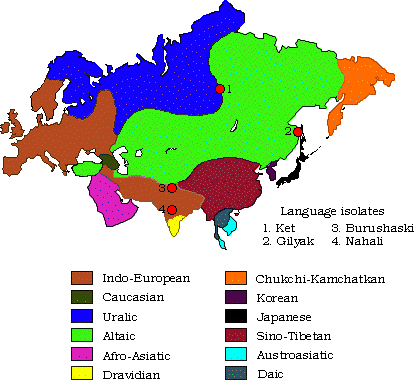
The purple region in the map below shows a region of Afro-Asian languages
(Semitic) in the Mideast, there are many more such languages in Africa.
The Greeks are included as part of the large Indo-European super-culture
that includes both a European western division and an Asiatic eastern divison
(see the brown regions in the map below).
Both Greek and Hebrew history have been influenced by iteractions between
"sea peoples" of the Mediterranean and peoples of the land. Greek history
is full of the idea of migrations, waves of Greek invasion from inland
areas to the coastal regions, where they interacted a highly civilized
Mediterranean culture that had vowel-containing scripts already in use.
Proto-Greeks were not the original inhabitants of Greece. Who were the
mysterious "sea people" of the Eastern Mediterranean before the arrival
of Indo-European?
The Hebrew culture is generally thought of as having formed between
the great Egyptian and Mesopotamian centers of culture, but any analysis
based only on a bipolar fertile-crescent view is overly simplistic. Again,
we will investigate influences on the Mideast from sea-going people of
the Mediterranean. Were the original people of the Eastern Mediterranean
coast Caucasians (see next paragraph) or some other group?
As the above map suggests, another people who are classified as being
members of a language group distinct from the Indo-European and Afro-Asiatic
groups played an important role in the ancient Mideast. The Cacasians may
have been the dominant culture in Mesopotamia before the arrival of Semitic
people from the southwest. Eventually, the remnants of the Caucasians were
restricted to a more northerly region between the Caspian and Black seas
(black, in the map above). In this sense, the Caucasians provide a good
example of how a people can be displaced from a geographical region by
other cultures. Is it known who the indiginous people of Greece and western
Asia Minor were? The green region in the map above represents a later invasion
by a new group of Asian people, and does not concern us here. Indo-Europeans
such as the Hittites came to occupy part of the region between Greece and
Mesopotamia in the time period that concerns us here, but who was in places
like Crete and Asia Minor before the Hittites?
Mediterranean peoples of an indiginous "sea-faring" culture shaped the
Greeks when they came into the Mediterranean basin and began assimilating
Mediterranean culture. Semitic people like the Hebrews were also shaped
by contacts between Semitic peoples and the "Sea People". Of particular
interest to both Greek and Hebrew cultural development is the common source
of their written languages. What was the origin of their related alphabetic
systems of writing? Usually, historical accounts stress that the Greek
and Hebrew alphabets both came by way of the sea-going Phoenicians. However,
the Phoenicians were late inheritors of the sea. Here is where we can trace
the Atlantis myth into pre-Mycenean times.
The geographical location of Phoenicia is interesting, being at a place
where Semitic, Caucasian, and Indo-European influences collided. There
are also deeper layers to the story, since Semitic and Indo-European influences
all converged on the geographical location of Phoenicia from outside. Who
were the "original" people of this region before the Semitic and Indo-European
influences came?
In searching for the origins of the people of the Mediteranean, we can
start with the basic environmental conditions after the last glacial period.
Archological investigation has revealed the presense of artistic
humans in the Mediterranean basin as far back as 35,000 years ago. However,
the dramatic climate changes since the last period of glaciation makes
it impossible for there to have been extensive cultural development or
continuity in the Mediterranian during the past 35,000 years. The pattern
has been one of relatively weak indiginous populationsthat were replaced
by or assimilated into invading populations.
The origins of the Minoans

map source
http://www.esd.ornl.gov/projects/qen/nerc.html
This map gives an estimate of vegetation cover at about 18,000 years
ago during the arid period of full-glacial conditions. There was much less
closed forest and more desert than at present. Evidence indicates that
these extreamly arid climatic conditions extended to as late as 12,000
BCE. The whole period from about 21,000 - 14,000 was much colder and more
arid than at present.
We could view this period as a kind of "dark age" for Mediterranean
culture with a low population density that was due to the harse environmental
conditions.

PAST
This map indicates vegetation cover and desert regions by 8,000 years
ago. The archeological record of plant and animal domestication in Asia
Minor dates to a period of climatic moderation with conditions warmer and
moister than those of the present in many parts of the world.
Present

This final map is for purposes of comparison, showing the areas of
forest and other desert that would be present in the present-day world
if humans had not altered them by agriculture and forestry. Although it
represents a 'potential' state, it is nevertheless much as the world would
actually have looked about 4,000-3,000 years ago, before agriculture became
important in modifying vegetation cover in many regions.
See the web site
of Jonathan M. Adams and "Global land environments since the last interglacial".
A sudden moderation of climatic conditions may have allowed the rapid
spread of Indo-European and other huntiner-gatherer tribes over large
geographical areas. Rapid climatic shifts during the past 10,000 years
may have given advantages to farming peoples, allowing a gradual spread
of farming techniques outward from Asia Minor into Europe.
See "Did Indo-European Languages spread before farming?" by Jonathan
Adams and Marcel Otte (http://www.esd.ornl.gov/projects/qen/Indo2.html)
Paleolithic ca. 25,000 - 10,300 b.p.
Mesolithic ca. 10,300 - 8000 b.p.
Aceramic Neolithic ca. 8000 - 7700 b.p.
Early Neolithic ca. 7700 - 7000 b.p.
Middle Neolithic ca. 7000 - 6500 b.p.
Late Neolithic ca. 6500 - 5700 b.p.
Final Neolithic ca. 5700 - 4600 b.p. (source)
Urban Civilization (source)
One of the first cities was Çatal in what is now Turkey, dating
to 6500 BCE. We can imagine that farming allowed efficient and stable food
production, allowing formation of an urban center. There were mud-brick
houses and shrines to fertility deities. About 6000 BCE farming spread
outward towards Europe and Mesopotamia from Asia Minor. By 6000 years ago
copper was mined and utlized. The inovation of mixing copper with tin to
produce bronze dates to about 5000 years ago. However, tin is rare, and
extensive use of bronze depended on access to distant sources (Italy, England)
of tin. About 4000 BCE there were 70 foot deep mine shafts in Yugoslavia
for extracting copper. Unfortunately, we know very little about the people
who were there at that time. The Indo-Europeans were entering into Europe
from Asia and Semitic people were coming into Mesopotamia from the south.
By 2000 BCE the Indo-European Hittites were finally a strong force in Asia
Minor.
If we search around the Mediterranean for clues to the indigenous Eastern
Mediterranean people that came before the Semitic and Indo-European invaders,
we find a few scattered remnants of clues that speak of such a people who
formed at least one more distinct language group. It has been suggested
that the Etruscans must have been representatives of the so-called Mediterannean
race which existed before Indo-Europeans came to the Eastern Mediterranean.
It is thought that the cultural origins of the Etruscans can be traced
to Asia Minor, somewhere between Syria and the Hellespont. Invaders like
the Indo-European Hittites (who had arrived from Central Asia) participated
the process of erasing evidence of Proto-Etruscan culture from the Eastern
Mediterranean.
It is interesting that this part of the world was the source of major
advances such as farming and iron working. We are interested in the idea
that Proto-Etruscan culture or other elements of a lost Mediterannean people
were involved in the development of another major advances towards our
Western culture, the development of a complete alphabetic script. The remnants
of early commentaries on the ancient languages of the Mediterranean indicate
that the Proto-Etruscans had once spread by sea from Asia Minor through
the Aegean Islands and on to Italy. Herodotus, wrote that the Etruscans
migrated from Lydia (Asia Minor). Some ancient historians (e.g. Herodotus,
Polibius and Tit Livy) noticed that the language of old inhabitants of
Lemnos island in the Aegean Sea was similar to Etruscan. Unfortunately,
we have no good inscripitions in an ancient Lemnos language. Etruscans
had no connection with Indo-European family of languages, they spoke a
language that was, maybe, the last survived form of the Pre-Indo-European
population of Eastern Mediterranean region. (source)
One interpretation of the Atlantis myth is by way of associating the
high Atlantian culture with Classical Greek memories of the earlier Mycenaean
period. However, evidence such as megalithic temples dating back
some six thousand years in places like Malta suggest a much earlier
Mediterranean culture predating the pyramids by a thousand years and Stonehenge
by two thousand. (source)
Is it possible that there was a Pre-Indo-European (this term is an over-simplification,
since there were at least two other major cultures in the area, Semitic
and Caucasian) population with a high culture that was the people of the
Atlantis myth? Was some natural disaster such as a major volcanic eruption
in the Mediterranean Sea the destroyer of of that high culture, creating
a power vacuum into which Semitic and Indo-European peoples could advance?
And most importantly, did the Pre-Indo-European "sea people" in any way
play a role in important cultural advances such as the development of written
language in Phoenicia?
A search for the archological remains of Troy provided an entry point
into the world of the Aegean in pre-Mycenaean times and evidence for ancient
Sea Peoples who conducted early trade by sea. Early occupation of the site
now called Troy probably dates back to neolithic times, but a city was
present as early as 3000-2550 BCE. The original city at Troy was
built by people under the cultural influence that had spread out from the
original source of agriculture in Asia Minor. How such pre-Greek cities
fit into Aegean prehistory not clear. There are other important city sites
along the western Anatolian coast, as well as on the large islands of the
Aegean. (source)
Thermi on the island of Lesbos is a good example of a site indicating
a maritime trade network involving Western Asia Minor ports. Certain types
of terracotta figurines that are rare at Troy, are more common at Thermi
where they were preferred to stone figurines that were popular in Troy
at the same time. Metal items such as daggers, a spear, and a knife have
been found in early city strata at Troy. There is little evidence of trade
between Minoan Crete and Troy at the earliest levels of occupation at the
Troy site. This evidence is concistent with the idea that the earliest
contacts between Asia Minor and Crete were by way of southern Asia Minor.
Around 2500 BCE, recovered implements reveal more Aegean contacts with
Troy: a steatite blossom bowl (Minoan), a spool-shaped pestle of marble
(Helladic or Cycladic), and Melian obsidian. It seems that the main spread
of contact from the origin of agriculture in Asia Minor to Minoan Crete
may have been by way of southern sea route, rather than the northerly land
arc over the top of the Aegean.
As mentioned above, Cyprus and its Cypro-Minoan script may have been
an important link between east and west when the first complete alphabet
was devised. What is the evidence for an early spread of the settled city
life and agriculture from Asia Minor to Cyprus and other Mediterranean
islands?
 Neolithic settlements in Cyprus at places like Khirokitia and Kalavassos
show evidence of stone vessels and simple technologies. The settlement
at Khirokitia dates to well before 6,000 BCE. It had about 2,000
in-
Neolithic settlements in Cyprus at places like Khirokitia and Kalavassos
show evidence of stone vessels and simple technologies. The settlement
at Khirokitia dates to well before 6,000 BCE. It had about 2,000
in-
habitants, living in round houses. The early Khirokitians used stone
tools and the presence of flakes of obsidian, which is not native to the
non-volcanic island of Cyprus, is a sign of contact with other lands, probably
Asia Minor (source).
After about 5000 BCE pottery was used, reflecting the same cultural dlopments
and transitions within early cities as seen in Asia Minor. Excavations
at sites like Kalavassos suggest influences originating in Syria, Palestine
or Asia Minor.
Around 4000 BCE the copper of the island began to be used. By 2500 BCE
bronze age contacts with outside peoples and eventually the Greeks were
common. This is the same time period that Troy shows signs of increasing
sea trade. Thus, the earliest and strongest contacts between Crete and
Asia Minor were probably by way of the mainland near Rhodes. Only later
did longer, more extensive sea trading become common.
With the inovation of bronze and distant trade for tin, the copper was
more extensively exploited bringing wealth to Cyprus. Trade was built up
with the Near East, Egypt and the Aegean. After 1400 BCE, Mycenaeans
from Greece reached Cyprus, perhaps first as merchants, then settlers.
There was a period of cultural innovation with the development of the distinctive
Cypro-Minoan script, advances in ceramics, strengthening of ties with the
Greek civilisation. (source)
The Cypro-Minoan script that developed during this period was used to write
both early Greek and the local Cypriot non-Indo-European language. During
the 12th and 11th centuries several waves of Achaean Greeks settled on
the island bringing with them their religion, their customs and the island
was progressively hellenised. This was a "dark age" in the Greek world
as new invaders disrupted previously established patterns of trade and
city-state administration. From around 1000 BCE Phoenician influence grew
as they built their extensive trade system in the Mediterranean. The 8th
century B.C. was a period of great prosperity on Cyprus and about the time
that the Phoenician script was adopted by the Greeks in places like Asia
Minor. Use of the Cypro-Minoan script continued into this time.
(source)
The Yarmukian Culture in Israel
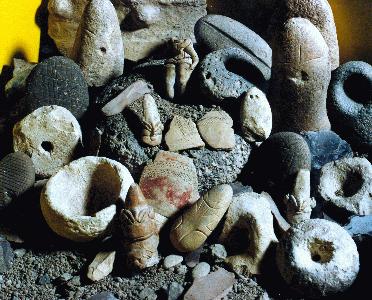
We can expand our sense of the indiginous Eastern Mediterranean people
by comparing archological evidence from several Neolithic sites, such as
those on Cyprus and early villages such as Sha`ar Hagolan (early occupation
8000-7500 years ago) in Israel. (source)
The Yarmukians lived in villages with both round and rectangular structures
that were bulit for dwellings. As in Cyprus, the Yarmukians graduated from
stone (see image at left) to pottery. Flint, limestone and basalt items
were extensivly used. Stone figurines are a common cultural element of
the 6th millennium BCE in the ancient Near East. The importance of female
fertility figures and certain established cults have been identified as
common cultural elements among the indigenoue East Mediterranean people
of the neolithic period. The Yarmukiam Culture flourished from 5500 - 5000
BCE. An important cultural element is artistically inscribed pebbles with
a variety of geometric designs. In Khirokitia on Cyprus similar
items have been found.
Minoans (more information here)
There is evidence of neolithic settlement of Crete about the same time
as for Cyprus, around 6000 BCE, as the grain growing culture from Asia
Minor spread. As mentioned above, the best guess is that the first spread
of agriculture and city living to Crete was by way of the shortest sea
route between Crete and Southwest Asia Minor.
There was a period of about 2-3,000 years before a high civilization
developed on Crete. Our search for the Atlantis civilization falls into
the time period from about 4,000 to 1,200 BCE. The Minoan civilization
(3000-1400 BCE) blossomed in the Aegean Sea, starting at about the same
time that Egypt and Mesopotamia were forming high cultures. (source)
It seems possible that the idea of a written script to represent spoken
words spread from one original source, possibly from Mesopotamia by land
to Egypt and by sea to Crete. Who were the peoples who lived in the Eastern
Mediterranean with the Minoans? The Minoans were one of several cultures
of the Aegean region; there was also the Cycladic island culture, the Mycenaean
Greeks who originated on mainland Greece, and the early people of the western
Asia Minor coast. Although trade between these cultures was possible, in
the earliest times it was probably limited and cultural isolation and diversification
was possible rather than the formation of far-flung empires. The Atlantian
myth of an island culture fits into this kind of early Aegean existence
rather than the later period of spreading cultural influence seen at the
peak of Mycenaean Greece.
Written language is one of the key elements of high culture. The Minoan
Linear A script was already flourishing by 1750 BCE; it has not been deciphered
because nobody is familiar with the spoken language of these early Sea
People. A later script, Linear B, was used as a form of Greek
transcription developed after Minoan interactions with the early Greeks
of the Aegean. Was Greek memory of the Minoans the source of the Atlantian
myth? Possibly not. Other Greek myths have been tentatively linked to the
palace culture of Minoan Crete. The close contacts between Greece and Crete
reflected in the spread of use of Linear B to administrative centers throughout
Mycenaean Greece, makes it unlikely that Crete could represent some "lost
civilization". The civilization of Minoan Crete was not lost as far as
the Greeks were concerned.
Where else can we look for Atlantis? Minoan Civilization may have peaked
after the explosion of the volcanic island of Thera (1600 BCE) suggesting
the pleasingly romantic idea that the Minoans may have been a relatively
minor civilization under the shadow of a greater Theran civilization until
the destruction of Thera. Is the Atlantian legend a memory of the lost
Theran civilization? There were impressive cities on There before the volcano
exploded. The earliest Greeks in the Aegean may have only known Theran
civilization from the outside as relative barbarians, resulting in the
myth of a great island culture that was lost.
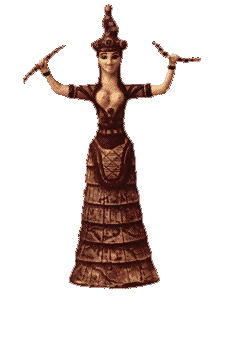 Minoan
culture "Snake Goddess."
Minoan
culture "Snake Goddess."
"Possibly when the Minoan script Linear A is deciphered a different
view on the Minoan civilization will emerge, but until then the visual
evidence alone describes an attractive, easy-going society centered
on large labyrinthine palace-like buildings which seem to have served
primarily, judging from the huge storage areas, as collection and
distribution centers for a well-organized system of local agricultural
production, and as the residence of local leaders and, possibly,
artists and craftspeople. Who the leaders were is unknown, but circumstantial
evidence indicates that women played a dominant role in Minoan religion
and perhaps also in Minoan society." (source)
Conclusions
The Minoans were a branch of indiginous Mediterranean people pre-dating
the Indo-Europeans and Semites who came later to the Eastern Mediterranean.
It seems possible that legends of Atlantis were based on the early high
culture that developed on Crete and other islands. Even if the Minoans
were not the mythical Atlantians, this culture had its own unique form
of writing which is known to have continued into the period of Classical
Greece and overlapped with the origins of the modern Greek alphabet and
Ionian Greek philosophy.
Etruscans
The Etruscans may have come from Asia Minor and been the last people
to speak a language of the orininal East Mediterraneans. The Etruscans
may have belonged to a loosely interrelated family of people who inhabited
the shores of the Mediterranean, including those of western Asia Minor,
before the Indo-European invasion upset the patterns of the region, an
invasion which came in the second millennium BCE. One thing seems well-established:
their language was neither Indo-European nor Semitic. Certain cultural
elements such as the practice of looking at the liver of sacrificial animals
(an oriental Divination practice) seem to indicate an eastern origin of
migration. The Etruscans, having moved to Italy (only coincidentaly to
a location of tin?) seem the last spark of a rich culture from the East
Mediterranian dating back to the time before the Greek domination of the
region. Unfortunately it was a culture that was eventually erased and assimilated
by Indo-European invaders like the Greeks and the tribes that became known
(after conciderable assimilation with the indigenous people of Asia Minor)
as the Hittites. Did the indiginous culture of the Eastern Mediterranean
have any great impact on Western Civilization, or was it just something
to be swept away? As suggested above, these people were involved in the
development of agriculture, animal domestication, metal use and may have
provided a key inovation in the development of the complete alphabet; the
idea of a complete vowel set within a script. We can now turn to the other
half of the story of the origin of the Greek alphabet, the source of the
characters.
The Semitic Alphabet
Mesopotamian culture is usually described as starting around 3500 BCE
in the lower Euphrates valley. Early pictographic writing and cuneiform
seem to have been inovations of people living in Mesopotamia. Around 2400
BCE, Semites finally prevailed over the indiginous people of the lower
Euphrates, marking the initiation of a period of inovations in the use
of scripts to represent spoken Semitic languages. The cultural tide shifted
again and again in Mesopotamia, and the exchange of ideas between peoples
speaking many languages was probably important in the development of scripts
that were easy to use and adapt to new uses. The exchange of ideas was
via both trade and invasion. Around 2000 BCE Caucasian "mountain
people" invaded Mesopotamia. This is also the time of invasions by other
Semitic people like the Amorites who gained control of the coastal region
we now call Syria. This was apparently the culture of the Biblical Abraham.
By 1600 BCE the Indo-European Hittites came as far south as Babylon. It
is interesting that invasion and trade corresponds with the appearance
of knowledge of chariots for warfare, iron working and even use of more
modern forms of writing in Mesopotamia. We can speculate that these inovations
were picked up and spread by invaders such as the Hittites and Amorites
from various sources.
The mixing of diverse cultures was important for the development of
cultural elements such as scripts. In the more isolated Egyptian and Minoan
civilizations, stasis rather than inovation was dominant. The most concise
scripts (fewest characters) were developed in the Mideast by Semitic people.
The idea of mixing cultural memories is a usful metaphor for the view of
physiological memory that is a main focus of this web site. Conscious brain
processes allow people to mix knowledge from multiple sense modalities
and from various experiences distributed in time. This is also a good metaphor
for stimulating further efforts towards cooperation and consilience within
the Science of Mind and between science and society at large.
The central location of the Semitic people who were the inventors of
alphabetic scripts made for an interesting type of cultural resiliency.
Invasions and cultural influences from outside never dislodged the Semitic
culture from Palestine and Syria once they had established themselves there.
Around 2000 BCE, the invading Indo-European forces from the north (if we
allow ourselves to use the term Indo-European for the highly assimilated
Hittites) played a role in directing Semitic peoples to the south, into
Egypt, setting the stage for Abraham's people to "reside in Egypt." When
the southern Egyptians eventually drove out the Semitic invaders of Northern
Egypt, the Egyptians moved further north only to find themselves running
into the Hittite empire (about 1400 BCE). What was even worse for Egypt,
"sea people" from the north invaded Egypt itself, greatly weakening Egypt,
allowing Moses to lead his Egyptianified Semitic tribe to the north, eventually
to form the Kingdom of Israel about 1000 BCE, with the help of the new
Semitic sea power, the Phoenicians. When the Israelites reached Judea,
they were confronted by several strong Semitic tribes such as the Moabs
(southeast) and the Phoenicians (northwest). The Kingdom of Israel was
also confined by the Philistines to the southwest and Mesopotamian forces
to the northeast. The nomadic Israelites adopted much of the culture of
the local people, including the Phoenician-like alphabet of the Hebrews.
The Israelites began to record their cultural mythology in writing, adapting
the stories from their oral tradition to a written format. The entry of
the nomadic Hebrews into urban existence was made possible by partial assimilation
into the indigenous urban culture. The Biblical story of David is one of
partial assimilation into the ways of the Philistines but with the priests
managing to form an aliance with David so as to bring the religion of Moses
into an urban kingdom. The Israelites had picked up some foriegn ideas
from Egypt that made them hard to fit in with the local Semitic peoples
of Palestine, cultural distinctions that had long-lasting implications
for the transient kingdom of Israel.
Egyptian influence: magic in the Moses stories
The Eqyptians tended to restrict their heiroglyphic writings to a secret
of the priesthood. There were forms of Egyptian writing that were more
widely used, but as far as we know the South was not a source of great
inovation in language and writing. However, while clay tabletswere preserved
to the north and the climate of Egypt allowed preservation of Egyptian
inscriptions on less durable substrates, the area in between may have simply
failed to preserve extensive writings on substrates like animal skin. It
is possible that there were early forms of the stories of the Hebrew that
were put into writing, but which were lost to us. One Southerly influence
which had important implications for the future of Western Civilization
was in the area of religion and mysiticism. Moses comes "out of Africa"
with magic snake staphs and a tradition of monotheism. This Egyptian
cultural bias included an interest in immortality that was reflected in
the Eden myth and also in the flowering of Christianity.
The Proto-Semitic people who became the Phoenicians probably started
arriving near the Eastern Mediterranean coast about 3000 BCE. After a period
of cultural assimilation with the indigenous people, what we now know as
the Semitic people were in control. The nature of the local inhabitans
who were displaced or assimilated by the Phoenicians is an important issue.
We know that there was a copper-using and sea-going culture in the Eastern
Mediterranean going back to the 4th century BCE. It can be expected that
the Semites learned about sea-going trade from these indiginous sea-going
people, and later took over as the major traders in the Mediterranean when
other dominant "sea people" like the Mycaenean Greeks declined. The Proto-Phoenicians
had established commercial and religious connections with Egypt which are
documented in records of the Egyptian Old Kingdom. The forest resources
of Lebannon were important to Egypt. It is likely that the Semites had
migrated to Asia from Africa and that they simply maintained ties with
people to the south that they were familiar with. The Phoenician city of
Byblos seems to have been a center for development of the Phoenician alphabet.
The name "byblos" itself speaks to us of close trade ties to Egypt and
the city's role as a major source of papyrus.
After the invasion of the region that was to become Phoenicia by the
Amorites (c. 2200 BC) the Proto-Phoenicians were linked within a larger
Mesopotamian cultural environment that included cuneiform writing as one
of its key cultural elements. (source)
The Phoenicians had a language and culture like those of other Semitic
peoples in the general area (the Canaanites of North Palestine) but they
were different in the fact that they were greatly influenced by "sea people"
and became great traders of the Mediterranean and beyond.
Early forms of writing developed in both the Nile and Euphrates river
valleys. Although the Phoenicians used cuneiform (Mesopotamian writing),
they also produced a script of their own, which showed Egyptian influences.
An important advance in writing was the use of letters to represent the
fundamental sounds of a spoken language and the transcription of spoken
word sounds into written words composed of letters of an alphabet. This
is a much more powerful system of printing than the use of pictographs
to represent entire words or the more complicated syllabic scripts that
came before alphabetic scripts. The origin of alphabetic letters coresponding
to a basic set of sounds is an important advance, allowing a script to
use many fewer symbols than is found in a syllabic or pictographic writing
system. The first steps towards this inovation appear in the lower Euphrates
about the time that Semitic invaders arrived there. The oldest of the known
written Semitic languages, Akkadian, was the vehicle of an early literature
of folk tales written in syllabic cuneiform.
Why did the Semites so vigorously develop the idea of a more concise
script that would exist outside of the familiar methodology of cuneiform
and clay tablets? Other cultures such as the Egyptian and that of
the original developers and users of cuneiform may have lacked a social
system that promoted the spread of the secret of writing beyond select
administrative and priest castes. The Semites seemed driven towards broader
literary and trade-related uses of written language, necessitating a more
easy to use script. An early version of the Phoenician alphabetic script
of 22 letters was used at Byblos as early as the 15th century BCE. This
method of writing, later adopted by the Greeks, is the ancestor of the
modern Roman and other Western alphabets. It also influenced Aramaic and
Arabic scripts which later played important roles in the transmission of
our Western cultural heritage. However, we cannot entirely avoid wondering
about the possibility of early interactions between Minoan Crete and the
Phoenicians. From 2000 to 1600 BCE was a period of growing trade and colonization
by the Minoans, and it is to be expected that there would have been the
oportunity for the Phoenicians to become aware of the Minoan scripts and
their explicit representation of five vowel sounds by distinct symbols.
We can only speculate as to why this Minoan inovation never had greater
influence on the development of the primarily consonantal Phoenician alphabet.
 Ugaritic text (image of Ugaritic cuneiform, left) was originally written
in an alphabetic cuneiform script that was different from the earlier Akkadian
cuneiform. The Canaanites of Phoenicia used an as yet undeciphered syllabic
script, the Proto-Byblian, in the 2nd millennium BCE. More southerly Semitic
speaking people like those of Palestine and the Sinai Peninsula employed
another undeciphered Sinaitic script, which may have included developments
in the direction of alphabetic writing. Alphabetic scripts developed among
the Western Semites, not the Eastern Semites who more closely interacted
with the high culture heart of Lower Mesopotamia.
Ugaritic text (image of Ugaritic cuneiform, left) was originally written
in an alphabetic cuneiform script that was different from the earlier Akkadian
cuneiform. The Canaanites of Phoenicia used an as yet undeciphered syllabic
script, the Proto-Byblian, in the 2nd millennium BCE. More southerly Semitic
speaking people like those of Palestine and the Sinai Peninsula employed
another undeciphered Sinaitic script, which may have included developments
in the direction of alphabetic writing. Alphabetic scripts developed among
the Western Semites, not the Eastern Semites who more closely interacted
with the high culture heart of Lower Mesopotamia.
Ugartic Script
Large numbers of Ugartic tablets were discovered in the ruins of a
temple in Ras Shamara. The Ugartic cuneiform alphabetic texts at this site
date from about 1,400 BCE to around 1,200 BCE ending with the destruction
of the city of Ugarit. The Ugartic script mixed together ideas from both
Akkadian syllabic cuneiform and early Phoenician alphabets. (source: David
Myriad Rosenbaum) The Semitic scripts such as Ugartic are consonantal alphabets
with only limited means to indicate the vowel sounds of the spoken words
represented by the script. Either the stucture of the script itself or
other cultural restrictions seem to have focused use of the script in temple
literature on representations of well known subject matters such as the
myths and legends from the oral traditions of the Mideast. While it was
possible to use earlier forms of writing for philosophical writing, a literature
of speculative philosophy did not fully develop and spread widely until
after the Ionian Greeks had the first complete alphabet.
The "lost" Ugartic script and all surviving semitic alphabets are related
to the Phoenician alphabet that evolved near the port of Byblos. All the
European alphabets are descendants of the Phoenician script by way of Greek.
The Asiatic alphabets of languages like Arabic evolved by way of Aramaic
forms of the Phoenician script.
Ugartic Myths
The cuneiform alphabet associated with Ras Shamra is important because
of the Mesopotamian habit of baking their clay tablets, preserving the
texts. The Minoans did not bake their tablets, and the few surviving texts
are thought to be the result of their being preserved by disastrous fires
in administrative centers and palaces. The use of paper and other perishable
substrates for non-cuneiform scripts made it hard to preserve such inscriptions
for centuries unless exceptional environmental conditions prevailed. Most
the early development of alphabetic writing is lost to us because of the
transient nature of the media used. The Ugaritic texts from Ras Shamra
give us an interesting perspective on a relatively late stage in alphabet
development and also the meaning of some cultural elements depicted in
the Hebrew Bible.
The Arab "Ras Shamra" was known as the ancient Ugarit in Egyptian and
Hittite documents. Located on the north Syrian coast near the island of
Cyprus, this archeological site has several major strata. The earliest
neolithic level is characterized by the development of agriculture and
the making of polished stone implements as described above for the more
southerly Sha`ar Hagolan site. Ancient Ugarit
disappears from the historical record about 1200 BCE., when the Sea Peoples
were attacking coastal areas from Syria to Egypt. The city had relations
with Egypt during the time of Moses. A library of clay tablets was found
associated with a temple of Baal. These texts were written with a cuneiform
alphabet of about thirty signs and the spoken languages that were represented
by this script were Semitic languages related to Hebrew.
The thirty Ugartic characters were consonantal, except that three could
indicate the type of vowel (a, i [or, e], or u) occurring after the special
aleph symbol. The oldest known extensive inscriptions (about 1000 BCE)
in the Phoenician alphabetic writing date from after the time of the Ras
Shamra library. As mentioned above, there is sketchy evidence of more southerly
sources of parallel (to Ugartic) alphabet development, but it was probably
poorly preserved due to use of media besides baked clay tablets. It is
also possible that the main use of the early alphabet outside of temple
locations like Ugarit was for transient administrative and trade documents
as was the case in Crete. After the violent destruction of the Ras Shamra
site, use of the Ugarit alphabet apparently declined while use of the Phoenician
script grew along with the expanding Phoenician trade empire. (source)
Parallel forms and structures in the Ugaritic
texts and the later Hebrew Bible provide useful insights into the cultural
world that the Isrealites came upon in their northward move from Egypt.
(source) The term "Baal"
(meaning "Lord", in reference to various local versions of a Chief Deity,
often thought of by the people of this hilly region as a god residing on-
or best being spoken to- the mountain tops) is often used in the Bible
by its authors in the context of competition with foreign religions and
cultures. The Biblical writers were concerned with condemnation of faith
in Baal, while the Ugaritic texts present Baal worship from the point of
view of non-Isrealite worship of Baal.
Tablets recovered from the ruins a high priest's house at Ras Shamra
provide inight into the "seductive allure" of the mythology of Baal. Israelite
priests had to struggle against assimilation of their people into this
dominant religious system of the region. For the people, Baal was a god
of natural forces like the seasonal rains that were depended on for grain
crops and animal feed. Baal was the key god at had to be honored in order
to assure rain and life.
In the Biblical book of Hosea there is reaction against the assimilation
of Israelites into the culture of Baal; women having children by "outside"
men and religious practices honoring Baal. The god of Israel is depicted
as saying, "I will make you forget your idols, it is I that will provide
the rain." It has been suggested that sexual activity was an integral part
of some worship of Baal. The Ugartic texts indicate that the religion of
Baal was less austere and cerebral than the religion that the priests of
Israel tried to craft. When invaders called the "sea people" caused the
destruction of major Baal-oriented temples in urban centers, it provided
the chance for the priests of Israel and Judea to craft and spread a different
kind of religion.
Phoenician trade in the Mediterranian
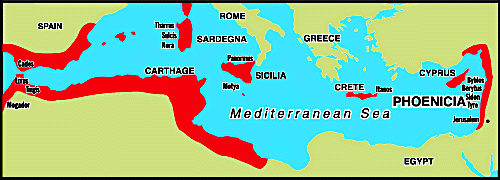
The rise of Phoenicia
The area around Phoenicia was invaded by the Hyksos (18th century BC),
the Egyptians (16th century BC), the Hittites (14th century BC), Egypt
again (1290-79 BC), and finally the Sea Peoples from the north and west.
In the power vacuum after the disruption of the Egyptian, Hittite, and
Mycaenean powers, the Phoenicians established a dominant role in Mediterranian
trade. The Pheonicians were able to move outward into a Mediterranenan
environment previously dominated by other cultures that had been disrupted
by natural disasters (Thera) and Indo-European invaders like the Dorian
Greeks. It is the later part of Pheonician existence that we know the most
about (see map above). Unfortunately, the first part of their existence
and their early interactions with "Sea People" are lost in the mists of
the past. What was the early Greek and Minoan influence on the early Phoenicians?
Before the thirteenth century BCE, sites along the eastern Mediterranean
coast traded distinctive ceramic vessels that were made in Mycenaean Greece.
Then there was an end to this late Bronze Age trade. Sites on Cyprus and
in places like Israel then show local imitations of the lost imports. At
some sites in Israel, the local imitation Greek pottery is followed by
a "Philistine" pottery. source
Some of the invasions of Troy seem to be related to the movement of
destructive Sea Peoples as they entered into the Mediterranian basin and
moved on towards Cyprus, Syria and Egypt. Cyprus was part of the link between
the
Aegean and Canaan. From sites in Cyprus, Sea People may have attacked
Egypt and places like Ugarit. (source)
The question remains, what early influences came from the sea to the
Semitic people of the Mideast? Physical artifacts such as pottery styles
tell us of extensive contacts between the Greeks who used Linear B script
and the Semitic people who were experimenting with alphabetic scripts.
Unfortunately, evidence of Minoan inscriptions in the Mideast is rare.
The Philistines (source)
No extensive Philistine texts have been found. Some brief inscriptions
have been found that resemble the Cypro-Minoan script of the thirteenth-twelfth
centuries BCE. Some clay tablets found at Deir Alla by the Jordan Valley
were uncovered in association with Philistine pottery. The script on these
tablets may be related to a Cypro-Minoan script, suggesting a link between
the Philistines and the Greeks who used Linear B or Cypro-Minoan scripts.
Some investigators hope that if more extensive Philistine texts are found,
they may be shown to be in a script that was related to those used by Mycenaean
Greeks. (source)
Conclusions.
We bagan this digression into language with two
guiding questions: 1) What was the script that the Ten Commandments
were originally written in? and 2) What was the origin of the Greek Alphabet?
The modern Greek alphabet arose through the interactions of at least
three major cultural groups: Indo-Europeans, Semites and the original "Sea
People" who included the Minoans. The Minoans were the first to use a script
with a complete set of vowels. The Phoenicians gave the Greeks their consonental
alphabet. The Greeks combined the Phoenician alphabet with the idea of
a complete vowel set and produced the first complete alphabetic script.
The modern Greek alphabet made more convenient certain ways of using written
language and opened the way to a new literature of speculative Greek Philosophy.
The Ionian Greeks lived in places that has once been the sites of Minoan
colonies and the Cypro-Minoan script was in use when the Ionians were developing
their alphabet.
The historical development of the Greek alphabet indicates the importance
of cultural memory and the mixing of ideas from different cultures. What
if Cypro-Minoan had not survived through the Greek "dark age" around 1000
BCE? Would the later Greeks have thought to include vowels in their script
without the Minoan example in their minds? We must also respect the lesson
of cultural momentum that exists in the story of how modern Greek arose.
Why didn't Greek speaking people adopt the Phoenician script earlier than
they did? Why were the Semites so resistant to the use of vowels? Was a
concise consonantal script somehow natural for Semitic speaking people
while inclusion of vowel characters in a larger syllabic script was natural
for the Minoans? In the absence of the Greek Indo-Europeans to mix the
Semetic alphabet with the Minoan idea of vowels, would the development
of a complete alphabet and the flowering of science and philosophy that
it made possible have been delayed for thousands of years? The unlikely
origin of the Greek alphabet at least suggests the beginning of an answer
to the mystery of why Western Civilization arose in Greece when it did:
the early Greek philosophers were the first in the world to have access
to a modern, complete alphabet. They could begin a process by which one
generation of thinkers could record and pass abstract philosophical speculations
on to future generations of thinkers. This was a new type of human knowledge
and thinking beyond that of oral myths and folk traditions.
When the Israelites assimilated into the culture of the lands south
of Syria, they formed alliances with the Phoenicians and other people who
has adopted the alphabetic script of Byblos. This script could be used
to write down representations of the spoken Hebrew language. When the oral
traditions of the Israelites were written down, the priests used the Phoenician
alphabetic characters. It is possible that there were earlier attempts
to record the story of Abraham in a Sinaic scrpt, but no record of this
has survived the cultural assimilayion of Moses' people into more northerly
culture. If this was the end of the story of Biblical writings, it is doubtful
that Western Society would have arisen as we know it. But Hellenization
reached the Hebrews and the Old Testament was translated into Greek. Eventually,
Hellenized cities from Egypt to Israel to Asia Minor to Athens were the
environment within which Christianity could evolve and begin to integrate
itself into the Roman Empire.
It is often posed as a mystery why the Romans were mostly indifferent
to the prospect of continuing the liveliness of Greek philosophical investigation.
Why did memory of the Classical Greeks largely fade away in the Western
World of the early Middle Ages? What role did Christianity and Islam play
in the recovery of the Greek philosophical spirit? We will return to these
questions after first exploring the transition from the myths of the oral
traditions that influenced Western Thought to the philosophical tradition
that was formulated by the Classical Greeks.
More on language origins
including images of the Linear B, Cypro-Minoan, Linear A, Phoenician and
Greek scripts.
Return to main Prehistory of Memory Page.