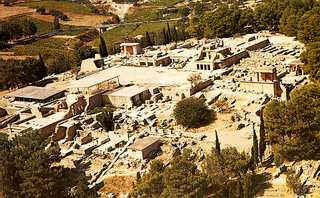
 Knossos,
Crete
Knossos,
Crete
The site was continuously inhabited from the Neolithic period.
Knossos,
Crete
The site was continuously inhabited from the Neolithic period.
 (7000-3000
B.C.) until Roman times.
(7000-3000
B.C.) until Roman times.
Eileithyia was a goddess that protected childbirth and a cave
on Crete was the most important place of her worship, being
Continuously used from Neolithic until late Roman times.
The palace at Zakros is the fourth in terms of size, among the Minoan
palaces. It was located at an advantageous strategic position, at a protected
bay, and was the centre of commercial exchange with the countries of the
East, as is indicated by the excavation finds (elephants' tusks, faience,
copper etc.) It has two main building phases: the old palace was built
in c. 1900 B.C., and the new one in c. 1600 B.C., but was destroyed in
1450 B.C. along with the other centres of Minoan Crete. (source)
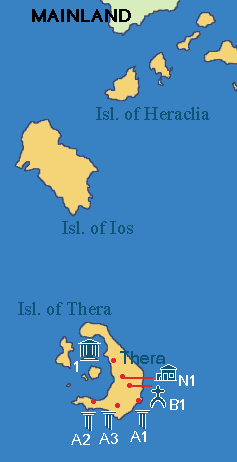 Thera.
Akrotiri of Thera
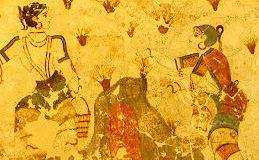 This
is one of the most important prehistoric settlements of the Aegean. The
first habitation at the site dates from the Late Neolithic times (at least
the 4th millenium B.C.). During the Early Bronze Age (3rd millenium B.C.),
a sizeable settlement was founded and in the Middle and early Late Bronze
Age (ca. 20th-17th centuries B.C.) it was extended and gradually developed
into one of the main urban centres and ports of the Aegean. The large extent
of the settlement (ca. 20 hectares), the elaborate drainage system, the
sophisticated multi-storeyed buildings with the magnificent wall-paintings,
furniture and vessels, show its great development and prosperity. The various
imported objects found in the buildings indicate the wide network of its
external relations. Akrotiri was in contact with Crete but also communicated
with the Greek Mainland, the Dodecanese, Cyprus, Syria and Egypt. The town's
life came to an abrupt end in the last quarter of the 17th century B.C.
when the inhabitants were obliged to abandon it as a result of severe earthquakes.
The erruption followed. The volcanic materials covered the entire island
and the town itself. These materials, however, have protected up to date
the buildings and their contents, just like in Pompei. (source)
This
is one of the most important prehistoric settlements of the Aegean. The
first habitation at the site dates from the Late Neolithic times (at least
the 4th millenium B.C.). During the Early Bronze Age (3rd millenium B.C.),
a sizeable settlement was founded and in the Middle and early Late Bronze
Age (ca. 20th-17th centuries B.C.) it was extended and gradually developed
into one of the main urban centres and ports of the Aegean. The large extent
of the settlement (ca. 20 hectares), the elaborate drainage system, the
sophisticated multi-storeyed buildings with the magnificent wall-paintings,
furniture and vessels, show its great development and prosperity. The various
imported objects found in the buildings indicate the wide network of its
external relations. Akrotiri was in contact with Crete but also communicated
with the Greek Mainland, the Dodecanese, Cyprus, Syria and Egypt. The town's
life came to an abrupt end in the last quarter of the 17th century B.C.
when the inhabitants were obliged to abandon it as a result of severe earthquakes.
The erruption followed. The volcanic materials covered the entire island
and the town itself. These materials, however, have protected up to date
the buildings and their contents, just like in Pompei. (source)
 Around 3500
B.C. a system of writing developed using pictographs. A pictograph is a
picture that represents a word.
Around 3500
B.C. a system of writing developed using pictographs. A pictograph is a
picture that represents a word. 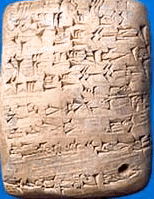 For
example, a picture of a donkey represents a donkey. A large number of tablets
with pictographic writing were discovered by archaeologists in the
ancient city of Uruk in Sumeria. (source)
But the pictographic system used too many symbols, and it developed into
a simpler system that we call "cuneiform" writing. Cuneiform is made of
wedge-shaped marks that represent sounds, and can be combined to form words.
Eventually cuneiform writing used over 1800 signs!
For
example, a picture of a donkey represents a donkey. A large number of tablets
with pictographic writing were discovered by archaeologists in the
ancient city of Uruk in Sumeria. (source)
But the pictographic system used too many symbols, and it developed into
a simpler system that we call "cuneiform" writing. Cuneiform is made of
wedge-shaped marks that represent sounds, and can be combined to form words.
Eventually cuneiform writing used over 1800 signs!
The exploitation of wild (as opposed to domesticated) food resources
played a surprisingly
limited role in the Greek Neolithic. The economy may therefore be accurately
described as
{agropastoral} [farming = agro-; stock-rearing and herding = pastoral],
with no significant
emphasis on hunting, except for the copious evidence for fishing in the
islands. During the
earlier phases of the Neolithic era, settlements were concentrated on the
most fertile alluvial and
colluvial soils. Because these soils retained water well and could be easily
enough turned over,
or tilled, by human labor, there was no need for draft animals or artificial
irrigation to any
significant degree. Not surprisingly, therefore, the faunal record offers
no evidence for the
presence of donkeys, horses, or oxen, nor does Neolithic architecture in
Greece include any
large-scale irrigation works, although fairly wide and deep ditches around
settlements are not
uncommon is some areas (e.g. Thessaly). Villages occupied throughout the
year (as indicated
by the age at death of the pigs raised in them) and for long periods of
time (as revealed by the
deep stratification at numerous mound sites in Macedonia [where they are
known as
toumbas], Thessaly [where they are known as magoulas], and central Greece,
as well as at
Knossos on Crete) are the norm for the Greek Neolithic; the latter phenomenon
in quite rare in
the remainder of Europe at this time. Settlement density and settlement
size are both
significantly higher in the northern parts of Greece than they are in the
Peloponnese and the
islands (aside from Knossos on Crete). Right from the beginning of the
Neolithic there is
evidence for widespread trade in utilitarian goods (mostly stone tools
and the materials from
which these were produced) as well as in exotics (display items of shell
and, in the later
phases, metal). Evidence for at least part-time craft specialization is
reasonably copious
throughout, but compelling evidence for social stratification and organizational
hierarchies is
rare. Monumental architecture, whether funerary or ritual in function,
is conspicuously absent. (source)
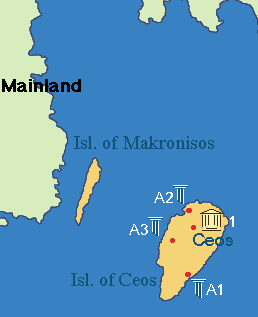 Archaeological
site of Karthaia
Archaeological
site of Karthaia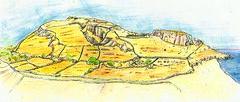
Karthaia was one of the four ancient cities of Ceos, famous for its
monumental architecture, its well built fortification. The literary sources
and the excavation finds bear evidence for the cultural and artistic activity
of the ancient city mainly after 600 BCE. (source)
Prehistoric Settlement of Aghia Eirene
Located in the north section of the harbour of Aghios Nicolaos,
the prehistoric settlement of Aghia Eirene was one of the most important
cultural centres of the Aegean. The site was first occupied in the
Late Neolithic period (3000 B.C.) and continued to be inhabited
until the 15th century B.C., when it was destroyed by a series of earthquakes
Located at the northwestern tip of the island of Keos, Kephala consists of both a settlement and a nearby extramural cemetery. The settlement was short-lived (estimated occupational duration of one century) and small (maximum population estimate of 50) and is one of several more or less contemporary sites on the island (which include Paoura, Sykamia, and Ayia Irini).
From the settlement comes evidence of metalworking on the site in the
form of pieces of slag
and of burnt clay fragments of furnace-lining or of crucibles. Four fragmentary
copper artifacts
from the site (the single piece analyzed was almost pure copper) were unfortunately
surface
finds, but there is little reason not to accept them as representative
of the sort of metal artifact in
use during the site's occupation. Most of the chipped stone on the site
is obsidian which was
clearly locally worked and of which a far larger percentage consists of
blades than at Saliagos.
Half-a-dozen tools of flint/chert are certainly imported. Eight terracotta
figurines, all but one
found in the cemetery although not in the tombs themselves, are either
small, crudely modelled
female figures (four examples), heads which resemble in their flat, backward-tilting
faces and
prominent noses the later marble Early Cycladic figurines (three examples),
or {ithyphallic}
[sexually aroused, as indicated by a prominent penile erection] males (one
example). Among
the pottery, the most common shapes are bowls, jars, and scoops. Decoration,
when it occurs,
may consist of incision, pattern-burnishing, or crusted decoration in red
or white applied after
firing. Of considerable interest are the impressions of woven mats on seventeen
potsherds and
of cloth on three more sherds.
The Kephala culture, assignable to the Final Neolithic period, has numerous connections with sites in Attica (Athens, Thorikos, Kitsos Cave) and the Saronic Gulf (Kolonna on Aegina).The extramural cemetery at Kephala is, after the appreciably earlier cemeteries of cremation burials from Souphli and Plateia Magoula Zarkou in Thessaly, the Aegean's first communal burial ground to be located outside of a cave. The tomb types, marble vessels, and some of the figurines anticipate those characteristic of the subsequent Grotta-Pelos culture, the earliest Bronze Age culture thus far identified in the islands. The evidence from Kephala for Neolithic metalwork corresponds in date with that from contemporary Knossos on Crete, Pefkakia in Thessaly, and Sitagroi in eastern Macedonia, but only at Kephala and Sitagroi do slags or crucibles attest to the actual practice of some kind of metallurgy. Roughly contemporary deposits of copper artifacts accompanied by gold and silver objects with undeniable parallels among the treasures found in the rich Neolithic burials at Varna in coastal Bulgaria have also been found in the Cave of Zas on Naxos and in the Alepotrypa Cave on the west coast of the Mani in southern Laconia. Such distant contacts are eloquent testimony to the impressive distances over which objects were being exchanged by sea in the Aegean during the later fourth millennium B.C. (http://devlab.cs.dartmouth.edu/history/bronze_age/lessons/2.html)
A Final Neolithic Successor to the Saliagos Culture?
Recent excavations at Grotta on Naxos have produced white-on-dark
painted pottery
reminiscent of that of the Saliagos Culture but here associated with an
obsidian chipped stone
industry consisting primarily of blades. The excavator has suggested that
this assemblage,
rather than that described above as the Kephala Culture, may be typical
of the central Aegean
islands at the end of the Neolithic and may have a better claim to being
the direct ancestor of the
Grotta-Pelos Culture, the Cyclades' earliest Bronze Age assemblage. The
Kephala culture may
thus be limited to Attica and islands in the adjacent waters of the Saronic
Gulf and the
westernmost Aegean.
EARLY CYCLADIC I (ca.3100/3000-2650 B.C.) (source)
The dead are buried in cemeteries of cist graves which never consist
of more than fifty tombs
and usually number twenty or less. These tomb groups presumably represent
small kinship
groups, in most cases probably no more than the members of a single nuclear
family over a
period of some two to six generations. Single inhumations are normal in
the cists, although
multiple burial of from two to eight individuals in two-level graves is
fairly common. Cists are
built of four upright slabs or sometimes of three slabs and a short stretch
of dry rubble walling.
The floor of the tomb is usually bedrock or simply sterile soil, but sometimes
it is covered by a
slab or slabs, occasionally by pebbles. The roof of the tomb iconsists
of one or more slabs.
Bodies are deposited in a contracted position, usually lying on the right
side. There are often no
grave goods at all. The lower level of two-level graves was evidently used
as a receptacle for
former tomb occupants in tombs utilized for multiple burials.
Scattered and sporadic contacts with sites in northern Crete (Pyrgos
Cave, Ayia Photia cemetery) and central Greece (Eutresis in Boeotia) are
attested, but the links with the cemetery of cist graves at the site of
Iasos on the western Anatolian coast seem closer and more extensive. The
Grotta-Pelos culture is likely to be a local development from the Kephala
culture.
The Pre palace period (2600-1900 BC)
With the arrival of new racial elements in Crete, bronze was
used for the first time in the fabrication of tools and weapons. The main
forms of deity, and the most important cult symbols, had made their appearance
in the sphere of religion, figurines of the Mother Goddess being typical.
(source)
II (ca. 2700/2650-2150 B.C.) There is no question of an invasion of
Crete by a foreign population.
Extensive contact with the Cyclades is documented by the marble figurines
of folded-arm type, by incised stone vases produced in chlorite schist,
by the overall similarity between the two areas in dagger and tweezer types
of copper, and by imported Cycladic pottery in both settlement and funerary
contexts. Contacts between Crete and the Greek Mainland are established
by the discovery of Urfirnis sauceboat fragments in Knossos and in
deposits at Platyvola in west Crete, as well as by the presence of a few
seals and amulets and an occasional vase in a Cycladic context.
Minoan activity at the site of Kastri on Kythera is considered by some
to mark the establishment of a Minoan colony, by far the earliest
Minoan settlement outside of Crete itself. Contact of some sort with the
Levant is attested by the ivory used to make Minoan seals. Stone bowls
of Egyptian manufacture may show contact either with Egypt (direct)
or with the Levant (indirect).
Middle Minoan
IA (ca. 2050/2000-2000/1950 B.C.) A very few pieces of Minoan pottery
have been found from this period further east, on Samos and on Cyprus.
IB (ca. 2000/1950-1900/1850 B.C.[palace sites], 1750/1720 [non-palatial
sites]) The first certain palaces are now constructed at Knossos and Phaistos.
Close contacts are maintained with the eastern Peloponnese and now are
extended for the first time on a similar scale to the central Aegean islands
(Ayia Irini on Keos, Phylakopi on Melos, Paroikia on Paros, and probably
Mikri Vigla on Naxos). The earliest Minoan pottery from the Dodecanese
(the Serraglio on Kos, Ialysos/Trianda on Rhodes) and the coast of Western
Anatolia (Iasos, Miletus, Knidos) is probably also of this period. Cretan
sherds of MM IB-IIA date have been found at Kahun and Harageh in
Egypt in levels datable to the early 19th century B.C. Minoan objects are
now also firmly attested at such Levantine sites as Ras Shamra (ancient
Ugarit) and are more numerous on Cyprus.
Middle Minoan IIIA-B (ca. 1750/1720-1700/1675 B.C.) This period witnesses
the rebuilding of the palaces at Knossos, Phaistos, and possibly Mallia
(where the existence of a true palace in the Protopalatial period is not
altogether certain at present), as well as the construction of the palace
at Zakro. During this phase, Minoan influence expands and intensifies
throughout the southern Aegean. For the first time there is good evidence
for Minoan contacts with the western Peloponnese, especially with Messenia.
Minoan artists and craftsmen have been considered by some to be resident
at some Mainland sites at this time (potters at Ayios Stephanos, smiths
at Mycenae). The sites of Trianda (Rhodes), the Serraglio (Kos), Miletus,
Iasos, and Knidos are thought by many to be firmly established Minoan colonies
by this time if indeed they had not been settlements of this kind
earlier. In the Cyclades, Minoan influence becomes so pervasive in
this and the ensuing Late Cycladic (LC) I period that Cycladic culture
in many ways is in danger of losing a distinct identity. It is against
this backdrop of marked Minoan cultural expansion in the early Neopalatial
period that, in the opinion of most specialists, the later Greek traditions
of a Minoan thalassocracy (or sea-empire) must be evaluated for their potential
historicity.
WRITING At least three different systems of writing in Crete can be dated to the Middle Minoan period.
1) Pictographic or Hieroglyphic Script
This appears in MM IA and continues into the MM IIIB period, a "life
history" of some 500-550 years. The signs are, as the name of the script
implies, pictorial and the script has an overall "glyptic" character. The
earliest examples occur on MM I seals with three or four sides. The number
of surviving texts is small, examples coming only from Knossos, Phaistos,
and Mallia. The texts themselves are very short. Aside from the numerals
(a decimal system), the script is undeciphered and is likely to remain
so. There is no uniformity in the direction in which the script is written.
2) Linear A
The discovery of early Linear A (so-called "Proto-Linear") texts in
the ruins of the First Palace at Phaistos has pushed back the date of this
script's first appearance to MM IIA or perhaps even to MM IB. It used to
be thought that Linear A developed directly out of Pictographic (about
one third of the signs in Linear A closely resemble Pictographic forms),
but it now seems possible that Linear A and Pictographic are virtually
contemporary in terms of their appearance. Linear A never appears on seals
and has a general "graphic" character. Texts read uniformly from left to
right and there is an extensive use of {ligature}s (combined or compound
signs). There appear to be definite local variations in this script. It
has a relatively wide distribution, having been found at some twenty different
sites on a wide variety of different objects. Only three sites outside
of Crete itself have so far produced examples of true texts (as opposed
to an individual sign or two) in this script: Ayia Irini on Keos, Phylakopi
on Melos, and Akrotiri on Thera. The language of Linear A is definitely
different from the archaic form of Greek which is the language of the graphically
related Linear B script. The Linear A script, like Linear B, is a syllabary
and consists of some 85 distinct signs. Various decipherments of Linear
A have been claimed but none have met with general approval. While it is
possible that the language of Linear A comes from a known language
family (e.g. Semitic or Indo-European) and hence that closely allied languages
still exist, it is just as likely that the language of the Minoans, like
modern Turkish or Basque, had no close linguistic relatives even in antiquity,
in which case the chances of its ever being deciphered are exceedingly
slim. (source)
At the beginning of the Early Bronze Age in the later 4th millennium B.C., there is no evidence on Crete for the existence of powerful authorities operating out of dominating architectural complexes at a few sites of major importance ("central places"). A modern issue is the problem of how to account for the social, economic, and political developments which made Minoan "central places" necessary.
Van Andel and Runnels prefer to return to an alternative explanatory
hypothesis championed by
Renfrew in 1972, one focussing attention on trade (whether commercial or
based upon
gift-exchange of prestige items), craft specialization, and the resulting
accumulation of wealth
by an élite. In their view, a modest network of trans-Aegean trade
routes had gradually come
into existence between late Mesolithic and Final Neolithic times. Late
in the 4th millennium
B.C., the introduction of animals exploited for traction in tandem with
the ard (a primitive
plough) and the use of animal fertilizer opened up extensive areas of previously
unused land to
rain-fed agriculture. In addition, increased emphasis on the secondary
products generated by
animal husbandry (e.g. milk, cheese, wool/hair, hides) raised the demand
for grazing land.
Thirdly, improved shipbuilding technology as evidenced by the advent of
the longboat (at least
by the time of the Keros-Syros culture of EC IIA, if not earlier) and the
sail (certainly by the
EM III period) made possible bulk transport of goods on a scale and across
distances not
previously practicable.
The result of these changes was the colonization and exploitation of the
Aegean islands and of
previously neglected areas of the Peloponnese, a process which still further
promoted trade and
possibly at the same time increased the variety of the items exchanged.
The broadly
contemporary development of lead, copper, gold, silver, and bronze technology
and what one
imagines was a brisk exchange of both metallic raw materials and finished
goods further
enhanced the development of trade networks. These would have been punctuated
by exchange
centers (emporia) at fairly regular intervals, centers where wealth may
have accumulated quite
rapidly in the hands of emerging élites. The seats of these élites
eventually became the foci of
the first Aegean states. (source)
Any viable explanation for the rise of palatial
civilization on Crete must also account for why equally complex societies
did not develop
elsewhere in Mediterranean Europe, especially in insular environments which
are quite closely
comparable to that of Crete (e.g. Corsica, Sardinia, Sicily, Cyprus).
Since the Minoans were not militaristic, why not assume that some other power (Thera?) was dominate, destroyed (assisted by both natural volcanic activity and Greek pressure from the North), and left a power vacuum filled by the Minoans? There is conciderable evidence of Minoan dominance over the Cycladic culture when Minoan civilzation was at its peak, with Minoans free to trade with the mainland of Greece.
THE LATE BRONZE AGE ERUPTION OF THE SANTORINI VOLCANO
Early in the Late Bronze Age, the volcano at the center of the island of
Santorini (or Thera)
erupted on a scale which may have had no parallel among eruptions over
the past four or five
millennia by volcanoes located in or near densely populated areas of the
globe. The caldera (or
crater) created by this eruption of the Theran volcano is said to have
measured as much as 83
square kilometers in area. It presently extends down as much as 480 meters
below sea level
inside of the wall of cliffs which ring it and which themselves rise up
as much as 300 meters
above sea level. (source)
Not surprisingly, in view of the prevailing wind patterns in the Aegean, most of the pumice from the eruption is found to the southeast of Santorini. The Greek Mainland and western Crete would have been altogether unaffected by the ash fall, but eastern Crete would have been covered by a maximum of ten, and more probably by between one and five, centimeters of fine pumice. Archaeologists eager to establish a correlation between the Theran eruption and the collapse of Neopalatial Crete feel that such a quantity of ash would have had a disastrous effect on agriculture in eastern Crete. However, others point out that such a relatively thin layer of pumice would have been eroded away by wind and rain within a year or two and would in fact enhance rather than detract from the fertility of the soil. A layer of Theran ash was identified in the late 1980's in some lake sediments in western Anatolia, indicating that the windborne dispersal of this ash had a much more northern and eastern distribution than previously suspected.
Often associated with the eruptions of insular volcanoes are tsunamis or tidal waves. In the case of Thera, a tidal wave would have been created by the collapse of the magma chamber within the volcano and the creation of a large, deep crater or caldera into which the sea would have rushed. For many of those seeking to connect the Theran eruption with the sudden decline of Minoan Crete in the fifteenth century B.C., the major destructive aspect of the eruption has been not the ash fall but the associated tidal wave. In the middle of the debate in the mid-1970's over the nature of the Theran eruption and its effects, Doumas in fact claimed that the collapse of the magma chamber and hence the appearance of the tidal wave was an event whichpostdated the volcanic eruption itself by a decade or more, thus explaining how events on Santorini directly caused the collapse of Minoan civilization even though Akrotiri was buried in late LM IA while the wave of destructions of sites throughout Crete which defines the end of the Neopalatial period cannot be dated earlier than LM IB. More recently, the vulcanologists have claimed that the Santorini caldera formed quite gradually and that a tidal wave, if indeed there was one at all, would not have been on anything like the scale envisaged by Marinatos and other proponents of the link between the Theran volcano and the sudden decline of Neopalatial Crete.
The simple facts are that the great earthquake which badly damaged Akrotiri is to be dated quite early in LM IA (either ca. 1650 or ca. 1560 B.C.?), that the entire town was buried in meters of volcanic ash still within the LM IA period (ca. 1625 or ca. 1550/1540 B.C.?), and that the wave of destructions (most of them including fires) which defines the end of the Neopalatial period on Crete and to which the palaces at Mallia, Phaistos, and Zakro all fell victim cannot be dated earlier than LM IB (ca. 1480/1470 B.C.?). Thus no direct correlation can be established between the Santorini volcano and the collapse of Neopalatial Minoan civilization, which thrived after the eruption.
The Nature of Minoan Power in the Aegean during the Neopalatial Period
To what extent is Thucydides' report (I.4, 8) that Minos established a
sea-empire
(thalassocracy) in the Aegean by virtue of the strength of his fleet an
accurate reflection of some
Bronze Age historical reality? There is as yet no scholarly consensus on
this issue although it
has been the subject of a good deal of recent scholarship (e.g. Hägg
and Marinatos 1984).
Only a few of the large number of significant questions which arise in
this connection are
briefly treated below:
1. If a Minoan thalassocracy like that described by Thucydides did exist, when did it flourish?
Minoan influence was felt strongly in much of the Aegean world throughout
the palatial era
(i.e. from ca. 1930 to ca. 1500 B.C.) but in areas such as the coastal
Peloponnese from as
early as ca. 2050/2000 B.C. Although it is just possible that Minoan political
and/or military
power could have been dominant in the Aegean for as long as four or five
centuries, indeed
even for seven, most authorities who believe in an historical Minoan thalassocracy
would place
it either in the Neopalatial period (ca. 1750-1500 B.C.) or in the brief
period when a
functioning palace existed only at Knossos under the domination of what
most feel was a
Mainland Greek dynasty or overlordship (ca. 1500-1375 B.C.) or conceivably
during both
periods.
2. Did the Minoans establish a network of colonies throughout the Aegean
as one facet of
their control over the area?
Although such colonialism at first seems anachronistic in the Aegean of
the second millennium
B.C., it cannot be denied that the city state of Athens developed a colonial
policy of this sort in
the second half of the fifth century B.C. nor that the settlement at Kastri
on Kythera, and
probably that at Trianda on Rhodes as well, seem to have been populated
only by Minoans in
the earliest phases of the Late Bronze Age. Whether one can hope to recognize
archaeologically
the presence of small ruling groups of Minoans in the midst of Cycladic
or Mainland Greek
populations is questionable. Even in cases such as Ayia Irini, Phylakopi,
and Akrotiri where
Minoan influence is strongest and where Linear A texts have been found,
the evidence is
insufficient to document the presence of Minoans in ruling roles.
3. Did a navy such as that cited by Thucydides as the basis for Minos'
control over the islands
exist in the Aegean of the second millennium B.C.?
The representations both of the fleet on the south wall of Room 5 in the
West House at Akrotiri
and of a cluster of warships floating just offshore on the north wall of
the same room are surely
evidence for the existence both of warships as a class of vessel and of
the capacity to organize
such ships into militarily more potent entities like fleets. Of course,
the fleet(s) illustrated in the
West House need not be Minoan nor need such a fleet have been permanently
employed in
ridding the Aegean of pirates and establishing a Minoan hegemony. In fact,
the ships in the
West House frescoes could well have been used at irregular intervals and
for short periods of
time in piratical raids, whether against other islands in the Cyclades
or against Crete itself. It
may have been just such a fleet that Homer's Agamemnon assembled at Aulis
for the attack on
Troy two or three centuries later.
4. Can all Minoan influence which is detectable during the Neopalatial
period throughout the
Aegean and beyond it, on Cyprus and in the Levant and Egypt, be explained
purely in terms
of trade/exchange, together with the employment of Minoan artisans abroad
(as, for example,
by the Shaft Grave princes)? In other words, can all indications of Minoan
influence be
explained without attributing both military capabilities and a militaristic
philosophy to the
Minoans?
Yes.
Return to Origin of Language page.