More on Language origins
Images of Important Eastern Mediterranean scripts:
Charts depicting relationships between various scripts
and languages
and some useful sources of information including web sites and books.
Return to main Prehistory of Memory Page.
Egypt,
the Aegean and the Levant : Interconnections in the Second Millenium
BC by W. V. Davies (Editor), Louise Schofield
 Linear
B and Related Scripts (Reading the Past) by John Chadwick
Linear
B and Related Scripts (Reading the Past) by John Chadwick
Chapters:
1. The discovery of linear B
2. The Decipherment
3. The uses of Linear B
4. Tablets as Historical Documents
5. Linear A
6. The Cypriot Connection
7. The Phaistos Disc
 Alphabetic
Labyrinth : The Letters in History and Imagination by Johanna
Drucker
Alphabetic
Labyrinth : The Letters in History and Imagination by Johanna
Drucker
from Amazon- "The alphabet is at once familiar and mysterious. Its
letters have been the object of speculation since their invention almost
four thousand years ago; the symbols represent sounds, yet they exist in
their own right, often invested with quasi-magical power. Johanna
Drucker, who teaches art history at Yale University, examines
the imaginative and idiosyncratic ways in which the letters of the alphabet
have been assigned value in political, spiritual, or religious
belief systems over two millennia. The first book to explore fully this
colorful, poetic, and frequently eccentric realm, The Alphabetic Labyrinth
is richly complemented by images that have rarely or never before
been reproduced. Drawing on a wide variety of little-known sources, both
literary and artistic, the author adds a new and exciting chapter to the
history of ideas which will prove fascinating to cultural historians,
art historians, and anyone interested in the history of writing."
 Mysteries
of the Alphabet : The Origins of Writing by Marc-Alain Oauknin,
Josephine Bacon (Translator), Marc A. Ouaknin
Mysteries
of the Alphabet : The Origins of Writing by Marc-Alain Oauknin,
Josephine Bacon (Translator), Marc A. Ouaknin
Hidden
Futures : Death and Immortality in Ancient Egypt, Anatolia, the Classical,
Biblical and Arabic-Islamic World
by J. M. Bremer (Editor), Van Den Hout (Editor), R. Peters (Editor)
SEMINAR: THE AEGEAN AND THE ORIENT IN THE SECOND MILLENNIUM BC
extensive bibliography (source)
"Who Invented the Alphabet: The Semites or the Greeks?" Archaeology
Odyssey 1 (1) (Premiere issue, 1998): 44-53; 70. source
1400 - 1300 BC Linear B Script (source)
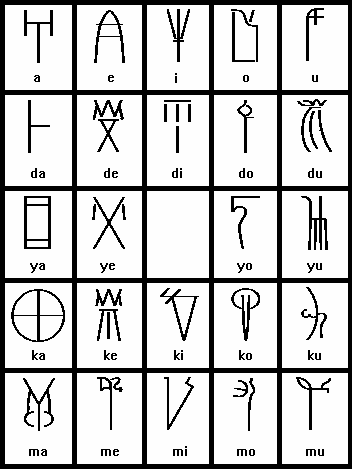
Cypro-Minoan script.
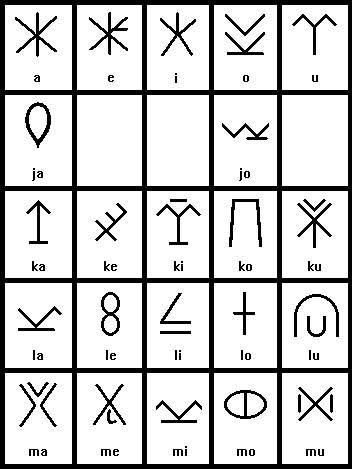
The island of Cyprus continued to use a Minoan-derived non-alphabetic
script into Classical Greek times. The Cypriot script is related to Minoan
Linear A and Linear B. The texts in Cypro-Minoan that can be translated
were produced by Greek speaking Cyriots of the 12th century BCE. This script
was also used to represent the indigenous non-Indo-European spoken language
of Cyprus.
The Cypro-Minoan script used about 56 signs and had symbols for vowels
and consonant and vowel combination syllables. Many surviving examples
of Cypro-Minoan inscriptions date to the 6th, 5th, and 4th centuries BCE,
after which the new alphabetic Greek scripts displaced it.
The Greek word anthropos (a person) could be inscribed as a-to-ro-po-se
using Cypro-Minoan symbols. Greek speaking Cypriots eventually adopted
the Greek Alphabet after the time of Alexander The Great. (source)
The linear scripts of Minoan origin seem to have evolved from pictograms
as was the case in Mesopotamia. The Minoan symbols have some similarities
to Egypt pictograms.
Linear A

Linear A script of the Minoans (1700 - 1550 BC). The script
had about 100 symbols, each representing a syllable. This script included
explicit representation of a basic vowel set that was useful for representing
vowel sounds at the start or end of words. The related Linear B script
came into use about 1450 BC and was used in mainland Mycenaean Greece to
represent spoken archaic Mycenaean as well as the indigenous spoken languages
(Eteocretan) of the Aegean islands. Linear B script had about 90 symbols
representing syllables and also utilized pictographic symbols that clarified
ambiguities and indicated contexts. (source)
It has been suggested that such a non-Indo-European script made it tricky
to represent the spoken proto-Greek language. Linear B script was mostly
used in Greek administrative centers for temporary trade and tax records.
After the Doric tribes invaded and disrupted the Mycenaean civilization,
the use of Linear B was lost. After a "dark age" of about five centuries,
Classical Greek speaking people such as the Ionians developed the modern
Greek alphabet, incorporating the Phoenician alphabetic script's characters
and a complete vowel set.
Greek (modern) (source)
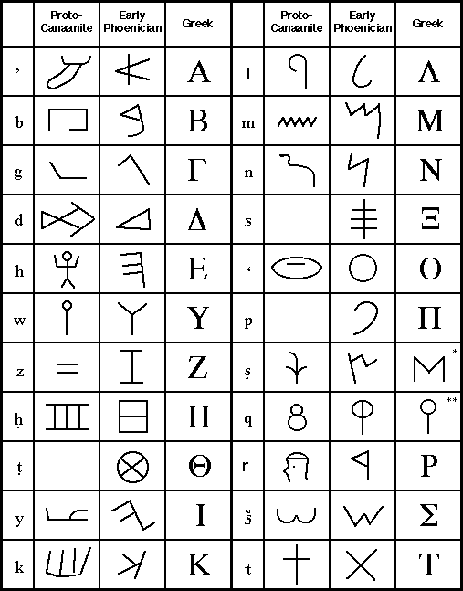
The modern Greek alphabet uses characters taken from the Phoenician
script. The Greek script developed as early as the 9th century BC.
The modern Greek alphabet was purposfully designed to represent the spoken
Indo-European Greek language, and it ultimately displaced Cypro-Minoan.
A lineage tree for various alphabetic
scripts (source)

Relationships between various spoken languages.
(source)

Indo-European
Chronology - Countries and Peoples
Return to main Prehistory of Memory Page.

