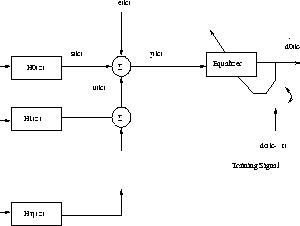
interfering co-channels with
transfer functions
interfering co-channels with
transfer functions
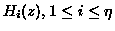 . The linear dispersive
channel and co-channels are modeled by finite impulse response filters
and, therefore, their transfer functions are given by
. The linear dispersive
channel and co-channels are modeled by finite impulse response filters
and, therefore, their transfer functions are given by
 |
(1) |
The transmitted data d0(k) and the interfering data
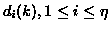 are assumed to be equiprobable and independent sequences. The data
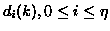 , would have zero mean, i.e.,
E[di(k)] = 0
and
, would have zero mean, i.e.,
E[di(k)] = 0
and
![$E[d_i(k_1)d_j(k_2)]=\delta(i-j) \delta(k_1 - k_2)$](img10.gif) , where E[.]
denotes the expectation operator. The additive white Gaussian noise e(k)
has zero mean and variance
, where E[.]
denotes the expectation operator. The additive white Gaussian noise e(k)
has zero mean and variance
 and is uncorrelated with the data
. As defined in [2] the channel
observation
y(k) = s(k) + u(k) + e(k) contains three terms called the
desired signal, the interfering signal and the noise respectively, where
and is uncorrelated with the data
. As defined in [2] the channel
observation
y(k) = s(k) + u(k) + e(k) contains three terms called the
desired signal, the interfering signal and the noise respectively, where
 and
and
 . Let
. Let
![$E[s^2(k)] = \sigma_s^2$](img14.gif) and
and
![$E[u^2(k)] = \sigma_u^2$](img15.gif) . The signal to noise
ratio is then defined as
. The signal to noise
ratio is then defined as
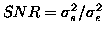 and the signal
to interference ratio is given by
and the signal
to interference ratio is given by
 and
finally the signal to interference and noise ratio is given by
and
finally the signal to interference and noise ratio is given by
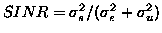 [4]. The task of the
equalizer is to estimate the transmitted data d0(k) based on the
channel observation y(k). There are variety of approaches proposed for
which one can refer [3].
[4]. The task of the
equalizer is to estimate the transmitted data d0(k) based on the
channel observation y(k). There are variety of approaches proposed for
which one can refer [3].