O.L.S.S. WILDLIFE RESCUE AND REHABILITATION CENTER
WOLVES, COYOTES, FOXES & BEARS
WOLVES, COYOTES AND FOXES - Family Canidae
This family is represented worldwide by 34 species; nine species, including the domestic dog, reside in the US and Canada. All North American canids have a dog-like appearance that is characterized by a lithe body; a long, narrow muzzle; erect, triangular ears; long, slender legs; and a bushy tail. Nearly all species have one annual litter.
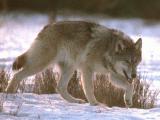
THE GRAY "TIMBER" WOLF Canis lupus
A very large canid, usually grizzled gray in color but shows a range from white to solid black. Long, bushy tail with black tip. Nose pad 1 1/4" wide. Long legs. Males are larger than females. Height ranges from 26-38" and weight can vary from 57 to 150 pounds.Wolves carry their tail straight out. Mates February - March; 1 litter of 1-11 pups born April-June, after gestation of 63 days.
Once roamed free over most of North America, now only in Alaska, Canada, Washington, Idaho, Montana, Isle Royale Natinal Park, and Minnesota. Other states with forestry areas have limited number of wolves.
A social animal, the Gray Wolf lives in packs of 2-15, usually 4-7, formed primarily of family members and relatives, although sometimes two packs join together. The strongest male of the pack is usually the leader. Within the pack hierarchy, there are male and female hierarchies. The alpha male is dominant over the entire pack, both males and females, and he can go anywhere he wants and take anything he wants. The beta male is second in the hierarchy, but the alpha female may be dominant over some of the lower-ranking males.
Dominance behaviors are open mouth and bared teeth, hair raised along the back, and ears erect and pointed forward. The Grey Wolf runs with a bounding gait with its tail held horizontal. The alpha male may hold his tail slightly higher than the others. A large pack's territory covers 100 to 260 square miles, traveling in regular intervals over such runways as animal trails, logging roads, and frozen lakes.The wolf ideally needs about 3-5 pounds of food per day, but can go for two weeks or more without food, then gorge itself on 100 pounds at a time.
There are 24 sub-categories of the Canis lupus, most acknowledging the region of where the wolf comes from. Example: The Canis Lupus Actos is a grey wolf from the arctic region or otherwise known as the arctic wolf; while the Canis Lupus Lycacon is a timber or grey wolf from the east.
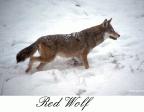
THE RED WOLF Canis rufus
Smaller than the grey Wolf this wolf usually weighs only 40 to 80 pounds. Is primarily gray in color, interspersed with blackish hairs, sometimes yellowish or reddish hairs on legs and underparts. Mates in February and March of their third year. One litter of 2-10 young born April - June, gestation about 2 months.
Prairies, brush, forested areas, coastal plains and swamps are this wolf's natural habitat. Originally seen in the U.S. north to Missouri, Indiana, and Virginia and west to Texas, but extirpated from all but SW Louisiana and SE Texas by 1900. Reintroduced into Alligator River National Wildife Refuge in Dare Country, NC; also Bull Island, SC; Horn Island, MI and St Vincent Island, FL.
The howl of the Red Wolf is closer to that of the Coyote in sound than to that of the Gray Wolf.
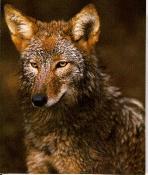
THE COYOTE Canis latrans
The Coyote is orangish gray or grizzled gray in color with buff underparts. Long, rusty or yellowish legs with dark vertical line on lower foreleg. Bushy tail with black tip and ears are prominent. Slender, pointed snout. Nose pad to 1 inch. weight varies from 20 to 40 pounds.
Mates from February to April. Litters of 1 - 19 are born between April and May, in a crevice or underground burrow.
Generally a common animal throughout the North American Continent.
The Coyote's scientific name means "barking dog". Its common name comes from "coyotl", the name used by Mexico's Nahuatl Indians.The best runner among the canids, the Coyote cruises normally at 25 to 30 mph, getting up to 40 mph for short distances and can make 14 foot leaps. Tagged coyotes have been known to travel great distances, up to 400 miles. The Coyote, unlike the Wolf, runs with its tail down.
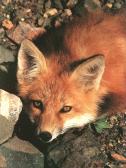
THE RED FOX Vulpes ulpes
Regarded as the embodiment of cunning, the Red Fox is believed by many field observers merely to be extremely cautious and, like other canids, capable of learning from experience. Even when fairly common, it may be difficult to observe, as it is shy, nervous, and primarily nocturnal.
Rusty, reddish coat with white underparts, chin and throat. Long bushy tail with a white tip. Prominent pointed ears. The back of the ears, lower legs, and feet are black. Color variations include a black phase (almost completely black), a silver phase (black with silver tipped hairs), a cross phase (reddish brown with a dark cross across shoulders), and intermediate phases, all have a white tipped tail.Approximately 15-16 in height and weigh between 7 and 15 pounds.
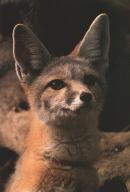
THE KIT "Swift" FOX Vulpes velox
Perhaps the smallest of the foxes, this fox weighs between 3 and 6 pounds and stands 10 to 12 inches tall. He is colored a yellowish buff on the back but tends to be whiter below. Tail also has a black tip and often has a black spot at the upper base. Feet are lightly colored. Ears are large triangular. This animal has dark spots below the eye.
Mates between January and February. Litters of 3 - 5 are born between March and April.
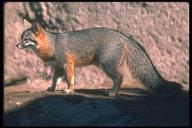
COMMON GRAY FOX Urocyon cinereoargenteus
The Grey Fox usually weighs between 7 and 13 pounds and stands 14 - 16 inches tall. He is grizzled gray on the back, but can easily have a reddish chest and undersides. Tail is similarly colored but has no black tip. Legs and feet are usually rust colored. Ears are prominent.
Mates January to April and litters numbered 1 to 7 are born March to May. Gestation period is 53 days.
BEARS Family - Ursidae
This family consists of nine species, distributed in the Americas and Eurasia. The three species found in the US and Canada are the Black Bear, the Grizzly Bear and the Polar Bear. These are the largest terrestrial carnivores. Ranging from 200 to 1700 pounds, they have powerful, densely furred bodies; small rounded ears; and small eyes set close together. While their vision is poor, their sense of smell is keen. They have five claws on each foot and like humans walk on the entire sole with the heel touching the gound. Bears tend to be omnivorous, eating leaves, twigs, berries, fruit, and insects as well as small mammals. Commonly believed to hibernate, bears enter a protected area and sleep away the harshest part of winter, but their sleep is not deep and their temperature falls only a few degrees below normal. North American bears produce one litter every other year. Although the bears mate in late spring or early summer, at which time the eggs are fertilized, six or seven months may pass before the embryos become implanted in the uterine wall, after which they develop rapidly. The young are born while the female is in her den for the winter. When born, bears are the size of rats, generally weighing only 1/2 to 2 pounds which makes the magniture of their eventual growth greater than that of all other mammals except marsupials.
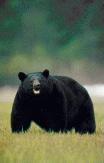
THE BLACK BEAR Ursus americanus
This bear weighs only 200 to 600 pounds. Usually black, dark brown or grizzled in color. Three pairs of upper incisors equal in size. Male is larger than female. Mates June to early July with litters of 1-5 born Janurary to early February. Birth weight not much over 7 ounces.We accept cubs only.
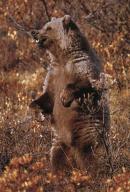
THE GRIZZLY BEAR ursus arctos
A very large bear, yellowish brown to dark brown in color, often with white tipped hairs, giving grizzled appearance. Hump above shoulers. Facial profile usually somewhat concave. Outer pair of incisors larger than inner. Two claws of front feet nearly 4" long. This bear weighs between 324 and 1500 pounds. Some individual bears have been recorded weighing as much as 1700 pounds. Mates late June to early July, with litters of 1-4 cubs born in January through March. Newborns weigh about 1 pound.
The O.L.S.S. Wildlife Rescue and Rehabilitation Center
is in the process of acquiring a new 26 acre facility with the newest housing and latest equipment.
Be sure to check out "WE NEED YOUR HELP".
O.L.S.S. Wildlife Rescue & Rehabilitation Center
P.O. Box 520
Church Rock, NM 87311
(505) 488-6632
TAKE THE TOUR
RAPTORS
OUR NATIVE CATS
OUR HOME PAGE
DEER & OUR HOOFED FRIENDS
WE NEED YOUR HELP
JOIN OUR FAMILY
PLANS FOR 1998
BOOKS AND REFERENCE MATERIALS
WILDLIFE LINKS
OUR OTHER SITE
Email: [email protected]

 This�
This�