O.L.S.S. WILDLIFE RESCUE AND REHABILITATION CENTER
O.L.S.S. WILDLIFE RESCUE AND REHABILITATION CENTER
DEER & OUR HOOFED FRIENDS
Family Cervidae
There are 43 species of cervids, as members of this family are known, eight of which occur in North America north of Mexico. Five are native: the Elk, Moose, Caribou, White-tailed Deer and Mule Deer. Three are introduced: the Sambar, Fallow and Sika deer. All male members of the N. American cervid species, as well as female Caribou, are distinguished by having antlers - bony outgrowths of the frontal bone that normally are shed annually. The antlers begin growing in the early summer, at which time they are soft and tender, and covered with a skin that grows as the antlers grow. The skin has short fine hairs, the "velvet" - whence the phrase "in velvet". The velvet contains a network of blood vessels that nourishes the growing bone beneath. By late summer, the antlers reach full size and the blood supply diminishes, causing the velvety skin to dry up, loosen and peel off. The bare horns then serve as sexual ornaments, and rival males may use them as weapons in courtship battles during the rut. After the mating season, decalcification occurs at the point where the antlers attach to the frontal bone, and the antlers are shed, usually both branches within two to three days of each other. Antlers are seldom found on the ground beause they are rapidly eaten by rodents craving calcium.
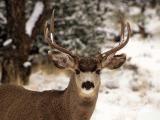
WHITE TAIL DEER Odocoileus virginianus
Often called the "Virginia Deer"; the size of this deer varies greatly depending on where the deer is located. Tan or reddish brown in the summer, grayish brown in the winter. Belly, throat, nose band, eye ring and inside of ears are white. Tail brown, edged with white, often with dark stripe down center. Black spots on sides of chin. Buck's antlers have main beam forward, several unbranched tines behind and a small brow tine; antler's spread to 3 feet. Doe rarely has antlers. Fawn is spotted. Males weigh between 150 and 310 pounds, while females weigh only 90 to 210 pounds. Reproductive season varies: first 2 weeks in November in the North, January - February in South. 1-3 young born after gestation of about 6 1/2 months.
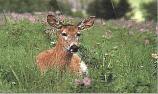
MULE DEER Odocileus bemionus
Called the Black tailed deer by some is a medium size deer. Stocky body with long, slim sturdy legs. In the summer this deer is reddish brown to yellowish brown; in the winter this deer turns shades of gray. Throat patch, rump patch, inside of ears and insides of legs are white; lower parts cream to tan. Very large ears. Buck's antlers are branded equally, each a separate beam forming into 2 tines; antlers spread to 4 feet. There are 2 major types, the Mule Deer - the more common type has tail white above and tipped with black. The second Mule Deer, the Black tailed Deer is found only along the Pacific Coast, has tail blackish or brown above. Juveniles of both are spotted. Males weigh between 110 and 475 pounds while females weigh 70 to 160 pounds.
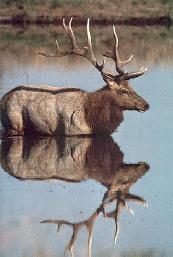
ELK "WAPITI" Cervus elaphus
A very large cervid, with thick neck and slender legs. Brown or tan above; underparts darker. Rump patch and tail yellowish brown. Buck has dark brown mane on throat and large, many tined antlers: 6 tines on each side when mature, with main beam up to 5 feet long. Juveniles are spotted until 3 months. Height 4'5" to 5'. Males weigh between 600 and 1100 pounds while females weigh between 450 and 650 pounds. Breeds in late August to November with the peak breeding transpiring in October and November. 1-2 young born after gestation of around 9 months. Newborns weigh 25 - 40 pounds.
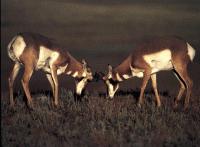
AMERICAN ANTELOPE "PRONGHORN" Antilocapra americana
A medium size deer-like mammal with long legs. Upper body and outside of legs pale tan or reddish tan; chest, belly, inner legs, cheeks, lower jaw, sides, and rump patch are white. Two broad white blazes across tan throat. Short erectile mane, about 2-4 inches long. Buck has a broad black band from eyes down snout to black nose and black neck patch. Horns are black: bucks: 12-20 inches long when fully grown" lyre-shaped, curving back and slightly inward near conical tips, each with 1 broad, short prong jutting forward and slightly upward, usually about halfway from base: doe's horns seldom more than 3-4 inches long, usually without prongs. Juvenile grayer and paler than adult and acquires adult coloration at 3 weeks of age. Males weigh between 90 and 140 pounds and females between 75 and 105.
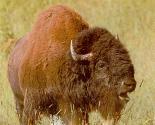
AMERICAN BISON "BUFFALO" Bos bison
The largest terrestrial animal in North America. Dark brown with shaggy mane and beard. Long tail with rufr at tip. Broad, massive head, humped shoulders, short legs clothed with shaggy hair, large hooves. Both sexes have short black horns with pointed tips that protrude from the top of the head, above and behind the eyes, curving outward, then in. Horns spread to 3 feet. Juvenile reddish brown; acquires adult coloration at 2-4 months of age. Male weighs between 900 and 2,000 pounds, females 700 to 1100 pounds.
O.L.S.S. Wildlife Rescue & Rehabilitation Center
P.O. Box 520
Church Rock, NM 87311
(505) 488-6632
TAKE THE TOUR
RAPTORS
OUR HOME PAGE
WOLVES, COYOTES, FOXES & BEAR
OUR HOME PAGE
WE NEED YOUR HELP
JOIN OUR FAMILY
PLANS FOR 1998
BOOKS AND REFERENCE MATERIALS
WILDLIFE LINKS
OUR OTHER SITE
Email: [email protected]
Email: [email protected]