|
|
A PARTICULARLY GOOD *EYE*
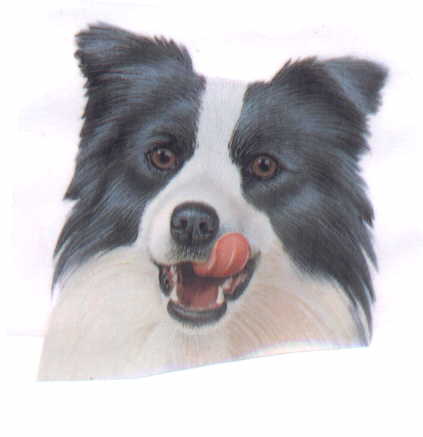
Toby was the greatest sheepdog this farm has ever seen. A black and white animal, Toby is remembered as a well-trained dog with a heap of natural ability and a particularly good 'eye'.
He must have been some dog. At shearing time, his exploits are told and retold every year, especially if there is someone new in the shed.
During shearing the order to 'go fetch the woolly ones' would send him off past the newly-shorns to the the back paddock where the self-satisfied woollies grazed unsuspectingly. A quick skirt around the fence to check for strays and he would soon have the mob in a nice little bunch, edgin them through the gate and up to the yards.
He was as reliable as the sunrise and worth any two working men. Like all farm dogs, he was a constant companion to his master, no matter what the job.
It was on one of these non-sheep jobs that Toby became almost immortal-well, his memory did anyway.
The men were fencing and Toby watched everything intently. He scratched the dirt as he pretended to dig post holes, and he supervised the wire-straining strand by strand. He walked twice as many miles as the men - backwards and forwards. He chased birds and had some fun with a hare.
By sundown, Toby had had a fully and satisfying day. The men packed their gear into the dray and rode home. Nobdoy noticed that Toby was missing until someone went to feed him. There was a scramble as the lanterns were lit and a couple of fellows went back to the day's work site. Was Toby hurt? Had he been run over by the dray? Perhaps he had got upwind of a neighbour's bitch.
Nothing so mundane would have caused Toby's story to be recalled so often.
When the men arrived back at the day's task, there was Toby - lying midway between two fence posts staring at the fence. The lanterns revealed the men had got the wires crossed.
Folk who recall this event insist that this was not a shaggy dog story.
MARGARET HANCOCK

COUNT TO TEN
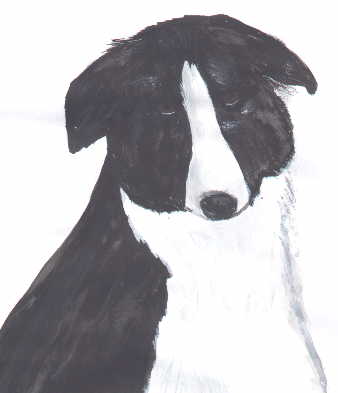
In the early 1960s we were given a puppy from a local farmer and named him Smith, after that famer, Jim Smith.
The puppy turned out to be a very faithful, hard-working dog and this is a true incident.
We had yarded cross-bred lambs to send to market and our stock agent was helping us. We ran the lambs up the loading ramp into the truck. We realised six more lambs could be fitted in to complete the load.
My father called Smith and said, 'Smith, we need six more.'
With that, Smith ran down, cut six lambs from the mob and ran them up the ramp into the truck.
The stock agent, dumbfounded, asked, "Good Lord, can that dog count?.
Dad replied, "He's all right until he gets to ten. After that, he makes a hell of a mess of it!'
GREG TWELFTREE
ALL FOUR BACK ON THE GROUND
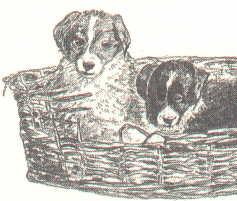
When John Corbett arrived home with two border collie pups, he bedded them down in their kennels under restraint. The pups soon voiced their resentment of this treatment and as the sounds penetrated the kitchen, Mary, John's wife, remarked: 'It sounds as though we're in for some country music - a Slim Dusty concert.' Unwittingly, she had christened the pups.
Slim grew to be a tall, rather rangy dog. Dignified and aloof, he gave unswerving devotion to John, but treated with the utmost disdain approaches from anyone else.
Dusty was a complete contrast. Affable and gregarious, he soon learnt how to cajole the tastiest household morsels from Mary and developed a rotund figure not conducive to the rigours of a working life. He would obligingly work for anyone, but at a very leisurely pace. He was adept at backing round a building or any reasonable cover to keep out of John's views, but as the tail of the mob approached the gate, he would appear to hunt the last few sheep in and stand by for any plaudits that might be forthcoming John was well aware of Dusty's habits but happily tolerated the friendly rogue.
'My dogs,' John always declared, 'are willing. Slim's willing to work and Dusty is willing to let him.'
A brush with a motor vehicle injured the youthful Slim and thereafter he carried one hind leg. It detracted little from his capacity for work and his speed around the paddocks invariably left Dusty floundering in his wake, floundering, but happily unconcerned.
One shearing season, however, Slim was again exercising his propensity for chasing motor vehicles. His collar caught in the wheel stud of a passing truck and he was whirled once around with the wheel and smashed heavily on to the bitumen surface. John, helped by the distraught truck driver, carried the unconscious dog to a makeshift shelter. Outwardly, there were no obvious injuries, but it was quite evident he had suffered serious injury - so evident that some observers suggested John should 'end his misery'.
By the next day, Slim was conscious, but incapable of movement. He gave no response to John's presence and appeared quite oblivious of the milk and tasty morsels thrust beneath his nose. Dusty proceeded to give the performance of his life. He sat beside Slim and his soft whine and rapt attention not only told his concern, but he was obviously exhorting his friend to respond. Her did respond, if only by a slight flicker of an eyelid.
Finally Dusty's pragmatic streak surfaced. He gobbled up the food, clearly thinking, 'there's no point in wasting it'.
Another factor was involved in Slim's eventual recovery. It was Julia Corbett, who had been a toddler when the pups arrived at the farm. They grew together. From the outset, Dusty and Julia were soul mates. Rolling and romping joyously on the lawn, their pleasure in each other's company was clear.
Slim watched these antics from close by though at first tending to shrink away from Julia's advances. But he did unbend, and she was the only person in his life to whom he did unbend.
Mary wasn't prepared for Slim's reaction one day when she reprimanded Julia and the child cried out in indignation. A menacing snarl from Slim gave a clear message of his views.
The day after Slim's accident, Julia came home from school and refused to look at and comfort her friend. An infinitely feeble movement of his head and an even more feeble twitch of his tail proved that Slim was aware of her. Alothough he ignored the saucer of milk she proffered, he did attempt to swallow when she dipped her small hand in the milk and pushed it into his mouth, letting the drops fall on his tongue.
This ritual was repeated over and again throughout the weekend until he was swallowing milk squeezed from a sponge onto his tongue. Although Dusty kept up his daily performance, ending as usual with his determination to maintain his own strength, he was excited and delighted when Slim did raise his head and lap the milk from the saucer.
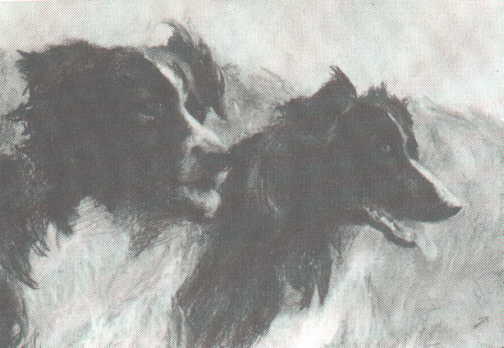
It took Slim about three weeks to recover sufficiently to struggle into a half-crouching position and ultimately to sit up and eat the food and drink on offer. During most of that time, he lay almost inert, but when Julia sat beside him gently stroking his head, his eyes and tail marked his appreciation.
It was a moment of jubilation when Slim finally struggled to his feet and after a few tentative, staggering steps began to walk with greater surety.
'Dad!' called an ecstatic Julia. 'Look, he's got all his feet on the ground!'
No-one ever knew what anatomical miracle had occurred for Slim but for the rest of his days he was back on four feet and never again carried that hind leg.
SYD NOSWORTHY
*WAYLEGGO* (and other commands
*..........One of the things that first fascinated me about sheep dog trialling was that, to an outsider, it appeared to be a separate society with its own values, language and traditions. It could never, of course, be described as a secret society, with strange rites of induction conducted behind closed doors - a triallist's introduction, alas, is very public!
At the same time uninformed onlookers can wonder what's going on, and what on earth the shepherd is actually saying. Deciphering the whistles and commands can be difficult, as there are some unusal words and phrases such as, 'come by', 'way-err', keep oot', 'that'll do' and 'get in'.
They're used as commands for the direction or side the dog is required to take and, since different people use them for either side, precise knowledge can be difficult to come by.
Then there's the great New zealand shepherd's cry, 'wayleggo'. This can also be pronounced or spelt - not that the dog's fussy - 'awaileggo' or 'wareleggo', and can mean 'let go' or 'come away out of that' or 'come in behind me' or all of the above.
"Wayleggo' can also mean something completely different, which an individual shepherd and his dog will have arranged between themselves. And, to throw a little more fog over the subject, any given spoken command can mean different things at different times, when it's delivered at different sound levels or intensity. It's not what you say, it's the way that you say it.
Eavesdropping on a conversation between a couple of triallists can be just as puzzling as the communciation between man and dog. To me, this reinforces the mystery and separatism any special interest group can develop, especially one that has emerged from practical stock work on New Zealand farms and stations, otherwise know as shepherding.................*
JOHN GORDON
[ 1 | 2 | 3 | 4 | 5 ]