

Ann Baker advertised widely and mailed fliers promoting the breed to cat lovers nationwide. Early publicity spread and the breed quickly became an object of controversy. Bakers breeding program consisted of a handful of breeders contracted under her. She was paid a royalty fee for every kitten sold. As time went on, Ann Baker's statements and claims about the became strange, supernatural and very hard to believe. She publicized statements outlining how Ragdoll cats have human genes in them and that they are immune to pain and represent a link between us and space aliens.
The breeders who were once loyal to her, were now having doubts about how to develop the breed, without losing integrity that these wonderful cats deserve. Because of this, several breeders broke off from Ann Baker and continued breeding Ragdolls for what they are.....highly affectionate and loving companions.
Denny Dayton was an instrumental figure in the history and development of the breed. After he broke away from Ann Baker, he fought hard to make the breed legitimate and acceptable by Cat Fanciers standards. Denny Dayton succeeded and in 1967, the Ragdoll breed was first recognized in the United States.
Dayton is the originator of RFCI (Ragdoll Fanciers Club International) the most reputable and highly respected Ragdoll cat registry in the world. Dayton also worked very hard to get the breed recognized by TICA. Ann Baker went on with her breeding program but her stand, relative to the breed's growth and acceptance, was that of anger and bitterness. In 1971 she created her own cat registry association known as IRCA (International Ragdoll Cat Association). Since then, she has been in bitter debate about how only her Ragdolls are legitimate and the rest are fake. Very few breeders are still working under her in the United States. Cat registered by IRCA are not recognized by ANY cat shows.
Today there are over 500 breeders worldwide and the Ragdoll stands on
solid ground, despite its controversial early years and development.
A Ragdoll is a beautiful, affectionate, loving companion. Many people have compared their Ragdoll's personality to that of a loyal canine. Ragdolls are eager to interact and their are numerous accounts of Ragdolls fetching there favorite toy, learning how to shake hands, and sitting up of command. The Ragdoll personality is warm and friendly. Ragdolls want to be with you all the time. Ragdolls need lots of attention and are wonderful lap warmers.
Your Ragdoll should be INDOORS only.
Ragdolls are very docile animals and are not able to defend themselves
from other animals. Even an indoor only cat should have a collar and name
tag, that way if he does escape from your house he will be easier to find.
Indoor only cats will be very scared if they wander outside.
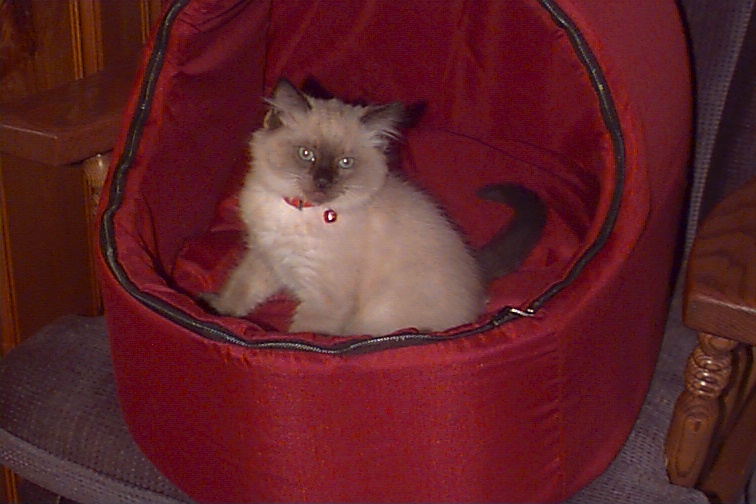
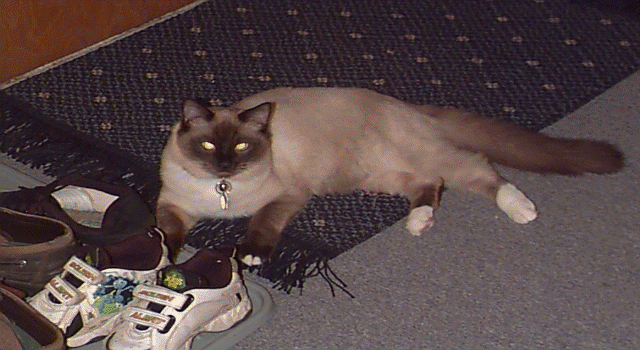
Ragdolls are pointed cats. This means that they have color on their ears, faces, legs, and tails with a much lighter, contrasting body color. Ragdolls come in four standard colors: Seal, Chocolate, bule, and Frost (Lilac). Seals have points that are deep seal brown (almost black). With a fawn to cream color shading. Chocolate Ragdolls have points that are a light milk chocolate color. Their bodies should have ivory to cream shading. Blue Ragdolls have points that are slate blue to silver. Their bodies are ivory to bluish white. Frost Ragdolls have points that are lilac to pinkish beige. Their bodies should be milk white.
There are 3 standard color patterns they are:
Color point, Mitted and Bicolor. Mitted Ragdolls are identical to color
point except that they have white paws, chin, and chest. Their front paws
have little white mittens and their back legs have white boots. Bicolor
Ragdolls have darker color on their ears, face, and tail. However, a bicolor's
face is characterized by a white, inverted "V". The stomach, all four legs,
the feet and ruff are white.
 Click HERE
to read a Newspaper article about Rags!
Click HERE
to read a Newspaper article about Rags!

 Email me!