
Wednesday 4 February 1998
The ultimate designer cat
Ragdoll cats are so laid back, they go limp when stroked.
Richard Starnes reports.
Richard Starnes
The Ottawa Citizen
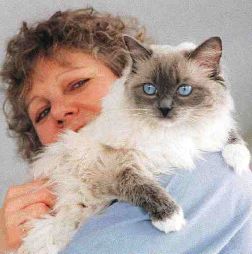
Rod MacIvor, The Ottawa Citizen / Ottawa's Sharon Harris owns one of the trendiest breeds of cat, a ragdoll, who tend to be large and lazy.
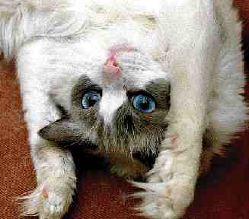
Drew Gragg, The Ottawa Citizen / Ragdoll cats are
rarely found on the tops of refrigerators; they're too lazy to jump up.
They can also be walked on a leash and trained to fetch things, like dogs.
One day around Christmas 1992, Isabelle Bellavance drove
from Montreal to New York, bought a ragdoll and drove home.
That's ragdoll as in cat, not ragdoll as in cuddly toy.
Mind you, there are startling similarities.
She may not have realized it then, but Ms. Bellavance had climbed aboard the the bandwagon led by a brand new breed of cat. Introduced to the world by accident in 1965 by an eccentric marketing whiz from California named Ann Baker, the ragdoll is being called by some the ultimate designer cat.
A cat that is so laid back, it goes limp when you stroke it.
A cat you can teach to fetch things.
A cat you can walk on a leash.
A cat you will never find on top of the fridge because it can't be bothered to jump up.
A cat that weighs upwards of 20 pounds.
"Originally, I wanted a second Pyrenees mountain dog to go with the one I already shared space with in our duplex in Mirabel," she said yesterday.
"My boyfriend said, 'How can you have two in this apartment?'"
So she went for a cat with a "very doggy" temperament.
Ms. Bellavance remembers well the day she arrived from New York with Toffee. She lifted her out of the cage and put her on the ground.
Toffee had never seen a dog before, let alone one almost the size of a Shetland pony.
But she went straight up to the Pyrenees and began to play with the tag attached to his collar.
That was five years ago. Today, Ms. Bellavance has moved to a much bigger home on Montreal's South Shore, has a second large dog -- a Labrador/Great Dane cross -- and 12 ragdolls including Toffee. She is Quebec's only major breeder of ragdolls.
The origin of the ragdoll, which is a booming breed in the United States and Britain and is beginning to take off in Canada, is controversial.
Certainly, the first ragdoll came from Josephine, a Persian-type cat who mated with a seal point Birman. Their offspring were subsequently crossed with a sable Burmese.
Ms. Baker, who died last year, claimed Josephine had undergone genetic alteration in a road accident -- a claim scientists would dismiss as nonsense -- and that was why ragdolls are so laid back and apparently do not feel pain.
It seems Ms. Baker used to market her ragdolls by tossing them in the air to show how they would go limp as they waited to be caught rather than lashing out with their claws.
However freaky the origin, there is no doubting the placid and loving nature of ragdolls.
Just ask Sharon Harris, who shares her condo on Queen Elizabeth Driveway with her husband, her older cat and her year-old ragdoll Zoe.
Ms. Harris, who bought Zoe from Port Colborne breeder Donna Taylor, found her new baby large -- and getting larger -- affectionate, happy and placid. That is, pretty much as advertised.
"Certainly she is very independent and chooses when she wants to sit together," she says. "And she likes to be picked up and carried about.
"Mind you, she does strike me as a bit odd," she says.
How so?
"I can't really explain it, but my husband thinks she is a bit dopey."
The lore of the ragdoll continues to grow.
Here's what British Ragdoll Cat Club treasurer Malcolm Beale told the Weekend Telegraph newspaper in London, for example:
"I put a cat flap in the back door so my ragdolls (19 of them) could go out into the garden when they wanted to," the report reads.
"But they simply can't be bothered to learn how to use it."