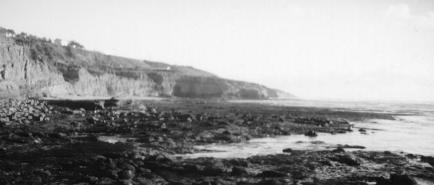
Life in the tidepools is diverse and full of extremes. When you visit the tidepools, you can see creatures, such as, molluscs, tiny sculpin fish, snails, and flower-like anemones. My research about life in the tidepools has allowed me to learn more about these fascinating creatures, so I'd like to share some of what I have seen and read about with you -- details, such as, the type of life that can be found in the tidepools as well as how it lives. The definitions of each creature are taken from the Pacific Intertidal Life book by Ron Russo and Pam Olhausen and the Seashore Life of Southern California book by Sam Hinton.
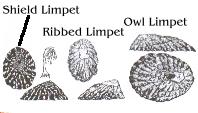 Limpets are molluscs, meaning any of numerous chiefly marine invertebrates of the phylum Mollusca, typically having a soft unsegmented body, a mantle, and a protective calcareous shell.
Pictured here are a few of the many types of limpets. They lurk about the tidepools, scraping tiny algae from rocks with their rough tongues. As the tide falls, they feel their way back to crevices within the tidepools so that they are protected from the waves. A limpet may use the same resting spot its entire life.
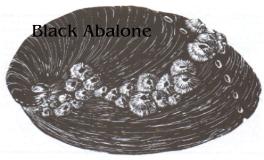 Abalones are molluscs closely related to limpets, but larger. It takes 13 years for abalones to grow to be about 18 centimeters long. Like the limpet, the abalone uses its coarse tongue to scrape and eat seaweed that it finds by smelling with its sensitive black tentacles, which protrude from under its shell.
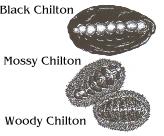 Chiltons, or sea cradles, are sluggish molluscs that creep along the under-sides of rocks on broad feet. They have overlapping plates on their backs. Even though they have no eyes, some chiltons have light-sensitive receptors that penetrate the plates on their backs. Like limpets, chiltons frequently have life-long spots where they rest and feed.
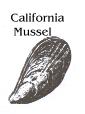 Mussels are related to other two-shelled molluscs, such as clams, oysters, and scallops. Mussels attach themselves to rocks by secreting a viscous liquid. They live upside down in their shell with their head nearest the point of attachment. To eat, they open their shell and with tiny hairs called cilia make a water current, bringing oxygen to their gills and microsopic plankton, which get trapped in a layer of mucus and pass to the mussels' mouth by other cilia.
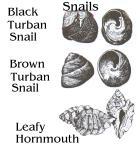 Snails are related to limpets, abalone, and chiltons. Their shells are not as streamlined and come off more easily. A snail can also completely hide in its shell, which has a trap-door-like plate called an operculum. The snail finds protection from predators and water loss.
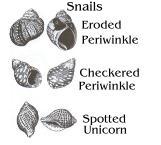 Snails get calcium carbonate from sea water and then deposit it through a membranous mantle onto the edge of its shell's opening, which makes the shell grow larger. Most intertidal snails scrape thin films of algae from rocks or the shells of other animals, and some eat seaweed. One species captures and eats plankton. Others use their coarse tongue to grind holes through mussel shells, inject a mussel-relaxing chemical, and then eat the exposed flesh of the mussel when it opens.
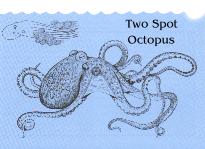 Octopi are mostly shy, but some can give a painful bite. They escape from danger by squirting out water to propel backwards, and they also spread an inky fluid to blur the vision and confuse their predators. They eat crabs, clams, mussels, scallops, worms, and fish. Females lay eggs under rocks and in small caves. They go without eating during the four-month hatching period as they guard their eggs.
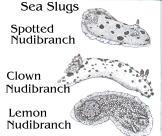 Sea slugs, or nudibranchs, are snail-like molluscs, but do not have shells. Some have gills near their back end. Others breathe through their skin. They may seem defenseless, but their bright colors warn predators of poisonous stings and bad taste. They feed on hydroids, bryozoans, sponges, sea squirts, sea pens, anemones, jellyfish, and other sea slugs, using their scraping radulae. Sea slugs that eat hydroids swallow the undischarged stinging cells of the hydroids, retaining them under their skin. Fish that try to prey upon them reject them as food after one bit, because of the stinging cells that are embedded in the skin of the sea slugs. Other defense mechanisms sea slugs use are secreting acids, camouflage coloration, or thrashing movement.
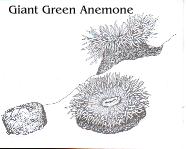 Anemones are flower-like coelenterates. Most attach to rocks, pilings, and kelp. Some species burrow into the sand or mud. You can find them in the intertidal zone as well as 10,000 meters below sea level. When they are either disturbed or feeding, anemones force water out of their body column and fold inwardly, pulling their tentacles and food inside. Any unwanted materials are sent out through the central mouth opening.
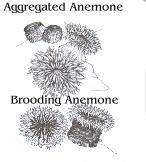 Anemones have needle-like stinging cells on their tentacles, which inject paralyzing compounds into their prey. They may feel sticky to the human touch, but they are harmless to humans.
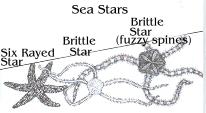 Sea stars are echinoderms with knobby spines on their backs. Their skin has soft fuzzy clumps of oxygen-absorbing tissue with tiny pincers that preserve the breathing ability of the skin, and prevent suffocation. Each foot of the star has tiny suction cups at the tip, which helps the star to hang on tight when waves crash against it.
The stars' tube feet can pry open clams or mussels far enough for the stars to insert their inside-out stomach into the shell and digest their prey. Stars can usually regenerate lost arms. In some species, severed arm tips can regenerate whole new animals. The sea stars' greatest enemies are human beings who like to collect them as souvenirs.
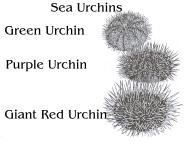 Sea urchins are echinoderms with roundish, fragile caldium carbonate shells called tests. They're covered with hundreds of spines that are used for defense and trapping bits of seaweed; and they rotate on ball-and-socket joints, which are seen as round knobs on old shell fragments or empty tests after the spines have broken off.
Like sea stars, urchins have tiny pincers nestled among their spines to keep their bodies clear of barnacles, sponges, tunicates, and the like, destroying their larvae. Feet and pincers can be regenerated. Minor shell cracks occur; but major shell repairs are not possible. Urchins grow by depositing new calcium on their outer shell surface and absorbing it on the inside.
Urchins are efficient at grazing for food, which sometimes leaves little to none for abalone, limpets, snails, and other grazers. They often burrow into reef rock by using a combination of rubbing spines, plucking tube feet, and water erosion.
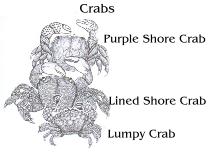 Crabs have claws and four other pairs of legs. Their sizes range from 1 cm to nearly 1 m. A crab occasionally sheds its shell as it grows bigger. It then has a new skin that grows and hardens. To escape enemies, crabs can shed their legs or claws by contracting special muscles at predetermined breakage points. The legs are later regenerated as the crabs molt. Most crabs are scavengers, but some are predators, and some eat plankton. Their flat bodies allow crabs to hide in crevices. Little crabs, like pea crabs, hide in the bodies, shells, or burrows of other creatures where they wait for plankton and edible debris to come along. The crabs' predators are fish, birds, octopi, and sea otters.
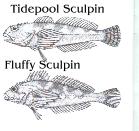 Last but not least, you'll see different kinds of fish, such as, sculpin and clingfish. Pictured here are two kinds of sculpin. Fish are the only intertidal animals with backbones. Seasonal tidepool residents like rockfish, opaleye, and sea perch are often vulnerable to intertidal changes in temperature and salinity, the pounding surf, and predators, such as birds and people.
Year-round residents like sculpins and pricklebacks, however, are hardier and better camouflaged; therefore they are able to stay safely in their habitats. Tide-pool fish have strong homing tendencies, so they usually return to the same pools when the tide drops. The sculpin eats small crabs, shrimp, fish eggs, and small fish.
I hope you're now ready to explore the tidepools, and discover the wonders of the creatures which make the intertidal zone their home. Be sure to enjoy them; but also handle them with care, so that we can preserve the species of each of these animals for generations to come.
 The Intertidal Zone
Back to the Tidepools of Southern California Home Page
Back to Humanity's Best Friend Home Page
Go to Catherine Robinson's Portfolio Site
