 |
|
|
|
|
|
|
|
|
|
|
|
|
|
|
|
|
|
|
|
|
|
|
|
|
|
|
|
|
|
|
|
|
|
|
|
|
|
|
|
|
|
|
Norfolk Composite |
|
Squadron |
|
|
|
|
|
Civil Air Patrol |
|
|
|
United States Air Force Auxiliary |
|
|
|
|
|
|
Missions For America |
|
|
|
The Civil Air Patrol Story |
|
|
|
 |
|
|
|
Birth of CAP |
|
|
| Civil Air Patrol was conceived of in the late 1930's by legendary New Jersey avaition advocate Gill Robb Wilson, who foresaw avaition's role in war and general avaition's potential to supplement America's unprepared military. Wilson, then aviation editor of The New York Herald Tribune and later NJ Aeronautics Commissioner, first sold the idea to New Jersey's governor, who created a statewide organization. Wilson then convinced New York mayor and National Civil Defense Chief Fiorello La Guardia of the need for a civilian air defense organization. The new CAP was born on December 1, 1941, just days before the Japanese attack on Pearl Harbor. |
|
|
|
|
|
|
Coastal Patrol |
|
|
| America entered the war with meager maritime defenses on the East Coast. Gasoline and oil shortages grew and vital war supplies for Europe were nearly choked off as enemy submarines operated with impunity -- often within sight of the beach. Tankers and freighters were going to the bottom in record numbers. While the American military frantically geared up to meet the threat, ships were torpedoed in the mouth of the Connecticut River and the Saint Lawrence River. One surfaced sub actually motored right into outer New York harbor on January 15, navigating by reference to a New York City tourist map and visible landmarks like the Ferris wheel at Coney Island. Subs could blast their prey at night as targets became silhouetted against still brightly lit coastal resorts. Usually unopposed, they would attack on the surface using deck guns to conserve torpedoes. Even years later, New Jersey teens termed their secluded romantic interludes on the beach, "Watching The Submarine Races." |
|
| As tankers burned, Philadelphia-based Sun Oil (Sunoco), along with other concerned companies, established a "Tanker Protection Fund" to establish civilian coastal patrol bases until government financial support caught up. Volunteers came from everywhere and, within months, some 40,000 signed up, ranging from over-age World War I fliers to aviation heroes and Hollywood celebrities. |
|
| CAP pilots provided their own airplanes and equipment, and often couldn't cover expenses on their $8 per flying-day government pay, which often arrived two months late. Civic organizations across the nation chipped in with "Sink-a-Sub Clubs," staging fundraisers for Coastal Patrol. |
|
|
| The military required an initial 90-day trial in early 1942 to prove civilians could do the job, so Coastal Patrol began as an experiment at the three hot spots of the submarine bloodbath: Altantic City, New Jersey; Rehoboth Beach, Delaware; and Lantana, Florida. |
|
|
| Flying 200 miles offshore were pilots whose previous overwater experience had been crossing the wide part of the Delaware River from below Wilmington over to the South Jersey side. They wore military uniforms and "U.S." insignia so that they would be prisoners of war if captured, instead of being shot as guerillas. |
|
|
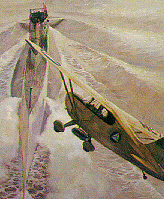
| Atlantic City's initial flight had been out only 15 minutes when it spotted its first torpedoed tanker and started coordinating rescue efforts. The presence of CAP raised tanker crew morale during the war and was even credited with convincing torpedoed tankermen to accept another assignment back at sea. A CAP crew first interrupted a sub attack on a flight out of Rehoboth Beach, saving a tanker off Cape May, New Jersey. Since radio calls for military bombers were often unproductive, unarmed CAP fliers dived in mock attacks to force subs to break and run. |
|
|
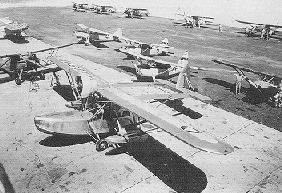
| Many CAP aviators earned membership in the "Duck Club" for their numerous engine failures and subsequent ditchings at sea. Radio calls to CAP's communications network, if made in time on the weak one-watt sets, brought CAP twin-engine Grumman Widgeon amphibians to the rescue. |
|
|
|
 |
|
|
| The first Air Medals of World War II presented in person by President Roosevelt went to CAP pilots Eddie Edwards and Hugh Sharp for one such rescue, which saved one of two crewmembers down in a bitterly cold wintertime ditching. Edwards had to perch on the Widgeon's wing to counterbalance the loss of the opposite pontoon, ripped away in the rescuer's landing. A half-frozen Edwards clung there for 11 hours as the unflyable Widgeon was water taxied all night to shore. |
|
|
|
 |
|
|
| CAP planes got bombs and depth charges after a crew watched in vain as a grounded sub off Cape Canaveral, Florida, escaped before the military arrived. The CAP Coastal Patrol flew 24 million miles, found 173 subs, attacked 57, hit 10, and sank two. |
|
| By Presidential Executive Order, CAP became an auxiliary of the Army Air Forces on April 29, 1943. The military had resisted "those country-club pilots" and their "toy planes", but 21 CAP Coastal Patrol bases from Maine to Texas had soon deterred close-in submarine operations. By August 31, 1943, it was time for Coastal patrol to stand down. A German commander later confirmed that coastal U-boat operations were withdrawn because of those damned little red and yellow airplanes. |
|
|
|
 |
|
|
|
|
|
|
Other Wartime Missions |
|
|
| CAP went on to target towing operations, courier services for the Army, liaison and cargo flights between war plants, Southern Border patrol against enemy infiltrators crossing from Mexico, and air search and rescue. Non-flying CAP members guarded airfields and trained a rapidly growing corps of CAP Cadets. CAP searched for many military planes that had gone down on training or ferry missions around the United States. After a B-24 crash landed one winter atop Mount Baldy near Taos, New Mexico, a CAP Taylorcraft made six successful landings at 12,800 feet to deliver survival rations and recover crucial equipment. Nevada CAP actually had its own calvary, conducting ground rescue operations in rough territory on horseback, including 24 mounts transferred from the Army's now-obsolete Calvary at Ft. Riley, Kansas. |
|
| Inland operations were typified by the flying of Liaison Pilot Bill "Pappy" Madsen, operations officer for the "Mountian Boys" flying from Peterson Field in Colorado Springs, Colorado. CAP's operations in the Rockies actually pioneered many routes and mountian flying concepts still in use today. Colorado-based courier pilots operated 100 scheduled flights a day over 50 routes, carrying 3.5 million pounds of cargo to military bases in 17 states. Seven courier pilots died in the mountians of the West, with a like number perishing in the East on flights between war plants. |
|
|
| Women were actively recruited by CAP, as well. In addition to support duties at Coastal Patrol bases, women pilots flew inland liaison, forest fire patrol and other missions. By the war's end, women made up 20 percent of CAP members. |
|
| Of course, women were not immune to duty's dangers. Margaret Bartholomew, commander of the Cincinnati courier station, was lost in the western Pensylvania mountians after departing Williamsport, unaware of a storm ahead. Departing just as new weather information reached Williamsport, Bartholomew did not hear the tower's desperate attempts to recall her flight. |
|
|
| In all, CAP flew a half-million hours during World War II and 64 CAP aviators lost their lives. |
|
|
| CAP's role after the war was much in question, and it was widely expected to fade away along with most other wartime institutions. But military and political leaders rose to praise CAP's unusual commitment and accomplishment. At a special dinner in Washington, DC in March, 1946, President Harry Truman, Speaker of the House Sam Rayburn, and no less than 300 members of Congress and 50 AAF generals gathered to praise the workof CAP. President Truman later signed a bill granting CAP a national charter, placing the organization in a unique status similiar to the American Red Cross. The United States Air Force was created as as an independent armed service in September, 1947, and the Civil Air Patrol was permanently designated as its official auxiliary the following year. |
|
|
|
|
|
|
The Peacetime CAP |
|
|
| Since air search and rescue had been one of CAP's primary missions during the war, it was obvious that there was no better organization with the equipment and training to continue this vital job in post-war years. Even though there were plenty of military aircraft available, they cost far too much to operate and flew too fast for accurate spotting of downed planes and personnel. Military pilots were expensive to train as well, and mission requirements limited their availability for search and rescue work. CAP, with its proven record of volunteer service using light aircraft, was put to work. |
|
| By 1954, CAP was flying over 50 percent of the search and rescue hours flown in the United States and, according to the Air Force Air Rescue Service (known today as the Air Force Rescue Coordination Center), CAP was saving the country $46 million a year -- the cost equal to the military and flight pay of the 12,000 aviators that would have been needed to fly the missions had CAP not been available. |
|
| In October, 1954, Navy pilot Joe Meder became one of the many crash survivors who owe their lives to CAP. Flying at night at 40,000 feet in stormy skies, he was forced to eject from his burning Banshee jet fighter. Falling almost 30,000 feet as he wrestled with his ejection seat, he was able to separate from it and get his parachute open, only to have it rip and began to lose air. He slammed into the ground, breaking both ankles and numerous other bones, and puncturing a lung. He crawled 150 feet before collapsing in a rain drenched bean field. Nearing death, Meder was spotted at first light by CAP pilots Vince Causmaker and John Zonge who were part of a two-state air and ground search team. |
|
| When floods ravaged Kentucky, Virginia, and West Virginia in 1957, CAP ground, air, and radio teams swung into action. CAP planes flew vital serum and vaccines to forward areas unreachable by heavier military aircraft. Ground teams helped in the evacuation of cities and towns. In the Hazard, Kentucky area, the CAP radio net handled most of the traffic for the emergency agencies, coordinated the activities of Army rescue helicopters, controlled CAP activities in the area, and broadcast weather advisories from the U. S. Weather Bureau. |
|
|
| By the 1960s and '70s, CAP was logging over 75% of the search and rescue hours flown each year. The burgeoning civil aircraft fleet was the primary impetus for the continued need for a growing CAP organization, but the CAP's part organization, the U.S. Air Force, sometimes had to use Civil Air Patrol's search and rescue skills as well. When an F-111 fighter-bomber went down in the southwest, CAP members from six states were called up in a 15 day search and rescue operation. CAP pilots flew over 80% of the 1,400 sorties flown. |
|
|
| On May 18, 1980, Mt. St. Helens in Washington exploded, devastating approximately 150 square miles and triggering massive mud flows, floods and ashfalls. When the county sheriff asked the CAP for help, CAP members were quickly on the scene, establishing a 24 hour headquarters, plotting leads, aiding search and rescue missions, and updating weather advisories. CAP teams assisted in several out-lying command centers and worked in ash cleanup crews. |
|
|
| The youth-centered CAP Drug Demand Reduction Program is only one of CAP's activities in our nation's "War on Drugs." Since 1986, CAP has made major contributions to the counterdrug fight by providing aerial reconnaissance, airborne communications support, and airlift of law enforcement personnel. In 1995, CAP units flew nearly 32,000 hours in support of counterdrug efforts. |
|
|
| As the official auxiliary of the the U. S. Air Force, it's not surprising that CAP performs vital Air Force missions upon request. This support includes air search and rescue on USAF directed missions, light transport, communications support, and low-altitude route surveys. |
|
| All in all, there are numerous reasons for enthusiastic, aviation-oriented volunteers to join one of the United States' premier service organizations. |
|
|
|
|
|
Links To Our Missions:
Home
Cadet Programs
Emergency Services
Frequently Asked Questions and Answers
Squadron Staff
How to Join
The Repeater: Our squadron's monthly newsletter
Military & Government Links:
Air Force Home
Air Force Publications
AFRCC-Langley AFB
Coast Guard Auxiliary
AAFES Online Catalog
Civil Air Patrol Links:
CAP National Headquarters
Middle East Region
Virginia Wing
The CAP Officer: A Professional Journal for CAP Volunteers
| |
|
|
|
 |
|
|
You are Visitor |
|
|
|
|