This is my alternate assignment project for Chemistry 2202.
|

|
|
|
Most people think of gold as a valuable substance that is commonly
used in the making of coins, jewelry and other valuable items. Actually, gold
is a substance that cannot be changed into a simpler substance, otherwise
known as an element. Gold �lives� on the periodic table of elements which
places all elements in a �home� according to a variety of its chemical
properties. It is also widely known to be found with various amounts of silver
and within the Earth�s crust, is fifty-eighth in order of abundance of elements.
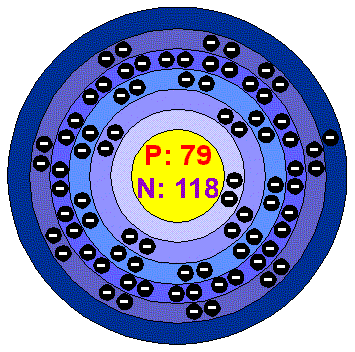
Gold itself is found in group 1B, as element #79 because it has 79 positively
charged sub-atomic particles, protons, and as an atom, the smallest part of
an element, has 79 negatively charged sub-atomic particles, or electrons.
Gold weighs 197 atomic mass units, and when subtracted by its 79 protons, it
is discovered that gold contains 118 neutrally charges sub-atomic particles,
known as neutrons. To the left is a Bohr-Rutherford model of gold.
In nature, gold is found within quartz veins as well as secondary alluvial
deposits and is almost always found with different amounts of silver.
Together, gold and silver form an alloy called electrum, and with mercury as
gold amalgam. Another place where gold is found is in sea water, but in very
tiny quantities as 5 to 250 parts by weight to 100 000 000 parts of water.
Unfortunately, it would be futile to harvest gold from the sea because as of
now, the cost to retrieve the gold is far more costly than its actual value.
Pure gold is the most malleable, ductile, one of the softest, densest, and
conductible of all the metals. It is bright yellow and has a high luster. Gold is
extremely inactive so it is not affected by air, heat, moisture, and most
solvents making it extremely useful in industry.
Gold is a solid, more specifically a transition metal, which is simply an
element found in one of the �B� groups on the periodic table. It is located to
the left of the �staircase� which divides the metals (to the left), from the
non-metals (to the right). To locate gold, find group 11 (1B) and period
(horizontal columns) number six.
 |
|
1st Energy Level: 2 electrons
2nd Energy Level: 8 electrons
3rd Energy Level: 18 electrons
4th Energy Level: 32 electrons
5th Energy Level: 18 electrons
6th Energy Level: 1 electron
|
|


 Intro & Properities