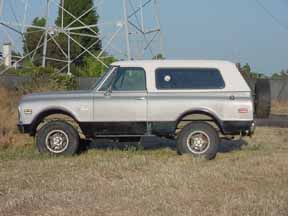
Shot of the left side of the Blazer. This is a shrunken-down version of one of the photos sent in June of 2001 to Terminal Reality for the 4x4 Evo2 game.
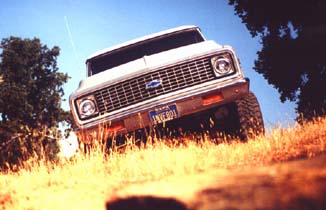
During the dove season opener of 1999 the Blazer saw a little bit of off-road action in the hills at U.S. military base Fort Hunter Liggett in California.
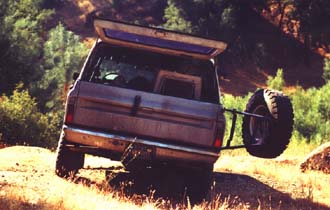
The slightly sloped parking lot near the first place we chose to dove hunt.
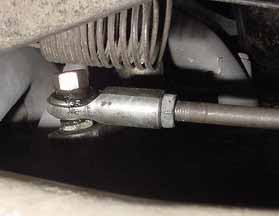
Here's a picture of the heim joint modification I performed on the lower clutch pushrod. Note the grease on the rod end, the nuts on either side of the ball (holding the bolt to the lower arm of the countershaft and the ball to the bolt), and the jam nut on the lower pushrod.
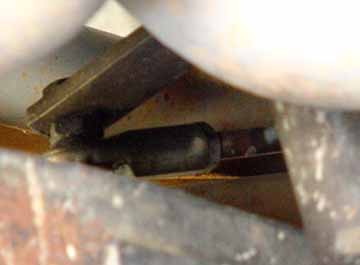
And here's the heim joint viewed from above.
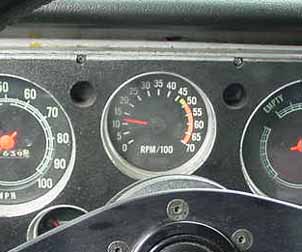
This is what the 1978 Camaro tachometer looks like in the Blazer's dash bezel. It's fully functional and more compatible with the HEI than an original Blazer/Truck tachometer would be. I wanted to get an earlier 8K RPM tach, but they're hard to find in the junkyards and I wasn't going to shell out big bucks for a repop or reconditioned one just so I could cut it up to install it.
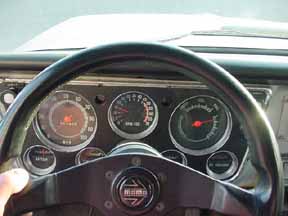
Here's a shot of the entire gauge cluster as viewed through the Momo Corse steering wheel. The Corse steering wheel actually allows the driver to view all of the gauges when the wheel is straight ahead or even slightly cocked off.
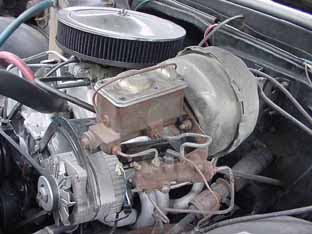
This is a shot of the 1977-78 Cadillac Seville master cylinder and proportioning valve, along with the 1981-88 Buick Regal vacuum booster. They look pretty much like they belong there, don't they?
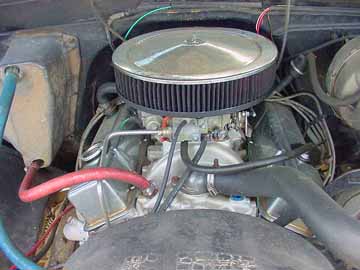
The engine compartment viewed from the front of the Blazer. The red wire behind the air cleaner is the ignition lead to the HEI. When converting a car with points ignition to an HEI, a non-resistor wire should replace the factory-installed resistor wire. Failure to replace or bypass the resistor qire could create a condition where the ignition is unable to support more than about 4000 engine RPM of. The green wire is power for the electric choke.
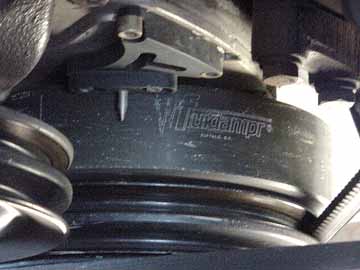
A view of the nodified Tavia adjustable timing pointer in front of the Comp Cams two-piece timing cover and above the Fluidampr. The adjustable pointer is handy for indexing the marks on the damper with the #1 rod throw, ensuring accurate timing.
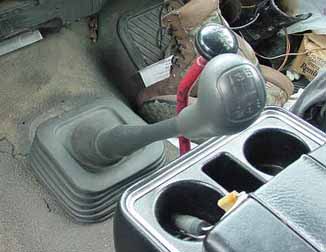
This is the gear selector stick and boot for the NV4500 transmission. They were originally intended for installation in a 1998 GM 4x4 truck with the 5-speed manual transmission option. Yeah, the rubber floor mat is ugly. Note the holes in the ugly floor mat from the original 4-speed shifter boot retaining screws (in front of the 5-speed boot). Also note the front of the "Adult Beverage Holder" console from a 1976 Blazer in the lower right of the photo...
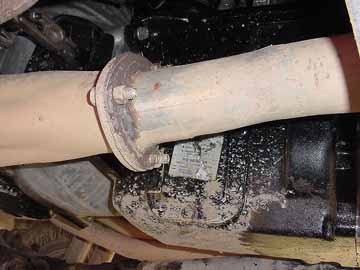
Here's a shot of the NV4500 transmission from the driver's side. It's kind of blocked by the left exhaust pipe. Note the Advance Adapters bellhousing and original clutch throwout fork.
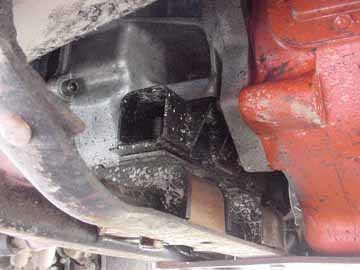
Here's a shot of the NV4500 transmission's modified Chrysler tailstock and NP205 transfer case from the driver's side. Sandwiched between the transmission tailstock and transfer case is the Advance Adapters adapter plate. Below the tailstock is the adapter mount I had to fabricate in order to make the transmission mate with the stock crossmember. The stock crossmembers had to be moved back about 1-5/16" in order to line up with the transmission and transfer case mounts.
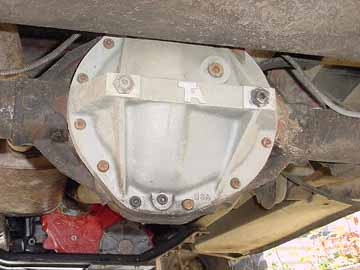
Going toward the back, here's the TA Products differential girdle/cover. It helps to support the carrier bearing caps and prevents them from distorting under heavy loads. This could mean the difference between breaking something and being able to drive home. Also note that there are plugs in the cover for filling and draining the differential. They are very handy. Also note the huge fuel tank at the top of the picture.
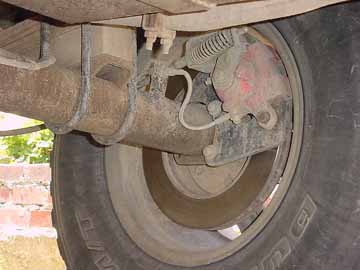
On the end of the right axle is a disc brake setup. Note the bracket welded to the axle tube for the flexible hose mount. The stock hard line was bent around the axle tube and mated to a bulkhead adapter fitting that is mounted to the bracket. Also note the fully-functioning (and applied) parking brake.
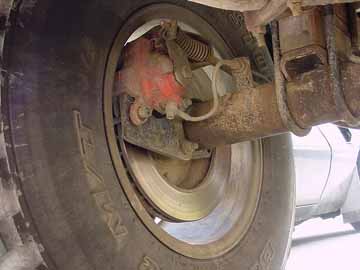
And here's the left axle, also sporting a disc brake with functional parking brake. If you install these brakes, you must use the parking brakes on these GM calipers or the brakes could go out of adjustment. For installation instructions, see my Blazer Rear Disc Install Article. In the background, you can see my Trans Am.
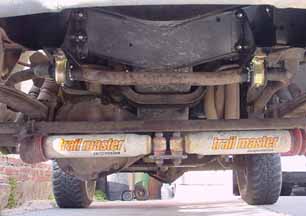
This is the front anti-sway bar off of a 1978 Blazer 4x4. I used the bar and spring plates off of the '78 and fabricated custom frame mounts to attach the transverse section of the bar to the front crossmember and frame.
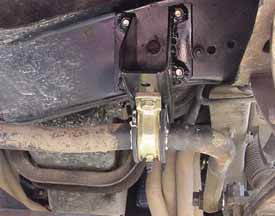
Here's a shot of the left frame mount for the anti sway bar. It's made of 1/8" thick rectangular stock, with one end sawn open. It bolts to the crossmember with 5 bolts and has a provision for stiffeners to be bolted to it, should I find it necessary.
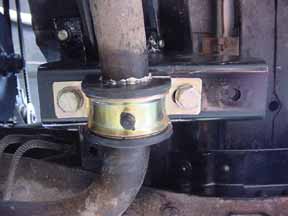
Here's a shot of the left frame mount from the under side. You can make out the fifth bolt that keeps the mount from twisting under the side loads that the bar imparts on the mount. It's near the top left corner of the photo.
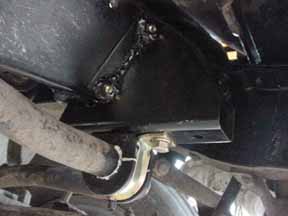
And another shot of the left frame mount. This is the inboard side view. My poor welding job is on display!
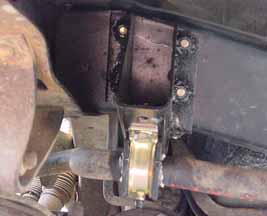
This is a head-on shot of the right side frame mount. It is not a mirror image of the left side mount because of the shape of the anti-sway bar and of the shape of the crossmember.
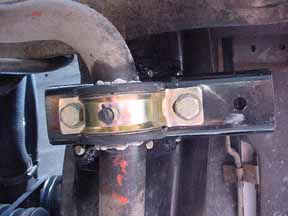
This is an underside view of the right side frame mount. The hole in front of the anti-sway bar bracket is threaded. I plan on adding stiffening stringers that will bolt to this hole and a similar hole in the other frame bracket and to holes in the frame above the front spring eyes.
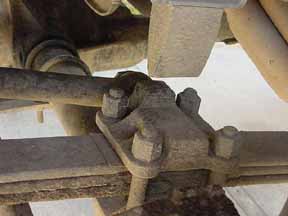
This is the driver's side spring plate from the '78 Blazer 4x4. It is a direct bolt-on for the '72 Blazer.
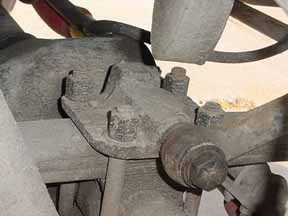
This is the passenger side spring plate from the '78 Blazer 4x4. Note that it is very different from the driver's side plate.