KINEMATICALLY CORRECTED IMPULSE APPROXIMATION
In order to bring the calculations performed using
the algorithm of Sec.2 into better agreement
with experiment, in Ref. 22 we proposed, in general
outline, a procedure for redefining the energy of the xN system
in the calculation of the xN amplitude. In more detail, this procedure
is as follows. In the construction of the xA potential in Sec.2,
we use the xN amplitudes on the mass shell, where the energy in
the xN c.m.s. for the calculation is determined from the free kinematics
for the incoming particles. However, the real process of an elementary
interaction takes place in the field of the nucleus, and when the particle
x propagates in the nucleus, its energy is changed by the nuclear potential.
Moreover, the xN amplitudes that are used require that the second
particle-the nucleon inside the nucleus-also be effectively "free," and
this leads to an additional change in the xN energy by the depth
of the potential in which the bound nucleon occurs. Thus, the amount by
which the energy is redefined in the kinematically corrected impulse approximation,
ExNKCIA-ExNIA=D
E has the form
D E(r)=-(Ub(r)+UxAeff(r)),
where Ub is the potential of the bound state, and UxA
is the real part of the potential (1), without L-dependent terms
or terms containing the first derivative of the wave function (see Ref.
22). The potential of the bound state was chosen in the Woods-Saxon form,
using the algorithm of Ref. 87 for 12C
and 4He, and was obtained in analytic form for d by substituting
a wave function in the Hulthen form into the Schrodinger equation. In general,
the value of D E depends on the coordinate of
the point in the nucleus. In order to simplify the computational scheme,
it is more convenient to
define the average value <D E > as the
value at the point R which is found from the condition
s tot(U(R))=1/2
s tot, 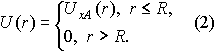 One the right-hand side of Eq. (2) we have the total cross section calculated
in the impulse approximation. Using this approach, we have calculated D
E for pd, p4He, p 12C, K+
d,
One the right-hand side of Eq. (2) we have the total cross section calculated
in the impulse approximation. Using this approach, we have calculated D
E for pd, p4He, p 12C, K+
d,
and K+ 12C scattering. The p
+A
potential is characterized by a substantial variation with the radius,
with a change of sign; this makes it impossible to use (2) and means that
it is necessary to carry out a phenomenological analysis using
DE
as an adjustable parameter [22]. Such an analysis was performed in
Ref.
25 in the range of energies Tplab>100
MeV, where the results in Refs. 22 and 25 agree. In the present paper,
we attempt to obtain the energy dependence of D
E on the basis of more experimental material than in Ref. 22. We find that
for p 12C scattering in the range
Tp lab<80 MeV it is not possible
to obtain equal values of DE for p
+
and p- mesons, and in this region
we find no substantial improvements in the total cross section. Moreover,
the introduction of a shift in the case of the pd
interaction does not improve the agreement with experiment.
The values of the shifts DE
obtained for pd, p4He, p 12C,
p+,- 12C, and K+
12C scattering are shown in Fig.
15, and the results of calculations using the kinematically corrected
impulse approximation are shown in Figs.1-14
by the solid curves. We fin improved agreement in the case of pA
scattering for Tplab=100-300 MeV in the integrated
cross sections, and for 50-200 MeV in the differential cross sections,
and in the case of pd scattering in the total cross section over the whole
interval of investigated energies up to 700 MeV. It should be noted that
the agreement of our calculations in the kinematically corrected impulse
approximation with the experimental data in the range of angles in which
the potential (1) is valid is no worse than the agreement given by microscopic
calculations [5] (see Fig.6). For p
12C scattering, we find an improvement in the differential cross
sections for elastic scattering of positive pions at energies below 300
MeV, and for scattering of p- mesons
in the range 70-300 MeV. It was not possible to fit the region below 70
MeV by means of a shift D E in the case of negative
pions. For K+ 12C scattering, no significant changes
in the calculated quantities are found; the differences are appreciable
only in the integrated K+ 12C cross sections (see
Figs. 11 and 12).
<Previous
part, Next part>