CHAPTER XI
| RESEARCH IN THE AFTERMATH OF THE FOUR COURTS FIRE |
| NOTICE: The contents of this WEB SITE are subject to Copyright � 1997-1999, 2000 by David B. Strong. All rights are reserved, including the right to reproduce the contents or portions thereof, in any form. Permission is hereby granted to copy for personal use only limited parts of the written material and of the attached data files contained herein as text material, provided, that any published reuse of this material must properly acknowledge and cite the copyright of David B. Strong as the author or compiler of the information. This material may not be copied except for personal use; and it may not be duplicated and sold, either separately, or as part of a compilation, either in print, on digitalized media such as Compact Disks, or electronically, without the express written consent of the author. Distribution of documents (as opposed to abstracted and reformatted data) downloaded from or copied from this site, whether in part or in whole, whether in print or via electronic media, is strictly forbidden, regardless of whether a fee is charged. This copyright applies to all parts of this site as published on the Internet. |
CHAPTER XI
| (N:Saturday 23 August 1997, 10:44:28) | ||
| ~~~~~~~~~~~~~~~~~~~ | (R:Tuesday, January 25, 2000 - 4:04:49 AM) | ||
RESEARCH IN THE AFTERMATH OF THE FOUR COURTS FIRE |
|
Attempting to research Strong family history and genealogy
in Ireland in the wake of the Four Courts Fire of 1922,
one is confronted by the fact that many original records were
lost in the fire. As a result, either the needed records do
not exist; or they exist in copies only, there are indexes
only, or must be reconstructed from compilations of tombstones
(if any), copies of wills gleaned from the offices of
lawyers, and other sources. As it happens, most of the
Strongs we have found in Ireland were farmers and
tenants...people who left few wills and small estates if at
all, and thus left few records initially. This makes the
work of researching them all the more difficult. |
|
Our method has been to compile facts from various Strong
family groups, both emigrant and resident in Ireland, and
from existing Irish records. We have then attempted to collate
the records and to compile reasonably correct lineages
from the data. The lineage charts are set out in Appendix
I, while the raw data is set out in Appendix III. In this
chapter we will discuss sources of the data, both to validate
our findings for the reader, to eliminate repetitive research
for subsequent researchers, and to hopefully point the way
for avenues of future inquiry which might add to our total
knowledge. A very important aspect of this inquiry is the
realization that the absence of Strongs in existing data
sources is often an important indicator of the time and place
of origin of Strongs to be found in later data from the same
area. |
|
With the partition of Ireland following the 1922 Treaty,
the official records were divided as well, with most of those
pertaining to Northern Ireland being deposited with the Public
Record Office (PRO) in Belfast, and those for the Republic
of Ireland being retained at the PRO in Dublin. Some of
the records are duplicated at each PRO, and some are found in
one location pertaining to the other and vice versa. As a
result, the researcher should have recourse to both sets of
records. Not to be over looked are the resources of the Public
Record Offices at Edinburgh and London, which contain
many useful sources. Further, many other useful records are
to be found in such locations as the National Library,
Dublin; The Genealogical Office, Dublin Castle; The Royal
Irish Academy, Dublin; The Registry of Deeds, Dublin; and the
Presbyterian Historical Society, Belfast. Additionally,
records can be found in many local county museums and
historical societies. |
|
Because of religious interests, the Church of Jesus
Christ of Latter Day Saints (LDS), headquartered in Salt Lake
City, Utah, has gathered an extensive library of books,
micro-fiche, and micro-film of original records from various
sources through out the world. At the Genealogical Department
Library, 50 East North Temple, Salt Lake City, Utah
84150, are collected over 170,000 volumes for use within the
Library only. They do not have an interlibrary loan service,
and do not sell library materials. A few of the books, but
by no means all of them, are reproduced on micro-film. |
|
In 1988 there were over 1.2 million rolls of microfilm from many
parts of the world. 40,000 rolls are added yearly. Film
may be ordered through local branch libraries, or "Family
History Centers", in communities through out the world,
where-ever an LDS Stake has been established. While the main
library department personnel do not undertake genealogical
research, there are available lists of professional genealogists
who will undertake searches for fees. |
|
While they do not have copies of all of the materials a
researcher would wish, the LDS records do provide an important
alternative source of materials for those unable to
travel to Ireland. Entry of the records is facilitated
through the LDS "Temple Ordinance" Indexes, including the
International Genealogical Index (IGI), the Temple Records Index
Bureau, and the Family Group Records Collection. These
are reproduced on micro-fiche, available at the local Family
History Centers, and updated rather frequently. The IGI is
an important key to locating records of concentrations of
particular surnames by locality. Another important index
particular to Ireland is the "Householder's Index", compiled
from the Griffith's Valuation Lists (~1858) and Tithe
Applotment Books (~1823), providing data for Strongs to be
found in named Counties, Baronies, Parishes, and Poor Law
Unions. |
|
In order to concentrate our efforts, we have elected to
utilize data from the LDS Householder's Index and from our
own subsequent analysis of the data base compiled in the IRISH STRONG DATA BASE
as a means of focusing on those
counties, baronies, and parishes within the identified counties,
wherein concentrations of Strongs may be found. The
Householders Index, of course, is limited to data between the
years of 1823 and 1868. It seems apparent that data from
these years will in most instances comport with what might be
indicated from an examination of earlier data from another
source. However, until compilation of the IRISH STRONG DATA BASE,, the
Householder's Index was probably the only index of Strong
family concentrations for all of Ireland that existed. Now,
the IRISH STRONG DATA BASE, enables us to verify the information gained
from the Householder's Index, and to go beyond it to add
information stretching back over the period of about 300 years. For further and more recent analysis of the distribution of Strong Births, Marriages, and Deaths for Ireland, see: Births, Marriages, Deaths Index, compiled by Philip B. Strong. |
|
Examination of the Householder's Index and the IRISH STRONG DATA BASE,
by Province, County, Barony, and Parish yields the
following information, indicating concentrations of Strongs.
The data has been organized by Province, County, Barony, Parish
and Diocese; those listed below are also reflected in the
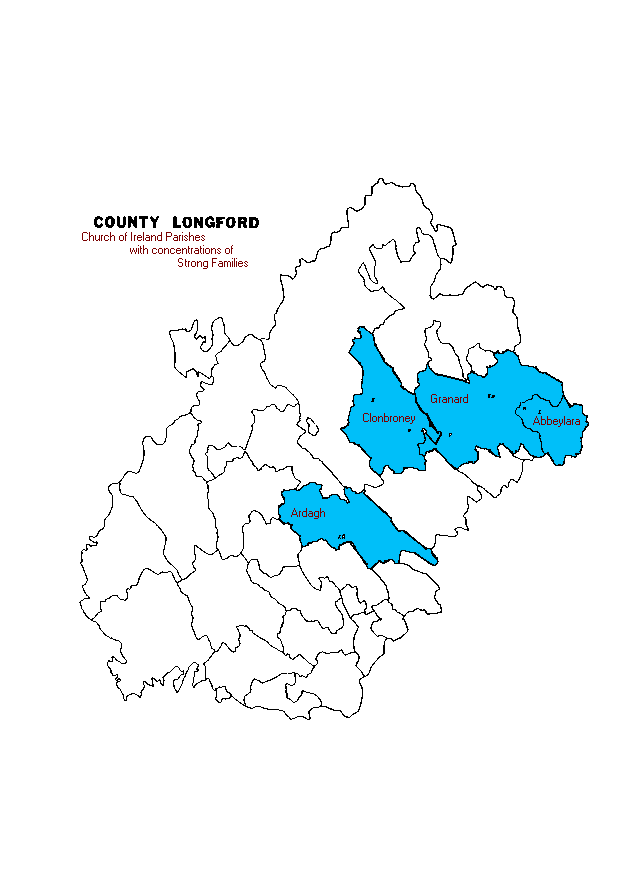
Maps in Chapters X and XIII. In some cases, designations of Cities,
Towns, and Liberties have been given instead of Baronys: |
ULSTER:
|
|
The above summary is based on the following discussion
concerning the governmental entities involved and the various
records available with reference to Ireland, particularily as
researched for the surnames L'Estrange, Strange, Strang,
Strong, and Stronge. Some explanations of the significance
of the records is related, and suggestions made for further
research. Reports of research in original records with reference
to LDS films where copies may be found are related
below. Appendix II sets forth a listing of all LDS micro-
films examined by the authors. |
|
Provinces: Ireland is divided into four provinces:
Ulster in the north, Connaught in the west, Leinster in the
east, and Munster in the south. The names are derived from
four of the five ancient kingdoms of Ireland: Uladh,
Laighean, Connaught, and Mumha. The fifth kingdom, Meath,
became merged in the province of Leinster. Other ancient
kingdoms such as Aileach and Oriel had become integrated with
Ulster by the 17th century. 1 Ulster is divided into nine
counties, three of which are in the Irish Republic (Monaghan,
Cavan, and Donegal) and six in Northern Ireland (Antrim,
Armagh, Down, Fermanagh, Londonderry, and Tyrone). |
|
Placenames: Many Irish placenames are English or
Scottish in origin. Others are Gaelic Irish in origin. The
Gaelic names are geographically descriptive and reveal much
about the area in which they are located. Table 1 sets out
some common elements in these Irish placenames. 2 |
|
Townlands: The Townlands were a unit of land which from
early times formed the building blocks for larger territorial
divisions such as the parish, barony, county, city and town.
In size the townlands vary considerably, on the average
containing about 350 acres. These were from early times family
holdings, being farms in the rural areas, and were mostly under
lease from large estates for periods of time varying from
"in perpetuity or 900 years", "61 years or three lifetimes,
whichever lasted longest", 21 years, or for shorter periods
as specified in the indenture between landlord and tenant.
The townlands were often divided between several tenants. 3 |
|
The names of the townlands, after their Anglicization
from the Gaelic, and the adoption of uniform spelling during
the "Down Survey, 1655-1659", have remained much the same.
See Meanings of Irish Placenames for some interpretations.
See also:
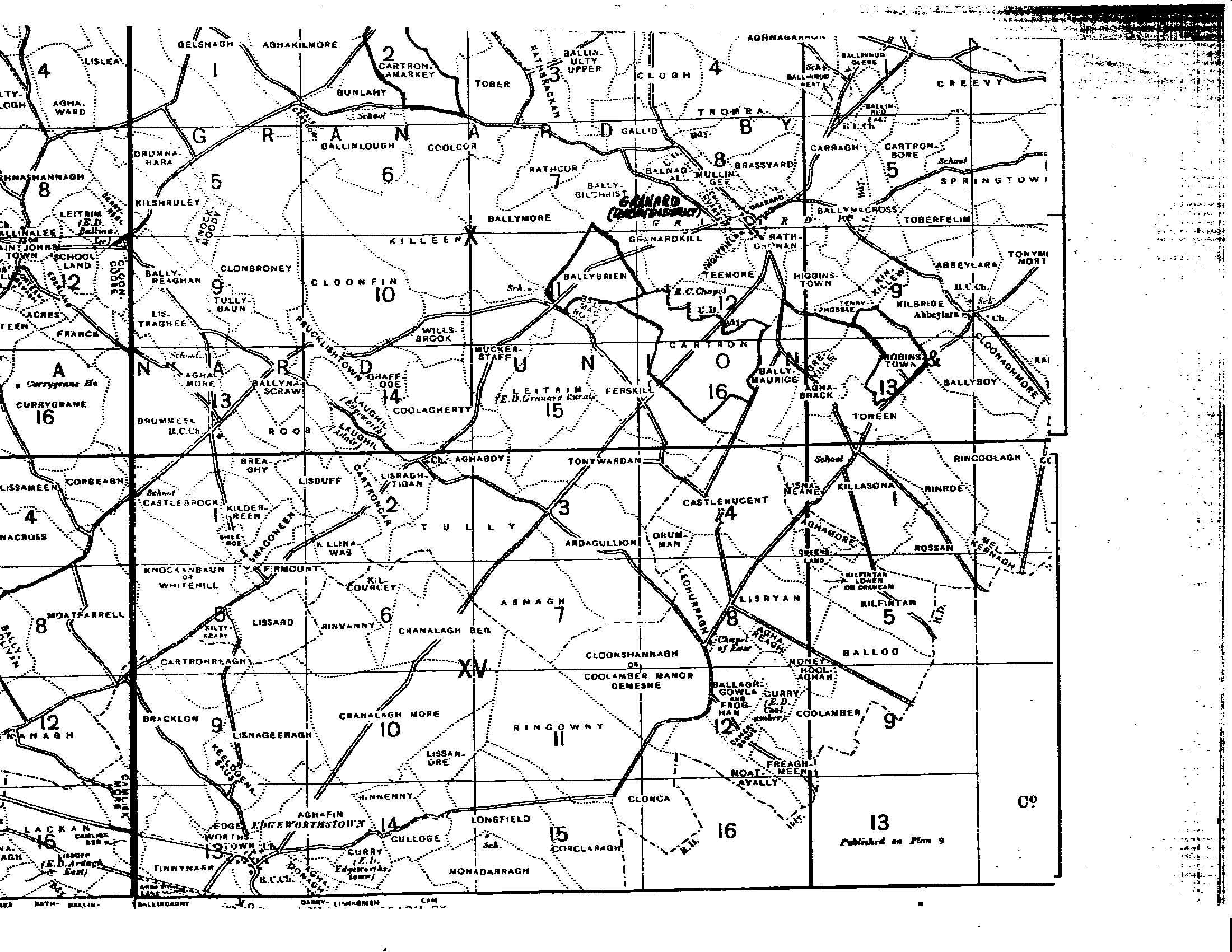
The "Census of Northern Ireland, 1926" shows 9521 townlands
in the six northern counties. In the south, there are about
54500 townlands. 4 Maps of the various townlands within the
parishes with concentrations of Strongs will appear in
Chapters X and XIII. |
|
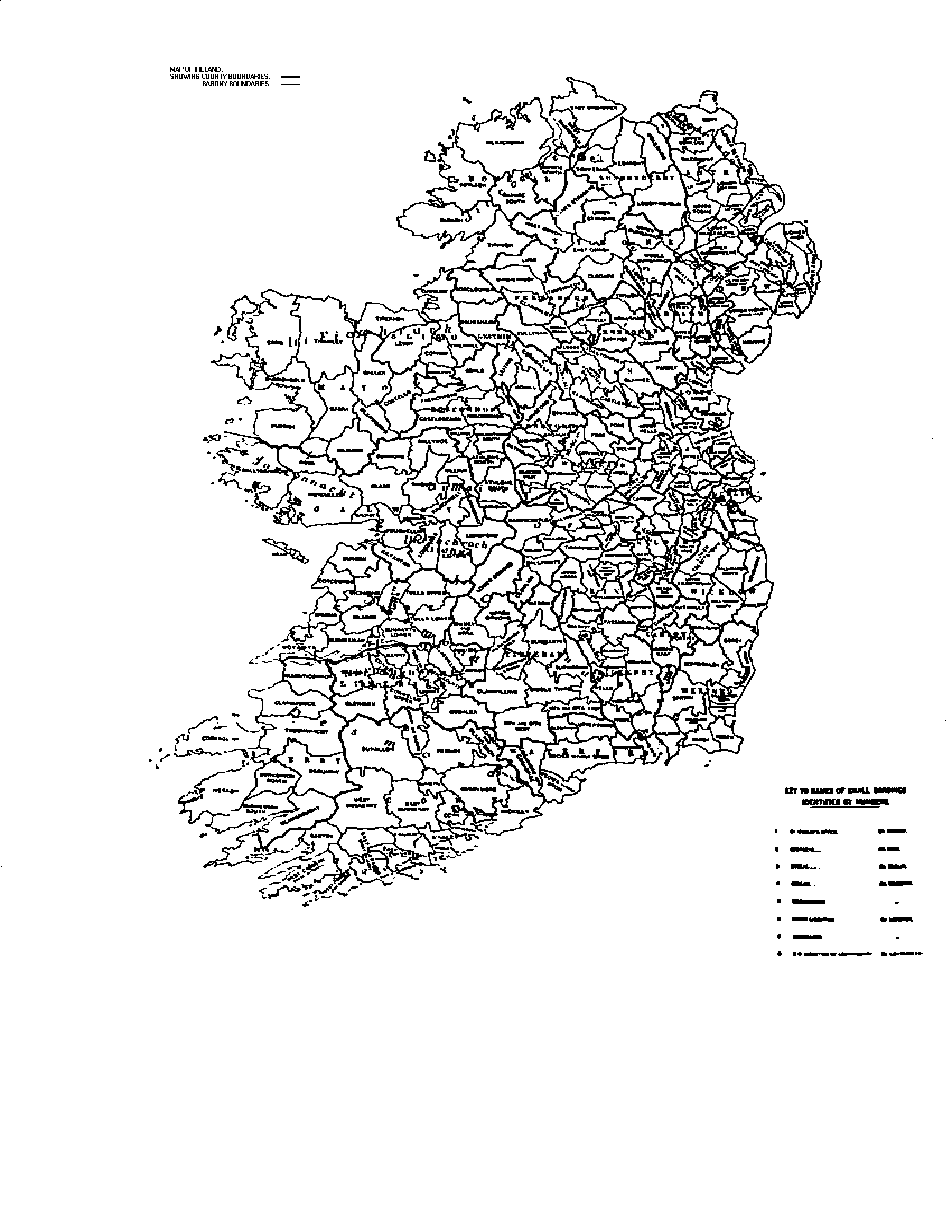
Baronies: The earlier model of civil administration
was the "barony", of which there are 325. The barony is a
division of great antiquity based on the great old
Gaelic family holdings. 5 When the Gaels were dispossessed,
the lands of the baronies often were redistributed as a unit
to new English or Scottish planters. The baronies are of
little import today 6; however, they define in many instances
the location or boundaries of estates, and are used with reference
to parishes as a locational reference in many sources.
To view a Map of the Baronies of Ireland, click here:
Irish Baronies Map.7 |
|
The baronies were the basic territorial unit in the
plantation plan of 1610. Groups of owners with a common
background were settled in a more or less uniform way
throughout the confiscated counties of Ulster. There were
three different categories of grantees, English and Lowland
Scots undertakers (civilian groups, so called because of the
conditions they undertook to fulfill), servitors (military
officers and government officials who had been employed in
Ireland), and Irish from the confiscated counties who were
restored to some of the land. 8 |
|
The servitors (whose title harkens back to the feudal
knight who held his land by "knight-service"), who were allowed
to have Irish tenants, were placed in the same baronies
as the Irish grantees, it being considered that their
military experience could be of value in such a juxtaposition.
An attempt was made to allocate the land across the
five counties of Donegal, Tyrone, Fermanagh, Armagh, and
Cavan, on an equal proportionate basis to English and Scottish
undertakers. Thus, one barony might be composed of English
landowners, while an adjacent barony might be composed
of Scots landowners. 9 The landlords usually recruited Protestant
tenants for their new Irish lands from the localities
surrounding their existing estates in England and Scotland.
Many of the new tenants in Ireland were the sons, daughters,
nephews, neices and cousins of existing tenants in Scotland
and England. |
|
However, while it is helpful to do so, it is too easy to
assume that one only need look to the national background of
the landlords in the particular baronies to determine the
origin of their tenants. The tenants moved, in later years,
from one area to another...and some came from Co. Derry,
where the London companies had total sway in the colonization
scheme. Not only did the tenants move, but the landlords
changed, with deaths, wars, marriages, purchases and sales,
and the like. Additionally, within each county much smaller
areas of land were designated for the support of corporate
towns and schools. Trinity College, Dublin, received an
extensive endowment in Donegal, Armagh, and Fermanagh.
Further, land was allocated from each estate to provide "glebe"
holdings for the support of each parish church, as well as
for various forts. Thus, a barony (or a precinct) allocated
at the time of the plantation to a particular category of
grantees might later also accommodate many of the other types
of landowners as well. 10 |
|
Counties: The counties are a result of the "shiring" of
Ireland, effected by the English as an aid to the civil administration
of the entire island on the English model. 11
The division of Ireland into counties began in 1210 when King
John of England constituted twelve of the present-day
counties--Dublin, Kildare, Meath, later divided into east and
west, Louth, Carlow, Kilkenny, Wexford, Waterford, Cork,
Kerry, Limerick and Tipperary. During the reign of Queen
Mary, King's and Queen's counties were constituted, and the
following were established under Queen Elizabeth I: Longford,
Clare, Galway, Sligo, Mayo, Roscommon, Leitrim, Armagh,
Monaghan, Tyrone, Derry, Donegal, Fermanagh and Cavan. The
origin of Antrim and Down as counties seems uncertain, and
the last county to be formed was Wicklow which was divided
from Dublin in 1605. Many counties have towns of the same
name, e.g., Dublin, Limerick, Cork, Donegal, etc. 12 |
|
Dioceses: There are 28 dioceses or ecclesiastical divisions
in all of Ireland, dating from early Roman Catholic jurisdiction.
When the Established Church of Ireland became
the State church in the time of Henry VIII, a Protestant was
appointed by the Crown to fill the seat of the Archbishop of
Armagh, Primate of all Ireland. Protestant bishops were also
appointed by the Crown, each holding ecclesiastical jurisdiction
over a diocese and the parishes within the area. The
boundaries of the dioceses have little or no relation to
those of the counties. Each diocese embraces parts of from
one to six counties and, conversely, each county falls into
from one to several dioceses. The area of the county in
which a person lived determined which diocese exercised
ecclesiastical jurisdiction over his parish record, probate
matters and so on. 13 Discussion of certain records maintained
by each diocese follows. 14 |
|
Beginning early in the 17th century, each Diocesan
Bishop was required to make a "Visitation" of all of the Parishes
in his diocese and to report their physical condition,
the identity and competency of the incumbent priest or curate,
and the financial provisions made for their support to
the Archbishop of Armagh. These visitations often give
considerable insight into the nature and extent of the "Plantation"
in the area, sometimes naming individual landlords
and estates, information having a bearing on genealogical
matters. |
|
Before 1858, all wills, regardless of denominational affiliation
of the decedent, had to be proved in the Diocesan
Courts of the Church of Ireland. The wills were destroyed in
the Four Courts Fire, but the indexes survived. Where a person
had property in more than one diocese, his will was
proved in the Prerogative Courts of the Church. Abstracts of
all wills so proved between 1536 and 1810 are contained in
the Betham Papers. A copy of the printed Index to the Prerogative
Wills of Ireland 1536-1810 is available in the
PRO-Erie at Dublin. Wills and other probate records have
also been found in family and estate papers, and in lawyer's
records. A separate index to these is available and is kept
up to date. |
|
Marriage Bonds were required to guarantee there was no
just impediment to a marriage by license. These were all
destroyed in the fire. However, indexes covering certain relevant
periods exist in the PRO-Erie at Dublin. |
|
Religious Censuses took place in 1766, when the local
rector of the Church of Ireland was instructed to list heads
of households as either Protestant or Catholic. The
originals were nearly all lost in the 1922 fire. Some transcripts
and extracts exist in the PRO-Erie. These refer to
the dioceses of Armagh (39 Parishes), Clogher (8 Parishes),
Connor (4 Parishes), Derry (10 Parishes), Kilmore (7 Parishes),
and Raphoe (3 Parishes). These have been microfilmed
by the LDS Church. Review of LDS Film number 1279356
revealed no Strongs in these censuses. |
The various Counties are set out following, with portions
of dioceses included within each: 15
|
|
Parishes: Each Diocese included numerous parishes.
While the parish was in early times a purely ecclesiastical
subdivision of the diocese, it became also an area for civil
or government purposes. 16 As used in the 19th century, civil
parishes were often smaller in area, and differed in names
from the ecclesiastical parishes. There are about 2500
ecclesiastical parishes in all of Ireland, and there are often
several, either in part or wholly, within the various
baronies. The definitive reference work for identifying parish records in the Northern part of Ireland is a publication entitled 'An Irish Genealogical Source - Guide to Church Records' published by the Public Records Office for Northern Ireland' (PRONI). This is a 279 page hard cover book (pages are UK A4 size i.e., 210 mm X 297 mm or around 8 inches X 11.5 inches) which details all the existing parish records for Northern Ireland (i.e. the 'six counties') and many of the records for the other Northern counties which are in the Republic of Ireland, including Co Donegal. There are on average 10 entries per page so it contains in total about 2,700 - 3,000 entries.
The Church of Ireland Directory is useful in
determining in which Diocese a Parish lies. Griffith's Valuation
is useful in locating parishes within the various Poor
Law Unions and Baronies. It is also helpful in locating
townlands within parishes and baronies. Another cross-reference
is the 1871 Irish Census Townland Index and
Cross-Reference. See LDS Film number 476999. |
|
Poor Law Unions: These units were established by the
Poor Relief Act of 1838. They were multiples of townlands,
usually with a large market town as a center, within a radius
of about ten miles. Some are situated wholly within one
county. Others extend into two or three counties. The local
rate-payers were made financially responsible for the care of
all the poor or starving people in the area. 17 |
|
In the years of the great potato famines the numbers of
people involved were considerable. It was the pressure from
local people unwilling to bear the expense which led to mass
emigration. It has been stated that, "Paupers and their
families would often have their passages overseas paid by local
subscription, on the cold-blooded calculation that this
would be cheaper than supporting them indefinitely by local
taxes." 18 |
|
Passenger Lists for ships leaving Ireland in the period
often list individuals as being only a "farmer" or
"labourer". It was necessary for many individuals to claim a
lowly occupation in order to qualify for "free" passage under
the requirements of the Poor Law. 19 One authority asserts
that another reason for the frequency of the listing of farmers
and labourers was that there was a ban in force at the
time against the emigration of skilled labour which was
desperately needed to power Britain's industrial revolution. 20 |
|
Given an understanding of the governmental entities involved,
and given some degree of geographical focus, we have
undertaken a study of the various additional sources available
in an attempt to gain sufficient detail in order to develop
some answers to the questions "Who were the Strongs of
Ireland?"; "What were these Strongs...eg., socially, economically,
religiously, politically?"; "Where were these
Strongs from?"; "Why were these Strongs here, and why did
they leave?"; "When and where and how did they go?" |
|
Excellent outlines of the records available at each of
the PROs and at the other research facilities in both Erie
and Northern Ireland appear in Angus Baxter's book "In Search
of Your British and Irish Roots" 21, and in Margaret Dickson
Falley's two volume text, "Irish and Scotch-Irish Ancestral
Research". 22 We will attempt to discuss some of them below. |
| Births, Marriages, Deaths Index: Compulsory state registration of all non-Catholic marriages only
began in Ireland on 1 April 1845. All births, all deaths and all marriages
including those conducted by Catholic clergy have been registered in Ireland
since 1 January 1864. Joyce House (the Registrar's Office) in Dublin has
microfilm copies of all registers of births, deaths and marriages from the
beginning of registration to the present day. They also have master indexes
for all three categories.
We are fortunate in that Philip B. Strong of Belfast, Northern Ireland, has combed
the Indexes to compile an index of all birth, marriage and death events involving
Strongs. Philip's index lists 'Strong' marriages
registrations from 1st April 1845 to 31st December 1958 for that
part of the island of Ireland which currently constitutes the
Republic of Ireland and from 1st April 1845 to 1922 for Northern
Ireland. His extracts from the births and deaths indexes list 'Strong' birth
and death registrations from 1st January 1864 to 31st December
1958 for that part of the island of Ireland which currently
constitutes the Republic of Ireland and from 1st January 1864 to
1922 for Northern Ireland. The compulsory registration of births
and deaths commenced on 1st January 1864.
For a wide variety of reasons not all births, deaths and marriages were registered, and this is especially true during the earlier years following the introduction of this requirement. See Births, Marriages, Deaths Index, compiled by Philip B. Strong. |
|
"Griffith's Valuation of 1854" evaluates the land by
townlands and gives the names of occupiers and immediate lessors
of lands and buildings, grouping them under Poor Law
Unions and Counties. For families emigrating after 1854 this
survey is useful in tracing tenants. Also, given the name of
a parish or townland of origin for a emigrant from earlier
years, one can examine Griffith's Valuation for names of
persons with related surnames where known, identity of landlords
whose estate records may contain further genealogically
significant records, and determine other townlands or
localities with in the same parish or poor law union. |
|
The Registry of Deeds, Henrietta Street, Dublin has
practically all the land records of all Ireland, with many
dating back to 1708. The deeds cover such subjects as
leases, business transactions, land transfers, marriage contracts,
and wills, indexed both under surnames and under
placenames. 23 All of the Grantor's Indexes for the names
STRANG, STRANGE, STRONG, and STRANGE have been transcribed
into the IRISH STRONG DATA BASE, for all years from
1708 to 1809, and 1833-1849. Additional data for the period
1810-1832 gleaned from searches of the records by other
researchers have been added into the IRISH STRONG DATA BASE,, but it is
not known whether the data is complete for those years. |
|
Review of "A Census of Ireland, ~1659", edited by Seamus
Pender, shows no Strongs in Counties Donegal, Fermanagh, and
Tyrone. A reprint edition of this 1939 text, consisting
of pp. xxxxv + 946 pages, which has been long out of
print, with a new introduction by Prof. William G. Smyth, under
ISBN 1-874280-150 (April 1998), is available from the Irish
Manuscript Commission, 73 Merrion Square, Dublin 2, Ireland,
attn: Margaret Clancy.... price L50. Irish plus L10 p & p.
Edward MacLysaght has asserted that the name Strong was of little note in Ireland prior to 1660.**** This seems borne out by examination of the records. It seems most Strong records begin to occur subsequent to that date. However, there are Strong records prior to that date in Kilkenny (Ossory), and indeed the records which do occur come from widely varying locations, indicating independant origins for the lineages. |
|
There are several books which give useful descriptive
accounts of the great estates. They include the following,
available in The National Library of Ireland, Kildare Street,
Dublin: |
| William Corrigan, "Antiquities of the Diocese of Ossory". |
|
Rev. George Hill, "An Historical Account of the Plantation
of Ulster, 1608-1620", Belfast, 1877: Shows how the
lands were laid out for Plantation purposes; the Grants and
Grantees are given including personal names and property by
county, precinct or barony; history and plan of the
"Londoner's Plantation" is given by barony; Pynnar's Survey
of the six escheated counties of Ulster after the settlement
with names of landlords, some tenants, and a description of
the estates. 24 |
|
John Patrick Prendergast, "The Cromwellian Settlement of
Ireland", Dublin (1875): Contains a list of the 1360 Adventurers
for land in Ireland, giving the names, occupations or
English places of residence, and money subscribed by each in
1642-1646. For an important reproduction of a portion of this
book, see Names of the Cromwellian Adventurers for Land in Ireland.
Note, Prendergast includes the names Strange, Fflolliot
Clutterbuck, Elliott, and Dacres in this listing. Each of these
names has significance in the research of the Strong lineages in
Ireland and England. See also by Prendergast, "Ireland from the restoration to the revolution, 1660-1690", London (1897). The latter book is on microfilm at the Library of Congress, Washington, D.C., call number Microfilm 48565 DA. |
|
Robert Pentland Mahaffy, "The Calendar of the State Papers
relating to Ireland preserved in the Public Record Office, London,
Adventureres for Land 1642-1659", London
(1903): A gold mine of genealogical information for English
families who subscribed money for the support of Parliament
in 1642, 1643, 1646. |
|
Robert Dunlop, "Ireland Under the Commonwealth",
Manchester (1913): lists the names of the various officers of
the regiments and companies who drew lots for the allocation
of lands in Ireland when Cromwell's New Model Army recieved
settlements of their arrearages following the Civil War,
~1649. |
|
Consultation of sources indicating the nature and extent
of the lands and estates of the nobility and gentry is most
important, as clues will be garnered which will assist the
researcher in finding and interpreting records of genealogical
value. Referencing the "Immediate Lessors" found in
Griffith's Valuations often reveals the identity of the Landlord
holding the great estate which included the particular
townland in question. |
|
It should be recognized that since there are no coherent
vital statistics records, it is necessary to examine the extant
records based on some self-imposed order. We have chosen
to do so chronologically within each county where Strongs
have been found. Not all records are available for all
years, nor for all counties. The chronology will commence
with the earliest known records approximating a census, and
move forward in time. The ensuing discussion will emphasize
research which has been conducted to develop the data we have
compiled on the Genealogy and History of Strongs in these
Parishes. The research sources will be discussed chronologically
within each County. |
|
Parish Records Per Email dated December 20, 1999, Philip B. Strong that 'An Irish Genealogical Source - Guide to Church Records' (published by the Northern Ireland Department of the Environment and the Public Records Office for Northern Ireland (PRONI) 1994, ISBN 0-901905-59-3, 279 pages); is the definitive source for information on what parish records are available. See below for extracts from that publication relative to Drumhome Parish, Co. Donegal, and for Templecarn Parish, Co. Fermanagh |
|
Hearth Money Rolls. In 1662, the British government
decided to extract two shillings for each fire hearth except
for people living on alms or in houses not worth more than
eight shillings per year, or having goods, land or cattle of
a capital value of four pounds sterling. Unfairly, it compelled
the labourer and farmer to pay the same amount per
hearth as the richest landowner. The Hearth Money Rolls contain
the name of every person in the county who was not exempt,
the number of firehearths, the name of the townland,
and sometimes the parish in which the hearth was located.
The tax was collected over large areas known as "walks" and
based on a town; thus the "Lisburn Walk" covered the town of
Lisburn and also a large part of south County Antrim. |
|
It is not known how many years the Rolls were compiled.
The Tithe Applotment Act of 1823 replaced the tax. The only
surviving Hearth Money Rolls are from the mid 1660's. The
originals were destroyed in the Four Courts Fire in 1922;
however copies of 16 of the rolls had been made by then.
They represent an incomplete census of the heads of households
in the fifteen counties for which the copies exist. |
|
There are complete copies of the Hearth Money Rolls
and/or Subsidy Rolls for the following counties, to be found
in the LDS micro-film rolls or other references indicated.
"Tracing The Past", by William Nolan, Dublin, 1982, pp.58-59,
lists existing copies and locations. See also "Irish Genealogy:
A Record Finder", by Heraldic Artists, Ltd., Dublin,
1981, pp.53, and, by counties, pp.63-74: 25
Apart from some of the Northern Counties practically no other Hearth Money
Roll records have survived.
|
County LDS Film # Strongs found?
|
|
Surname Index to the Linen Industry, 1796: Sometimes referred to
as the Spinning Wheel List, this document lists by Surname and Townland only, those
individuals who were entitled to a Premium for production of linen from flax. See
Generally, LDS micro-film # 1419442. See also LDS micro-film # 1279238. |
|
The Householder's Index. We will next identify sources
for the data contained in the Householder's Index, which was
compiled by the LDS Church. |
|
1823-1837 Tithe Applotment Records: The Tithe was a
tax on agricultural land which was paid by occupiers of all
religious denominations to the Church of Ireland. In 1823,
it was replaced by a cash payment by landowners. The amount
due was based on a special survey. The records, arranged by
civil parish and townland, are in the "Tithe Applotment
Books". These records give the name of the landholders and
the acreage of the land owners in 242 of the 273 parishes
surveyed in Northern Ireland between 1823 and 1837. |
|
The Tithe Applotment Books compiled between 1823 and
1838 provided the first comprehensive enumeration of Ireland
since the Hearth Money Rolls of the 1660s. The two thousand
hand written volumes, arranged alphabetically by parish and
within each parish by townland, are a very useful and important
source of genealogical information; however, they are
incomplete. 26. |
|
The information generally contained in the Tithe
Applotment Books includes name of civil parish, arranged
alphabetically regardless of county, barony or union; date of
the survey; name of the townland; rough, but detailed maps,
in a relatively few cases; full name of the occupiers; number
of acres, roods and perch occupied (Irish measure: 1 Irish
acre equals 1.6 English acres); quality of the land in three
grades; value per acre within each grade; yearly amount of
tithe assessed; and a column for observations made by the assessors.
Only the occupier is listed, and not other adults
in the household; although the numbers of adults and children
is shown. The Tithe Applotment Books do not list labourers,
weavers, cottiers, purely urban dwellers, or any person not
holding land. Thus, a relatively small portion of the actual
adult inhabitants in Ireland are captured in the books. 27. |
|
The Householder's Index (HHI) compiled by the LDS church
is incomplete, and contains inaccuracies. Irish Research
Group members of the Ottawa Branch, Ontario Genealogical Society,
have found some names in the Tithe Applotment Books
not listed in the HHI. This is apparently always true when
two or more people, often of different surnames are listed as
occupiers. The LDS film crews apparently missed microfilming
the Parish of Dromore in County Down, although the book is
available for reference in the PRO Belfast. In cases where a
parish was created after the tithe system was abolished, data
for the parish will be found within the book for the
parish(es) from which it was created. In other cases, the
parish was united to another parish in the Tithe Applotment
Books, or is just missing. In still other cases, the parish
may have been "extra-parochial", ie, the land formerly belonged
to a monastery (these parishes often begin with the
name "Grange"). The land within these parishes was either
not liable for the payment of tithes, or the tihes were payable
by a lay impropriator. Sometimes, name changes or
spelling changes have occurred, making it extremely difficult
to identify a parish listed in the HHI. 28. |
County LDS Film # Strongs Found?
|
|
Summary: Now, having reference to the counties where Strongs have
been shown to exist in concentrations in the existing
records, the following summary and additional data has been
developed: |
|
Antrim: Per email dated 15 Dec 1999 from Philip B. Strong: "The 'Index to the 1669 County Antrim, the 1663 County Londonderry and the 1664 County Tyrone Hearth Money Rolls (PRONI reference T.370A) contain the following references to the name 'Strong': "T.370A; page 58; 1669 Hearth Money Rolls ('HM Rolls') for Dunluce Barony, Co. Antrim lists Ballymoney parish and town and a Cutbert Strong; "T.370A; page 94; 1669 HM Rolls for Mazareen Barony, Co.Antrim lists Ballynedrentock (Ballynadrentagh) and a John Strong; and "T370A; page 100; 1669 HM Rolls for Mazareen Barony, Co.Antrim lists Ballyvolane (part of Crumlin) and a Thomas Strong." Armagh: 1630 Muster Rolls of men and arms of the various plantations in Counties Armagh. There are very complete musters for plantations in Armagh, which list no Strongs. See LDS Film 1279356, researched by David B. Strong, and see: Per Email dated 15 Dec 1999 received from Philip B. Strong: " Around the same time (between 29th - 31st December 1993), I searched the '1631 Muster Rolls' (PRONI reference T.934). A thorough search of the 'Muster Rolls' for counties Cavan, Armagh, Fermanagh and Tyrone did not reveal the inclusion of the name 'Strong' in these records. This is a very large and detailed set of records containing many thousands of names, almost all of which are of English/Scottish origin as one would expect. In my view it is highly improbable that any able bodied male 'Strong' living at that time in those counties would have been excluded from the list. Hence, one may assume that there was no able bodied male person of that name living in those counties at that time. For my part, the absence of the name 'Strong' from Co. Cavan at that time is particularly significant as it lends weight to the view that this name may have appeared there at a later date than it did in Co.Donegal. As you already know I have a theory that my line and probably the Co.cavan line came later with The Lord Protector of the Commonwealth of England, Oliver Cromwell." Per email dated 15 Dec 1999 from Philip B. Strong: "The 'Index to the 1664 Hearth Money Rolls for County Armagh' do not list any 'Strongs'. The Stronges who subsequently settled at Tynan Abbey had not moved from Co Londonderry and Co.Tyrone by that date." Cavan: 1630 Muster Rolls of men and arms of the various plantations in County Cavan. The musters for Cavan are summaries only of the numbers of men and arms, and are of no assistance. See LDS Film 1279356, researched by David B. Strong, and see: Per Email dated 15 Dec 1999 received from Philip B. Strong: " Around the same time (between 29th - 31st December 1993), I searched the '1631 Muster Rolls' (PRONI reference T.934). A thorough search of the 'Muster Rolls' for counties Cavan, Armagh, Fermanagh and Tyrone did not reveal the inclusion of the name 'Strong' in these records. This is a very large and detailed set of records containing many thousands of names, almost all of which are of English/Scottish origin as one would expect. In my view it is highly improbable that any able bodied male 'Strong' living at that time in those counties would have been excluded from the list. Hence, one may assume that there was no able bodied male person of that name living in those counties at that time. For my part, the absence of the name 'Strong' from Co. Cavan at that time is particularly significant as it lends weight to the view that this name may have appeared there at a later date than it did in Co.Donegal. As you already know I have a theory that my line and probably the Co.cavan line came later with The Lord Protector of the Commonwealth of England, Oliver Cromwell." "...Kings book entitled 'The State of the Protestants of Ireland Under the late King James's Goverment' printed at the beginning of the 18th Century (the edition (Philip B. Strong) consulted was printed in 1713) lists, by county, a huge number of people who were attainted by King James during the period of the 'Glorious Revolution' (1689 - 1690). It includes the following 'Strongs'; Co.Cavan - "...............John Strong of Tanlagh Yeoman, James Strong of same Yeoman.................." 1708 Index to Officers in the Cavan County Militia: No Strongs. LDS Film 1279356, part 24. 1821 Census: Numerous Strongs in County Cavan, various townlands. See LDS Film number 014454.
Donegal:
"Church of Ireland (Raphoe diocese) [NOTE: all of the above records are held by PRONI, some are on microfilm reference MIC.1/148; and the rest are originals/copies of originals reference T.607/2]
Vestry minutes, 1783 - ; census, 1831 - all in local custody
Church of Ireland Laghey (Raphoe diocese)
Church of Ireland, Rossnowlagh (Raphoe diocese):
Baptisms, 1879-1972;
Methodist, Ballintra
Methodist, Ballyshannon Circuit:
[Part of Drumhome parish is in Ballyshannon Circuit - see under KILBARRON]
Presbyterian, 1st Donegal
[After 1885 1st & 2nd Donegal united - see also under KILLYMARD]
Roman Catholic, Drumholm (Ballintra) (Raphoe diocese)
Baptisms and marriages, 1866-81. Where Philip B. Strong inserted [NOTE:.........] in the above reference, it relates to his notes; they do not appear in the above publication. The above publication just gives the microfilm/document reference. End of extract for Drumholm, Co Donegal I now turn to the Methodist records for the Ballyshannon Methodist circuit which are listed under KILLYMARD (see above reference to Methodist, Ballyshannon Circuit under Drumholm, Co Donegal).
Extract from the publication referred to above.
Sir Basil Brookborough, a former Prime Minister in the original Northern
Ireland Parliament, was a direct descendant of Henry Brooke.
Down:
"In the eighteenth century the qualification for entitlement to vote at elections in counties in Ireland was the same as in England, e.g., the forty shilling freehold. This meant property worth fifty (sic... may be a misprint?!) shillings a year above the rent and either owned outright or leased on certain terms. Leases for lives lasting during the lives of named individuals, qualified as freeholds for voting purposes and these were the most common form of tenure for Protestant tenants.... No Catholics could vote at elections between 1728 and 1793... to ensure this regulation was strictly enforced from 1728 onwards voters in Ireland had to conform to an increasingly strict system of registration. "
Very Significantly, NO Strongs, Stranges, LeStranges, etc., are to be
found in this very complete index, which appears to cover every
Freeholder, giving name, residence, Parish, and initial date of registration
to vote. This finding should be compared with the following entry re
the 1788 Elector's Poll, where certain Strongs are found.
Query... were they there in 1747-1768, but engaged in less
than 40 shilling freeholds, or more likely, did they not take up their
freeholds until after 1768?!
Londonderry:
|
|
1980 and 1989 Telephone Directories for Ireland and
Northern Ireland have been used to help identify several locations
in the IRELAND computer base. As most residents of
Ireland seem seldom to move, and many families have occupied
the same lands for generations, it is likely present day
resident Strongs are descended from Strongs of earlier years.
This may be helpful in further tracing family relationships
in the past and present. |
| As to sheer number of records of Strongs by county in the IRISH STRONG DATA BASE,, the charts in Tables 2, 3, 4, and 5 give another indication of concentrations of Strongs over the period 1600 to the present. The Maps in Appendix ..... identify within each county the location of the Baronies and Parishes wherein Strongs have been found. In the next chapter we will use the information gleaned from the records discussed above in an attempt to develop a rational explanation of the answer posed above...the who, what, where, when, why of the Scots- and Anglo-Irish Strongs. |
|
Table 2 Insert
Chart Insert Chart Insert Chart Insert
|
|
Footnotes:
1 Hibernian Research Company, Ltd., Association of Irish Professional
Genealogists, Windsor House, 22 Windsor Road, Rathmines, Dublin 6. |
Go to Table of Contents
Go to the Strong Genealogy Network Home Page; while you are there, find other web addresses for members of the Strong Genealogy Network!
Go to the Strong Quest - including the STRONG-List Home Page,
While you are there, be sure to consider subscribing to the Rootsweb Email STRONG List!
See also the Strong Genealogical Forum, and the Strong Biographical and Anecdotal Website
To review some of the discussion on the Strong-List in the past, Go to the Strong List Archives. or go to the Rootsweb Archives.
Help add to our Strong(e)-Strang(e) Roots Database