CHAPTER VI: IRISH ESTATES & SOCIETY (1600-1885)

NOTICE:   The contents of this WEB SITE are subject to  Copyright
1997-1999 by David B. Strong. by David B. Strong.  All rights are reserved,  in-
cluding  the   right to reproduce the  contents  or  portions
thereof, in  any form.   Permission is hereby granted to copy
for  personal use only limited parts of the written  material
and of the attached data files contained herein as text mate-
rial.   This material may not be copied except  for  personal
use;   and  it  may  not  be  duplicated  and  sold,   either
separately, or as part of a compilation, either in print,  on
digitalized media such as Compact Disks,  or  electronically,
without  the  express written consent of  the  author.   This
copyright  applies to all parts of this site as published  on
the Internet.
CHAPTER VI | |||
IRISH ESTATES & SOCIETY (1600-1885) | N: (October, 1997) | ||
R: (Monday, January 18, 1999 - 7:23:34 PM) |
Background: During the seventeenth and eighteenth centuries the British Crown undertook vigorously to put down the Irish, through rigorous enforcements of a series of enactments called the Penal Codes, which deprived Irish Catholics of the right to vote, serve on a jury, teach school, carry a gun, enter the army, enter a university, work for the government, or even to own a horse valued at over 5 guineas. Irish Catholics had to speak English, and had to pay tithes to support the state church, the Church of Ireland. When a Catholic died, his land had to be divided among all his sons unless the eldest became a Protestant, in which case he inherited it all. The Catholic church was suppressed, and it was illegal for it's priests to carry out their offices; they were subject to ar- rest and deportation. 1
By 1700, there were few Catholic landlords anywhere in Ireland. The Penal Codes enacted by the Irish Parliament in 1704 pressured landowning Catholics and Presbyterians with political ambition to conform to the sacramental tests of the Established Church of Ireland. 2 With protestant control of the land as well as an effective administrative system in place, the "Protestant Ascendancy" was established. Its mem- bers were primarily English and included descendants of those who had settled during the Tudor and Stuart periods, and Cromwellians as well as Old English Anglo-Normans. Dominated politically and socially by the landed class, but extending through all ranks, it became the most powerful political force in Ireland. Property meant power, and with nearly all of the land in the possession of the Protestants, this is where the political power lay. 3
One of the enactments which fostered the control as- serted by the Protestant Ascendancy was "Poyning's Law", adopted in 1494 by the Parliament of Drogheda, which subordi- nated the Irish Parliament to that of England. Any legisla- tion adopted by the Irish Parliament had to be consented to by the English Parliament before it could become law. The Irish legislature was totally subservient to the interests of the landowning class, who also controlled the English Parlia- ment at the time. 4
It is not correct to assume the Irish Parliament was the puppet of the English crown merely because the Protestant Ascendancy was dominated by English interests. On the con- trary, the political power wielded by the Protestants in Ire- land in the eighteenth century was often nationalistic in na- ture, resentful of England's political and trade restrictions. While they did not forget their English heritage nor their need for English military support, the Protestants of Ireland came to think of themselves as Irish people. Their sense of nationalism was based upon the Prot- estant Ascendancy and celebrated by the Battle of the Boyne. 5
Irish commerce and industries were deliberately crushed by the English, both as a deliberate effort to put down the Irish, and also in furtherance of the general English eco- nomic policy of mercantilism, which held that England's colonies existed solely to advance the wealth of England. Any commerce in competition with English commerce was out- lawed. By enactments in 1665 and 1680 the Irish export trade to England in cattle, milk, butter, and cheese was forbidden. The trade in woolens, which had grown up among the Irish Protestants, was likewise crushed by an enactment of 1699, which prohibited the export of woolen goods from Ireland to any country whatever. The linen trade was left untouched, however. 6 As a consequence, raising flax became a major ag- ricultural pursuit, and people often worked in nearby flax mills. The famous Irish Linens were developed as a result of this phenomenon.
According to Margaret Dickson Falley, "A significant outcome of all the confiscations, plantations and settlements of the lands of Ireland between 1540 and 1703 was the sur- vival of some great mediaeval and later plantation estates in the possession of the old aristocracy. The final settlement of 1703 also preserved or established some hundreds of new estates, whose owners soon profited with every opportunity for further accumulations of land offered by marriage, inher- itance and purchase." 7
Arthur Chichester, Baron Chichester of Belfast, Marquis of Donegal: As has been seen, the foundation of the estates of Ire- land in 1700 was molded by all the events of the preceding 100 years and more. One of the foremost estates was that of the descendants of the man who had commenced the plantations of Ulster in 1607. Arthur Chichester was the second son of Sir John Chichester of Raleigh, Devonshire, England. After various adventures in service of Queen Elizabeth, he was ap- pointed Lord-Deputy of Ireland, October 15,1604. It was Chichester who proclaimed the abolishment of the semi-feudal rights of the native Irish chieftains, and he who carried out the plantation of Ulster after the Flight of the Earls. In 1613 he was made Baron Chichester of Belfast. 8 His descen- dants included the Marquis' of Donegal. 9 They held lands throughout Ulster, particularly in Antrim, through the 18th century and beyond. 10
The following discussion is from an article by David Dickson, appearing as Chpater 14, of "Donegal - History and Society", edited by Wm. Nolan, Liam Ronayne, and Mairead Dunlevy, published by Georgraphy Publications, Dublin, Ireland, 1995. While it deals with another part of the Marquis of Donegall Estates, it is quoted here for the insights it offers regarding the probable state of affairs regarding his Estate in Co. Antrim:
" The demands of public office, ill-health and financial difficulty had restricted Sir Arthur Chichester's direct involvement with (his estates); his brother Edward, who inherited the property in 1625, appears to have had a closer knowledge and interest, but family charges and legal displutes forced him to continue a low-risk policy of "benevolent" leasing, therby consolidating the position of the original (Irish Gaelic) tenantry. The family appears to have drawn no revenue from any of their Ulster estates between 1641 adn 1656, but under Edward's heir Arthur, raised to the earldom of Donegall in 1647, things improved and the much bruised title of the family to their huge estates was confirmed in 1668. Despite this, the first earl's regime continued the process of disengagement; for all the symbolism of the "Donegall" earldom, the centre of gravity of the estate was in Antrim and, specifically, in the estate town of Belfast. The first earl's lack of a male heir was one incident in a long history of genetic misfortune for the family: in the six transfers of the Chichester estates between 1625 and 1757 only two were from father to son. The consequences were heightened encumbrances on the core properties, and intra-family litigation. In addition at least one link in the chain of inheritance, the fourth earl (1695-1757), was feeble-minded."
".... Most of the Chichester leases expired in the 1760s, and the consequent revaluation and resetting process held out the possibility of a transformation of the .... head-tenantry."
"A shift in the management of many Irish estates, favouring the breakup of large tenancies and the shortening of lease terms, was becoming evident in the later eighteeenth century.... There was intense competition in the 1760's for new leases on what was regarded as a massively under-let property; but the spendthrift fifth earl of Donegall and his creditors saw little attraction in what would have a long-term programme of tenancy division and upward rent revision as against an immediate drive for large entry fines, discounted against future rent income, and for tenants wealthy enough to pay up-front."
"Between 1767 and 1770, new leases for holdings (mainly in the range of 100 to 1000 plantation acres) were tortuously negotiated with ... tenants to produce an (increased) annual, (and large sums in)... entry fines. The inablility to raise loans to finance such fines excluded many woul-be tenants. Around three-quarters of the successful bidders resided locally, but virtually all were- to use the new term coined by Arthur Young:- "middlemen". But, in the legal terminalogy of the day, the majority were also "yeomen"... i.e. strong farmers who employed lobour and sublet only a part of their tenancies. .... (One agent for Donegall), reminded his own heir in 1770, "never let it slip off your mind that what we now have is of a short duration, that we must and ought to make a forturne out of our Donegal leases equal to what we now have""... "...The attraction of a direct lease (from Lord Donegall) was more than as a status symbol; it offered the prospect of abundant profit in the futher shether through farming or subletting...." "The very long lease terms first granted in the 1610's (up to sixty-one years at fixed rent levels) had continued with little modification until the great re-letting. Slightly over half of the new leases after 1770 were for thirty-one years, and nearly all the rest were for three lives and forty-one years. However, by contemporary standards these were loose agreements, not obliging tenants to make specific expenditures. Heavy entry fines and light annual rents continued to be the dominant tenancy arragement for head tenants until well into the new century, by which time the Donegalls' debts were reaching another crisis, further diluting their control... The second marquess was in gaol for gambling debts around 1800, and ... the head-rents for ... parts of the estate (were bought out by other families)".
In Chapter 19 of the same book, Breandan MacSuibhne, makes the following points: "The first Chichester-- Sir Arthur (d.1625) - assembled his estate in a peicemeal fashion, firstly through his position as an undertaker in the Ulster Plantation and then as lord deputy of Ireland (1605-1615). By 1797 the value of the family's Irish property, including some 90,000 acres in Antrim; over 100,000 acres in Donegal, and 11,000 in Wexford, was estimated at L48,000 (Sterling). Although long leases and fee farm grants were available to principal tenants from the early seventeenth century, alienation of land began in earnest from 1794, as a result ot substantial debts. At that time Ggeoge Augustus Chichester, the second marquis of Donegall, was indebted to several persons for the sum of L40,000 (Sterling) and therefore began selling the interest in land for terms of 1000 years..... "
"It was the commercialisation of agriculture and the resultant rise in land values and rent, especially in the years from 1740- 1760 and 1790-1815 that eroded the advantages of the middlemen system, at least for solvent proprietors...."
The foregoing discussion will probably be of interest to researchers of the South Carolina Strongs.
During the eighteenth century the great families of the manors controlled life in Ireland. Research of the period must resolve around the family estate records and diaries of the families. In County Armagh, and indeed throughout Ire- land, the Stronge family centered at Tynan Abbey demand re- search attention in this work. The authors have identified the Hamilton and Conolly families and the H.G. Murray-Stewart Estate as being significant land owners in County Donegal whose records must be examined. Everywhere Strongs can be located by townland, parish, barony and county, one must look for the identity of the overlords who ultimately owned the land. Then one may find estate records made by the overlord's family placed with the Public Record Offices in Dublin, Belfast, London, Edinburgh, and elsewhere.
The great families of Ireland were closely related in
society, religion, the economy, and every way. Examination
of the records available reveal many insights. For example,
in Burke's Peerage and Baronetage, 105th edition, is the fol-
lowing information concerning the lineage of
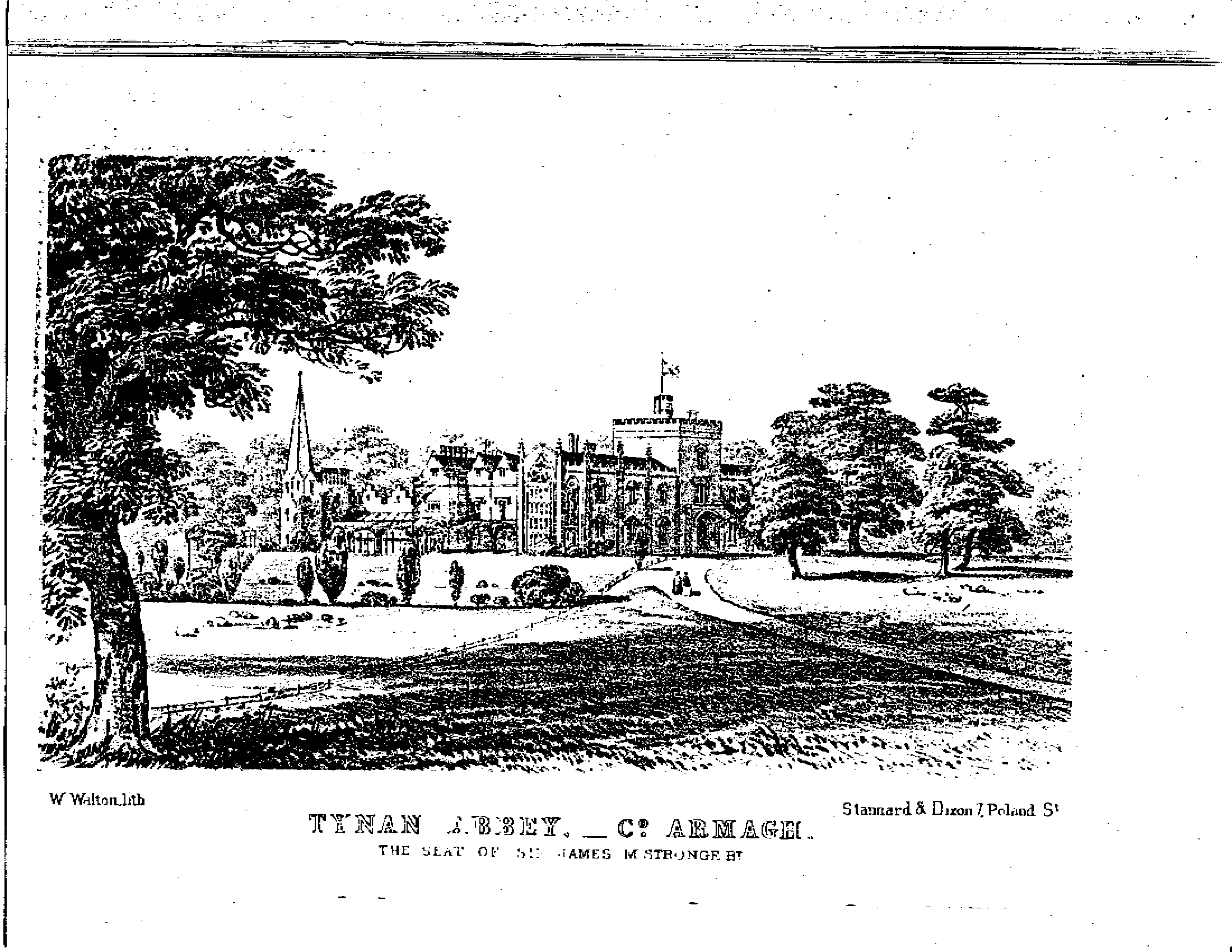
Sir Norman Stronge, of Tynan Abbey, County Armagh:
View DRAWING OF TYNAN ABBEY:
"Matthew Stronge, of Strabane 1670, and of Clonleigh
1616 (sic), a scion of Strang of Balcaskie, was warden of
Lifford, Co. Donegal, 1713. He acquired a considerable tract
of land in Co. Derry, by lease from the corporation of gold-
smiths of London, and in 1689, in consideration of services
done and losses sustained at the memorable defence of Derry,
obtained a renewal thereof. He also purchased lands in Cos.
Tyrone and Donegal. In 1688 he was attainted by James II's
Parliament, and d. 1716..." 11
Mention of attainder by James II's Parliament would be a badge of honor to a Protestant. The attainders were subse- quently revoked by William and Mary, and the stalwarts of the 1688 Revolution against James II were generously rewarded with titles and land.
The Tynan Abbey Stronges were dealing with the London companies prior to 1689 for their lands--and were likely among the early "planter" families in Ulster. The indication that they are descended from "Strang of Balcaskie" may show that they were of Scots descent, Balcaskie being in Fifeshire, Scotland. Somewhat cynically, it may also be speculated the family capitalized upon the genealogical study done by the Scottish Herald, Lord Lyon, on the occasion of the knighthood of Sir Robert Strange, the Engraver, in 1787 by King George III. Sir Robert's genealogy has been traced from his birthplace in The Orkney Islands backward in time to a Strang family in, of all places, Balcaskie! When Reverend James Stronge was awarded a Baronetcy in 1803, probably in reward for his assistance in uniting Ireland with Great Britain, it may have been all too easy for him to have "tacked on" to the "Strang of Balcaskie" lineage.
The Shirley Estate. Turning to County Monaghan, it will be remembered that English landlords acquired estates in that county by grant from the Lord Deputy, Arthur Chichester, at the time the Irish Earls were fleeing to the continent in 1603. By 1640, less than half of Monaghan was in Irish hands, and after the rebellion of 1641-49, more land was confiscated by Cromwell and granted to additional English landlords. When Robert, 3rd Earl of Essex died, (WHEN?) his estate in Farney Barony was inherited by his sister, Lady Francis, who married Sir William Seymour, Marquis of Hertford, and another sister's son, Sir Robert Shirley. In 1692, the estate was divided among the descendents of these, including another Robert Shirley, Lord Ferrers. 12
The Shirleys were major landholders in the Barony of Farney well into the 19th century. Mr. Evelyn Phillip Shirley, who wrote "An Account of Farney", was undoubtedly a member of the family. An Evelyn P. Shirley was listed as the immediate lessor of Joseph Strong in the 1861 Griffiths Valuation of Lisnakeeny townland in Magherclooney Parish, Barony of Farney, County Monaghan. The Shirley Estate Records are available at the Public Record Office of Northern Ireland. 13
Hamilton of Brown Hall, Co. Donegal. Another entry in Burke's Peerage shows the following re the lineage of the Earl of Erne in County Fermanagh:
"Abraham Creichton of Dromboory, on Lough Erne, settled in Ireland before 17 August 1616..." His son Abraham "...was High Sheriff of Co. Fermanagh, 1673, M.P. for Co. Fermanagh 1692, and for Enniskillen 1695, was celebrated for his suc- cessful defence of Crom Castle against King James Army. The younger Abraham died in 1702, leaving: -his son James married Hester, daughter and co-heir of James Hamilton of Manor Hamilton. -his daughter Jane married John Hamilton of Brown Hall, Co. Donegal and left issue." 14
INSERT DISCUSSION CONCERNING HAMILTON FAMILY
This would have been circa 1697-1720. In the "Memoirs of John Hamilton" there is found an "editors note below": "Brown Hall had been in the possession of the Hamilton family since 1697." 15
H.G.Murray-Stewart Estate. It remains an open question whether the Creighton's of Erne were related to Sir Robert Creighton (also spelled Crichton) who in 1658 claimed to have inherited the baronys of Boylagh and Bannagh by will from James Murray, 2nd Earl of Annandale. The Irish lord McSwine's estate was confiscated by the crown in 1608, and regranted in 1610 to certain Scots as follows: 16
the Rosses to Sir Robert McLellan,
Monargan (Ardara and Loughross) to Alexander Cunningham of Powton,
Upper Boylagh (Killymard Parish) to Sir John Vance of Barnbarrock and Patrick Vance of Lybrack,
Kilkieran (Kilcar and Largy) to Alexander Dunbar of Egerness,
Dunkineely (Killaghtee Parish and part of Killybegs and Inver) to William Stewart of Mains, and
Cargie (Doorin and eastern part of Inver Parish to Patrick McKie of Larg; all in 1610.
All of these people were closely interrelated. Most of them came from three parishes in Wigtonshire, Scotland. Few except Alexander Dunbar spent any time in their new lands in Donegal and started selling them off. About 1620, the es- tates were regranted as a whole to John Murray, 1st Earl of Annandale, who was a favourite of James VI of Scotland and I of England. Annan is a small and royal burgh of Dumphrieshire, Scotland, on the Annan River, nearly 2 miles from its mouth which opens into the Solway firth. 17 Murray was originally master farrier to James VI, and helped to save his life on one occasion. Murray died in 1640, and his Boylagh and Bannagh estate passed to his son James Murray, 2nd Earl of Annandale, who died in London in 1658. He had no children and his young cousin Sir Robert Crichton claimed the estates by virtue of a will made by James Murray. 18
Another cousin, Richard Murray of Broughton, claimed the estates by virtue of a deed of conveyance made in his favor by James Murray before the will. Endless court cases fol- lowed, first in Ireland; then in Scotland, to determine whether the deed of conveyance was a forgery as the Crichtons claimed. Throughout the reign of Charles II (1660-1685) there was endless feuding between the two parties in south Donegal. Sir Robert Creighton was in residence at Castlemurray in 1659, and apparently remained there until about 1685, when he died, leaving his rights in the estates to his daughters. In that last year of Charles II's reign, Richard Murray of Broughton was confirmed in possession of half of Boylagh and Bannagh and his cousin Sir Albert Conyingham who supported his claim got a "commission of grace grant" of the other half. Sir Robert Creighton's daughters, Jean and Anna, were still bringing suits in the Scottish courts well into the 18th century, but never gained a conclu- sive judgement. 19
The Murrays of Broughton never felt sure of their right to the estates and so had difficulty in selling them. They always lived in Scotland and mostly left their agents to run the Donegal estates. The Donegal Annual for 1977 contains an interesting account by an auditor, Thomas Addi, sent by Alex- ander Murray of Broughton in 1730 to report on the adequacy and accuracy of the rents received from the various tenants of the townlands on the rent rolls. Addi's reports were sent to Murray at his residence at Cally, in Scotland. 20
The last Alexander Murray of Broughton and Cally did take some interest in the Donegal estate, and stayed there on occasion. 21 When he died childless in 1845, the estates were inherited by the great-grandnephew of Alexander Murray's mother. He was Horatio Granville Stewart, a boy of nine, who was not even a descendent of the Murrays of Broughton. Being under age, the estates were administered by Irish trustees in Dublin. 22 In the 1858 Griffith's Valuations, the estates are referred to as belonging to "H.G.Murray-Stewart"; several townlands are of interest to the present research because their tenantry included Strongs in the 18th and 19th centu- ries.
Pakenham Estate in Killybegs. Another Killybegs Estate of interest was that of the fourteen ballyboes of land owned by the Church of Ireland in the Parish of Killybegs. In 1638, the Bishop of Raphoe had leased the lands for a term of 56 years to one Archibald Erskine. At the expiration of the lease in 1699, the lessee became Brigadier Henry Conyngham of Mountcharles and Slane. He was married to a sister of William Conolly, famous speaker of the House of Commons and known as "the richest man in Ire- land". Conolly was the son of a Ballyshannon public house owner and was the first of many Ballyshannon men who contrib- uted to the development of Killybegs. Brigadier Conyngham lease was dated 1699, but he died in 1706 and his interest in the lands passed to William Conolly. The Conolly family con- tinued the lease down through the years until the early 1830's when the teams from the Ordnance Survey arrived in Killybegs. Their task was to measure all land into acres, roods and perches and to set it out into "proper" townlands in the modern sense. 23.
The male line of the Conollys had died out by this time and the inheritor of the lease was Edward Michael Pakenham, a relative of the family. Under the terms of a will, Pakenham assumed the name of Conolly, and became Edward Michael Con- olly. While the Ordnance Survey teams were at work measuring the lands, this man purchased them from the Protestant Church for the sum L2,331-1-3. The Church reserved for itself an annual rent of L294-7-01/4, which meant that Pakenham-Conolly did not own them absolutely. After Conolly died in 1848 his Killybegs lands passed to his eldest son, Thomas, known popularly as "Tom Conolly". The lands reverted to the Gov- ernment at the time of Disestablishment of the Church of Ire- land in 1869. In 1871, the Representative church Body bought out the townland of Glebe, where the old parish church now stands, and the Government sold the rest of the "fourteen ballyboes" for L4,134. 24.
The Pakenham family was closely related to the Hamilton Family...(insert discussion from Rev.H.C. White).
Note the close relationship between the Hamilton family
and the Earls of Erne, discussed previously.
Earls of Enniskillen, the Cole Family. See Burke's discussion re the :
"The 6th Earl of Enniskillen (David Lowry Cole, M.B.E.),
Viscount Enniskillen, and Baron Mountflorence in Ireland,
(etc.)...(was descended from the following)...Lineage--The
first of the family who settled in Ireland was Sir William
Cole, Kt., who fixed his abode, early in the reign of James
I, in Co. Fermanagh, and becoming an undertaker in the north-
ern plantation, had an assignment in 1611, of one thousand
acres of escheated lands in the county, to which, in 1612,
were added three hundred and twenty acres, of which eighty
were assigned for the town of Enniskillen, and that town was
then incorporated by charter, consisting of a provost and
twelve burgesses, Sir William Cole being the first Provost.
Sir William raised a regiment which he cmd'd against the
rebels in 1643,with important success. He married Susannah,
widow of Stephen Segar, Lieutenant of Dublin Castle, and
daughter and heir of John Croft, of Co. Lancaster, and died
1653, leaving issue..." 25
The seat of the Earl of Enniskillen was Florence Court. See:
Charles Maclosure?... p.78, per Isobel Hurlburt notes.
Rev. Lord Adam Loftis, Marquis of Ely. Another Co.Fermanagh estate of interest may be that of the Marquis of Ely. See Samuel Lewis for partial discussion. Topic needs more research. Note, the Marquis of Ely was a title for Rev. Lord Adam Loftis. The Loftis family is the center of focus for further research. The following is quoted from notes by Isobel Hurlburt from "Charles Maclosure?": "1641 rebellion .... largest planter, Sir John Humes or Hume, the founder of Tully Castle... passed in 1731 through the female line, there being no male heir, to the Loftus family. After peace restore, the Hume family erected a mansion, called Castle Hume, nearer Enniskillen, and which is now incorporated in the demesne of Ely Lodge. .... the soil is variable, the staple trade principally domestic consisting of butter, corn, and manufacture of linen to a slight degree..."
".... after the Battle of Lisnackea... excerpts from Rev. John Graham's history of 1688 and 1690... William of Orange arrived and James II fled Ireland in 1688. A service of Thanksgiving for the Protestant victory over the Irish... A scroll sent to King William and Queen Mary for relief of Enniskillen and Derry... Thm. Wolseley, Commander in chief... signed by Gustavius Hamilton, Governor and about 200 others, including James Devitt. See p. 62."
Note also that certain Fermanagh Strongs were tenants of the Loftis family. See Deputy Keepers Reports and cf. Griffith's Valuations.
Western Fermanagh: Templecarne and Belleek Parishs. From the Parliamentary Gazatteer of Ireland (1844-45): p. 323: "Templecarne, a parish, partly in the barony of Lurg, Co. Fermanagh, and partly in the barony of Tyrhugh, Co.Donegal, Ulster. The Donegal section contains part of the town of Pettigoe. p. 71: Pettigoe, a village, partly in the parish of Drumkeeran, Barony of Lurg, Co. Fermanagh, but chiefly in the parish of Templecarne, Barony of Tyrhugh, Co. Donegal, Ulster.... pretty, greeen and wooded hills... the village contains a church, a Presbyterian meeting- house and a Roman Catholic chapel. Area of the Fermanagh section of the village ... 10 acres; of the Donegal section... 15 acres. Population of the whole, in 1841, 616. Houses, 90. Families employed chiefly in agriculture, 30; in manufacture and trade, 65; in other pursuits, 19. Population of the Donegal section, in 1841, 490; houses, 71." The following is found in Lewis's "Topographical Dictionary of Ireland", Vol. 2, p.602 (1837): "Templecarne, or Templecarn, a parish partly in Lurg... and partly in Tirhugh (Donegal). 4 miles west of Kesh, containing 5461 inhabitants.... 45,868 statute acres; of which 7719 are in Fermanagh (of these, 2140 are Lough Derg, 4400 in Lower Lough Erne and 1085 in small loughs... About three- fourths of the land consists of heathy mountain, affording during the summer only a scanty pasturage to a few black cattle; the remainder, with the exception of a moderate portion of meadow, is principally under tillage. The soil is but indifferent... Lots of fish... Waterfoot, the residence of Lieut.Col. Barton." "The church, situate at Pettigoe, is a small, old, and dilapidated structure, towards the rebuilding of which Mrs. Leslie, (the proprietor of the estates), the rector and the Protestant parishoners have contributed a large sum, and a subscription has been raised to build a chapel of ease about four miles from the town." The following is found in Lewis's "Topographical Dictionary of Ireland", Vol. A-G, p.202 (1837): "Belleek, a parish, in the barony of Lurg, County of Fermanagh... 3 miles East of Ballyshannon... was erected into a parish in 1792 by disuniting 36 townlands from the parish of Templecarn... the land is principally heathy mountain, but that which is under tillage is of very superior quality; the state of agriculture, though very backward, is gradually improving; there is a large tract of bog, and abundance of limestone. The seats are Castle Caldwell, the residence of J.C. Bloomfield, Esq., and Maghramena, of W. Johnston, Esq.... the village (of Belleek) consists of 27 houses .... the church, a neat plain edifice, was erected in 1790... diocese of Clogher... there are schools at Belleek and Tullynabehogue, partly suppored by the rector and at Castle Caldwell is a school supported by Mrs. Bloomfield. In these schools are about 60 boys and 80 girls and there are also three pay schools, in which are about 180 boys and 70 girls and a Sunday school. There are some ruins of the old church; on the shore of Lough Keenaghan are those of an abbey; and there are the remains of several Danish forts in the parish."
The foregoing was provided by Isobel Hurlburt, Edmonton, Alberta, Canada,
who in 1991 made an extensive study of Devitt and Strong family origins
in western Co. Fermanagh and Co. Donegal. Much of the following
is extracted from her handwritten notes:
From "Wakeman".... p. 85: Waterfoot, the demesne of Captain Barton and
those of Templecarne Glebe.
.....p. 86: Belleek... about 4 miles from Castle Caldwell.
The china works was originally started by Bloomfield."
From "Dundas".... p.197: Ennniskillen, the town, was planted in1612.
....p. 209: ffrancis Blennerhassett, Esq., undertaker of 1000 acres
(in the plantation scheme), called "Bannaghmore"
.....p. 314: The Blennerhassett Family sold the estate to
James Caldwell, (p.136: a merchant in Enniskillen)
about 1662; who apparently renamed the estate
"Castle Caldwell", and built the pottery. Castle Caldwell
is the "Castle at Belleek". James Caldwell
was created a baronet in 1683. He d. 1717.
In 1830, the Caldwell estate passed to Frances,
wife of Sir John Colpoys Bloomfield (died 1830),
and from her to her son, John Caldwell Bloomfield,
who died in Enniskillen in 1897.
....p.154 of Chapter 65.... Col. Abraham Creighton's Regiment
of Foot, Raised in 1689... List of First Militia Officers
apparently includes James Devitt as one of the Lieutenants;
and he was also listed as a Lieutenant in 1698 when
the regiment was broken (i.e., disbanded) in Ireland.
For more material extracted from Mrs. Hurlburt's notes, see: Fermanagh Research Notes
The Earls of Erne, Tynan Abbey Stronges, and other prominent families controlled the politics, large land hold- ings, and social and economic life of Ireland in the 18th and 19th century. Their lands and titles had been received in reward for service to William of Orange and the "protestant ascendancy".
Irish Society was dominated by an agricultural economy. In general, four classes of people occupied the soil of Ire- land. At the top of the scale were the landlords, about five percent of the population. Of these, one-fifth controlled eighty percent of the arable land. The landlords included the London Companies and their undertakers. 26 Another "landlord" was Trinity College, Dublin, the trustees of which held extensive lands as a source of revenue. 27
Below the landlords were the leaseholders, who held the land in perpetuity. These people, comprising about 2.5 per- cent of the population, belonged to the "established" Church of Ireland, were part of the "Ascendancy", did not engage in tilling the soil, and generally occupied grazing land. 28
Under the leaseholders, or directly under the landlords, were one or more "freeholders" or middlemen, who might hold their lands for terms such as "three lives or 31 years, whichever came first". Leases in general in Ireland at this time were of four main types:
(1) Leases for three lives renewable for ever;
(2) Leases for three lives which expired on the death of the last life;
(3) Leases for a period of years, e.g. 21 years, 31 years, 41 years, etc.;
(4) Leases for three lives, or so many years, whichever was longer. 29
These leaseholders were usually not obliged to work for the landlord. If they did, they were paid in money. Grazing land sufficient for a few head of cattle per family might be held in common. While the title of "freeholder" con- ferred dignity on the individuals concerned, these freehold estates lasted only for the duration of the lease or of the lives concerned, and thus were of uncertain length. 30
Often, significant changes in the lives of the "free- holders" came at the expiration of the leases. For example, an entire congregation of Scots-Irish "Associate Reformed Presbyterians" apparently emigrated to South Carolina in 1771 when their leaseholds on his Antrim estate expired and the Marquis of Donegal demanded exorbitant increases. Included in the congregation were Charles Strong and James Strong, de- scendants of a certain Christopher Strong, and who founded a lineage described herein as the "South Carolina Strongs". See APPENDIX One, Chart 3. 31(To be added later)
Middlemen sometimes made, or added to, their living by renting land themselves and then letting it out in small holdings on shorter term leases, usually annual in length, or even "at will", in which case the tenants could be driven off the land if the middleman could get a higher rent from some- one else. These middlemen were often oppressive, looking for quick profits at the expense of their subtenants. Because of personal supervision, conditions were usually better when the landlord handled the leases himself. 32
Under the middlemen came the tenants...the most numerous class of all. There were three classes of tenants: 33
(1) The annual tenants formed about seventy-seven per- cent of the occupiers of farms. This was the typical "small farmer" class. They settled mainly on lands valued at per- haps less than L15 per annual leasehold, land which totaled more than fifty percent of the cultivated acreage.
(2) Next came the cotters who lived in poor cottages usually located on someone else's land. They usually rented a patch of "conacre", or land rented annually on an eleven month tenure to the highest bidder, to grow a crop of pota- toes, or to pasture their sheep. Labor was often exchanged for rent.
(3) At the bottom rung of the ladder were agricul- tural laborers who had no land at all, but they too often rented a patch of conacre. The potato crop from one acre was enough to maintain a man and wife and six children for three-quarters of a year in a less than satisfactory condi- tion.
By law, any improvements made by a tenant became the property of the landlord. Improved property commanded higher rent and the tenant who made the improvements was not compen- sated. Consequently, he was discouraged from bettering his house or his land. 34
The situation of the peasantry was indeed deplorable. A description of their condition in County Monaghan is con- tained in a Parliamentary Gazetteer of Ireland, written in the early to mid-19th century: 35
"Population is dense, the number of labourers has in- creased, and the system of con-acre is prevalent. Marriages are, in general, early and without provision. The wages of agricultural labour average 10d per day; and the amount of work for each labourer averages about 180 days in the year. Most of the peasantry pay their rent in labour to the parties from whom they hold their con-acre and their cabins. Labour- ers wives occasionally earn a mere trifle by keeping poultry or by spinning; and their children sometimes earn from 10s to 15s during the summer for weeding and herding.
"The common food is potatoes with rarely a little butter-milk or sweet-milk; and is preferred, as constant food, to bread or meal. The cabins have either one room or two rooms; they may measure 12 feet square, and seven or eight feet high; they are floored with mere soil, occasion- ally mixed with lime; they have straw thatching, and in gen- eral, chimneys of sticks and clay, with perhaps an old firkin square (a small wooden vessel or cask 36) for a chimney pot; and their windows are usually about a foot square, and rarely glazed.
"Clothing is, for the most part, both poor and scanty. Few women make their own clothes; though since the failure of employment at spinning, many are becoming more used to the needle. When families are large, a portion of the bedding is usually mere straw spread upon the floor. Pawning and drunk- enness, up to a period of about 5 years ago, were seriously on the increase; and the chief drunkards were tradesmen about the towns, and farmers who frequented the markets. Emigra- tion, principally to Canada and the United States has been considerable."
Ffolliott / Folliot Family, Barons of Ballyshannon: What follows is a followup re the Ffolliott / Folliot family, which MAY be related to the "Ffillot" family mentioned as part of the Warham lineage discussed by Martha F.B. Strong in her "Southern Triangle" papers. Note, I think this material is significant because it MAY provide a link from the "Southern Triangle" to Counties Donegal, Fermanagh, Sligo, and Cork for the Strong families who can be found in the records of each of these counties! It may well be that these families were "planted" in Ireland as under-tenants of the Ffolliotts. I invite further examination and research by interested researchers! The following is quoted from "Donegal History and Society", edited by William Nolan, Liam Ronayne, and Mairead Dunlevy, published by Geography Publications, Dublin, 1995: at pps 185-186, "....in the Civil Survey of 1654 the plain between the Drowes and the Erne, the property of Thomas Lord ffolliott, is firmly described as part of the barony of Tirhugh and the county of Donegal." The following is quoted from "The Folliotts, Wardtown Castle and the Colleen Bawn", by Anthony Begley, published in The Donegal Annual, 1991, at p.61,62-69: ....."Henry Folliott was born at Pirton Court in Worcestershire in 1569, the son of Thomas Folliott and Katherine Lygon. He had one elder brother, Sir John Folliott, who inherited the English lands of the family and a branch of whose family subsequently settled at Hollybrook in Co. Sligo. Henry married Anne, daughter of Sir William Stroude of Stoke-under-Hamden, Co. Somerset, and they had seven children. In May 1594 Henry Folliott was based in the Ballyshannon (Co. Donegal) area, presumably in the military service of the crown.... "In December 1607 the Earl of Tyrconnell complained of "sundry rapes and extortions" of the soldiers of Sir Henry Folliott and for "the said Sir Henry's house, every month there were six beeves and six muttons taken up by his own officers within the barony of TISHERE (Tirhugh) without any payment"... In June 1608 the Castle of Lough Eske was delivered to Sir Henry, and in the same year he sacked Tory Island and killed rebels there". "(During the "Plantation of Ulster",) The Barony of Tirhugh, in which Ballyshannon is situated, was granted to Servitors (ex-army officers), to the Church and to Trinity College, Dublin; The Irish were allowed to remain in the barony and it was planted relatively thinly with Scots and English. Henry Folliott, because of his military service to the Crown, acquired much of the lands in the Ballyshannon area by grant and he also plurchased additional land... (including subsequently the lands of the former Abbey of St. Barnard of Asheroe, located at the present site of Ballyshannon).... "Henry, First Baron Folliott of Ballyshannon, had seven children. Thomas, who became the Second Baron, Michael, Arthur, Charles, Anne, Elizabeth and Frances, who married Sir Robert King, M.P. for Boyle. The First Baron died in 1622.... The inheritance of the First Baron passed to his eldest son Thomas who was only nine years old at the time of his father's death in 1622. During his long minority he was in ward to the King from the 26th February 1623 to 30th May 1634. Thomas, Second Baron of Ballyshannon, married Rebecca French, relict of a Mr. Waterhouse of Dublin. They had four children: Henry, Anne, Rebecca and Elizabeth. An indication of the extent of the Folliott property in the Barony of Tirhugh can be gleaned from the following survey in the 1650's: "Parish of Innishmacsaint: "Eleven quarters and a halfe in total. Ogherous, Knockaterry, Killerlacky, Dunmuckrum, Crevagh, Donoghmore, Leckalastran, Camlin, Beleeke, Conntokker, and ye halfe quarter of Reglass". In the above parish, Thomas Folliott had and estimated 1034 acres and he had a mill on the River Erne at Ballyshannon. He also held Ballyhanna by lease from the Bishop of Clogher. "Parish of Kilbarron: "Ten quarters and six ballibose called the halfe quarter of Shiggis, ye halfe quarter of Mullinashee, ye halfe quarter of Crevaugh, the quarter of Cashell, ye halfe quarter of Alla, the quarter of Cillcarbare, ye halfe quarter of Legaltion, the quarter of Knada, the quarter of Corlee, the quarter of Cassalard, the quarter of Teagh Leagh, the quarter of Tubber, the quarter of Garvanagh". In the parish of Kilbarron Thomas Folliott held 1187 acres Parish of Drumhome: "Two quarters of land called Ballimagroty containing 360 acres. One quarter of land called Ballidermott containing 160 acres; a total of 520 acres.... Trinity College Lands: Trinity College Dublin had been granted land in the Barony of Tirhugh under the Ulster Plantation arrangements. The Folliotts leased the College lands in the parishes of Innishmacsaint and Kilbarron. In the parish of Innishmacsaint, they leased the 4 quarters of Bundrouse, Drumkrin, Ardfarnagh and Ramore, comprising 588 acres. In Kilbarron they leased the six ballibose called BalliMcWard containing 115 acres and "Nine ballibose called Colearrmur, one quarter one balliboe of Keran". A total of 703 plus acres. "The Folliotts also held land in Fermanagh, including the Manor of Dumkyn, and in England where Thomas 2nd Baron resided at Ferney Hall in Worcestershire..... Wardtown Castle is located on the townland of Ballymacaward. The land was originally the home of the Wards who were the chief poets to the O'Donnell Irish Chieftans. As described in the Civil Survey of 1654-56, the "six ballibose of BalliMcWard begineth their bounds norward with a brooke which runneth into the sea called Ffalkinlargg and soe runeth tel wee come to a ditch with boundeth them westward from a hill called Shiggis belonging to the Lord Folliott which ditch runneth from thence to a bogg called Monin Kilbaugh and continueth westward while we come to Collchill and from thence turneth norward to Shiggis and from thence eastward to Gortnebrade and soe norwest to a brooke from which runneth a gutter norwest into a brooke which boundeth them from one partt of ye Lord Folliott's lands called Kildone and from thence southwest into the sea and soe south to ye Barr of Ballishanon and from thence eastward to Ffaulkinlard where wee began our bounds." No Folliotts have resided in Wardtown Castle for the past two hundred years. By famine time, John Folliott let the land and Castle to Henry Likely, who had an estate of 575 acres. The Likelys came from Parke, near Kinlough, Co. Leitrim.... The last of the Likelys to reside in the castle was Henry Likely who died in 1914. Mrs. Violet (Likely) Strong recalls that as a baby she slept in the Castle in September 1914, while her parents attended the funeral of Henry Likely. The Castle has not been lived in since that time. View Wardtown Castle: "The Jacobite-Williamite Wars saw much military activity in this area. King James II on his arrival in Dublin in 1689 passed an act ...(attainering diverse rebels including Thomas Folliott, John Folliott, and Lord Folliott of Belashannan(sic)").... After King William established his authority in Ireland the parliament passed an ...(act annulling the attainders)... "Sir John Folliott, brother of the First Baron, had a son, Major John, who served in the army in Ireland and whose residence was at St. Finbarres, Cork. Major John Folliott was appoined Commissioner of Donegal in 1646 and he leased Ballymacaward (which was part of the holdings of Trinity College). In 1665 Major John paid taxes on three hearths in Ballymacaward. His two sons Francis and John were engaged in the Inniskilling regiments in the Jacobite-Williamite Wars. John took over the lease on Ballymacaward on the death of his father in 1682. Francis Folliott, Parkhill, Ballyshannon, was M.P. for Ballyshannon in 1692 and uniquely, his brother John was also M.P. in 1692. John Folliott died in 1697 and his wife Lucy remained at Ballymacaward until her death in 1730. Thomas, Second Baron Folliott, died at Ferney Hall, Worcestershire, and was bured in the Chancel of Onibury Church nearby in 1696. In 1697 Henry Folliott was created Lord Folliott and became the Third Baron of Ballyshannon. On acquiring his title he retired as M.P. for Ballyshannon, an office which he had assumed in 1695. "The Third Baron, ... Lord Henry Folliott married Elizabeth Pudsey of Langley, Co. Warwick, and they had one daughter, Rebecca, who died in 1697. On the 17th October 1716 Henry died at his home, Four Oaks Hall, Co Worcester, and he was buried at Sutton Coldfield. As he died without surviving issue, all the unentailed property was divided between his five sisters. The entailed property went to the next male heir, Lieutenant General John Folliott. With the death of Henry Folliott in 1716 the title, Baron of Ballyshannon, became extinct and much of the Folliott property was sold... (to William Connelly, Speaker of the Irish Parliament)... "Lieutenant General John Folliott who had inherited the Third Barons' estate in 1716 also inherited the estate of Robert Folliott, Sligo, who died in 1746. In this way the Sligo property (including Hollybrook) and the Ballyshannon estate of the Folliott family, came into one ownership. On the death of Lieutenenat General Johhn Folliott at Lickhill, Worcestershire, in 1762, the estates in Worcestershire, Sligo, and what remained of the Donegal estate went to his namesake and cousin John Folliott, who had been born in Ballyshannon in 1696, the eldest son of the previously named Francis...." It should be obvious to all concerned that WORCESTERSHIRE figures large in the fortunes of the Folliotts, and it should also be clear that the same English County is the home of many Strongs. It seems almost too much of a coincidence that Strongs are in turn found as tenants in the very lands held by the Folliott family in Donegal and Fermanagh, and perhaps in Sligo and Cork as well (although the situation in the latter two counties has not been verified by me at this time).
William Conolly's Ballyshannon Estate: Part of the Conolly Estate of Co.Donegal was originally granted in about 1610 to Francis Gofton, Auditor to the Lord Deputy of Ireland. Gofton then sold his Ballyshannon Estate to Sir Henry Folliot. 37 According to John B. Cunningham's article, "William Conolly's Ballyshannon Estate 1718-1726", his successor, Lord Folliott sold the estate to William Conolly, his legal advisor, in 1718 for L52,000. The estate had a stated rental income of L2,000 fer annum plus L450 for the Erne Fishery. The Ballyshannon estate totalled some 18,900 acres. Conolly also rented "College" lands in the area from Trinity College, Dublin, to the extent of about 1719 acres for L292-18-10.5. Additionally, he had an estate in Co. Fermanagh around Ballinamallard, called Newporton, totalling 4212 acres with a rental of L582-4-11, and lots in the town of Ballyshannon, the fishery of Ballyshannon, the warren at Ffinure, Mills, Tenements on the Carriggboys side of Ballyshannon, a tanyard and storehouse at Balleek, and Tenements and mills at Ballynemallar. 38
The Conolly Estate extended roughly from Balleek to near Bundoran on the south of the River Erne, and on the north bank of the river it extended from the sea at Ballyshannon several miles northward towards Rossnowlagh and then inland to the east about five or six miles, to include Breesy Mountain about 5 miles northeast of Belleek. As described above generally, the landlord usually let out his estate in sizable areas to one substantial tenant or to a combination of sub- stantial tenants. These tenants could sublet to others below them on the economic ladder at a profit for themselves, or they could retain their own parcel and farm it themselves. 39
Cunningham indicates that in the 1690's much land had been leased for 31 years at a low rent in the aftermath of the "Williamite War". Scots emigration to the north of Ireland was apparently particularly strong in the mid-1690's due to a famine in Scotland around 1695-7. A preponderance of Scots names are noted in the estate records for this pe- riod. Cunningham's article studies the estate records of re- newals of the leases in about 1726, at the end of the 31 year term of the first leases. Using the estate records from the time of the sale from Lord Folliott to William Conolly in 1718, he was able to compare the rent charges to verify the renewals were at generally higher levels. 40
The lease renewals in question related to the "freehold- ers" or middlemen. They did not apply to the sub-tenants. The sub-tenants only had security from year to year and would have dwelt in a "clachan", or collection, of houses and trav- elled to their scattered "bitty" portions of land round the locality. This was part of the "rundale" system, and gave the sub-tenant some good, some middling, and some bad land in relation to what he could pay. The middleman, i.e., the leaseholder, could quickly "tax" him if agricultural prices went up, while the landlord had to wait until the lease term finished to get his slice of the enlarged pie. Remember too, that the population density was much lower in the early eigh- teenth century than it was to be later in the century and in the early nineteenth century. 41
Cunningham presents several insights in his analysis. One is that in this early period of the Penal Laws, 1726, Ro- man Catholics held substantial sections of the Conolly Estate as middle men. At this time, many of the middlemen carried obviously Gaelic names such as McGill, O'Gorman, O'Boyle, Flanagan and O'Coen, which were known to be Catholic at the time. The Conolly family were themselves very probably "not long after" conforming to the Church of Ireland and many of their relatives or friends in the area were still Roman Catholics. 42
Another insight is that it was common in those days to name children after a local notable as a means of currying favor, probably with the idea that the child as an adult would be suitably looked after by the family he was named af- ter; thus one finds names in the records like Folliott Lip- sett (obviously named after Lord Folliott), and later one Conolly Coen, named after the Conolly family. Many of the lessees were related in some way or another to the Folliott and Conolly families. One Mrs. Crow, the wife of Captain Francis Folliott, and later after his death remarried to a Mr. Robert Crowe, held a tenancy from December 17, 1695. Other leaseholders were Thomas Dickson and Thomas Atkinson, both married to sisters of William Conolly. 43 Reference to Griffith's Valuations for the area of the Estate in 1857 re- veal that one of the "immediate lessors" of many townlands was then listed as "Rep.s Col. Dickson", probably a descen- dant.
Cunningham makes no mention of Strong lessees in the Conolly Estate article. It is probable, however, they came into possession of some of the lands about 1695. Dale G. Strong found that one Will Strong leased "Ardellan" Townland from the Conolly Estate in 1718; and that William Strong had another lease of "Ardeelan" Townland in 1726. In 1727, William Strong owed "18L as tenant at Ballyshannon Manor...also...John Strong." Also, in Raphoe Wills 1684-1858" is found a reference to a will for Arthur Strong of "Ardeelane" in 1743. Finally, there is mention of Edward Strong and son at Ardeelan in 1774. 44 Analysis of the dates and events with reference to the likely length of the lease terms suggests the following sequence of events:
1695-1726: 31 years, original lease to William Strong
1726: likely renewal of the lease, probably for 31 years and/or the lives of William and his son Arthur. William probably died between 1727 and 1743.
1726-1743: After 16 years, death of Arthur Strong; with subsequent re-letting of the townland property to his son or other relative, Edward Strong.
1743-1774: 31 years lease term; re-letting of leasehold to Edward Strong and son.
1774-1805: 31 years lease term; probably to Edward Strong and son.
1805-1836: 31 year lease term. Emigrations thereafter to America. See: "The Descendants of John Strong (1770-1837) and Martha Watson (1772-1851) of Drumhome Parish, Co. Done- gal, Ireland." 45
Also to be weighed is the indication found by Dale G. Strong that one Redmond O'Gollogher had a lease of "Achidooey", apparently from Lord Folliott, in May, 1684. 46 This was probably the nearby townland of Aghadowey, found by Dale Strong in 1982 to have been tenanted by a Strong family to whom he traced his ancestry. Two possibilies arise. One, O'Gollogher may have been dispossessed following the "Williamite War", circa 1696; leading to a sequence of events similar to that postulated above. Two, a different, possibly related family of Strongs may have taken the leasehold subse- quently. This latter scenario does not as well tie to the lease terms set out above, but may also be possible.
Rev. John Hamilton, of St. Ernan's: In the early nineteenth century, we find another Donegal landlord, one John Hamilton, scion of the same Hamilton fam- ily discussed above, who was born in Dublin on 25th August 1800, and was educated at Armagh School and at St. John's College, Cambridge. Orphaned in 1807 with his brother Edward, he came of age in 1821. Waiting for him was an en- tailed estate of 20,000 acres in County Donegal, the seat of which was Brown Hall, held under lease from Trinity College. Coming under pressure from the trustees for higher renewal rents, he determined in 1824 to remove himself and his family to a new residence he built on the Isle of St. Ernan's in Donegal Bay, about two miles from the town of Donegal. He ceded his interest in Brown Hall to his brother, Edward Ham- ilton. 47
Upon assuming his estate in 1821, John Hamilton found a very backward peasantry. The Irish peasantry was described as being among the worst clad peasantry in Europe, albeit cheerful in rags, good-tempered on a starving stomach. It was, according to Hamilton,
"a district which ought not to be populous, and its soil pays ill for cultivation..."The unhappy legislation which made leases of the value of forty shillings a year give a vote for the county representative, had led my forefathers to encourage subdivision to such a degree that instead of five or six substantial tenants I found a hundred. That they were poor I need not say. But they paid their rents duly, and were a more civilized fold than, under the circumstances in a very remote corner of a very remote county, could be ex- pected....But poor and ill-circumstanced as they were, they had spirit and energy to provide for the education of their children." 48
Hamilton encouraged the peasantry in their efforts to better themselves, and brought in Scots workmen and skilled laborers in an attempt to introduce new technology and new methods of working the soil. He also became involved in the Methodist movement, becoming renowned as a preacher amongst protestant and Catholic alike. 49
In 1838, a system of Poor Law relief was introduced in Ireland, based upon Union chargeability. The country was di- vided into 130 unions, subdivided into 2050 electoral divi- sions. The system penalized the resident landlord who by his husbandry improved his estates. Neglected estates of absen- tee landlords had become veritable pauper warrens, and by virtue of their rundown condition, were taxed based on their lesser values. 50
In 1841, Mr. Hamilton took into his own hands the agency of his estate. Up to the summer of 1845, all was going on well, the extent of arable land compared with that of 1840 increasing from year to year. 51 It has also been asserted that John Hamilton was estate agent for the Conolly Estate around Ballyshannon and possibly for the Leslie Estate of Pettigo and other estates as well. 52
In the autumn of 1845, the partial failure of the potato crop was the harbringer of the terrible famine crisis, 1846-1850. Hamilton suffered pecuniarily in the coming years to give profitable employment to the poor. The great migra- tion to America began, and Hamilton often lent funds to his tenants so that they might gain passage to the new world. Remarkably, most repaid him. 53
During the preceding century and a half of relative peace since the Revolution of 1691, the population of Ireland had been steadily on the increase. By 1800, the population was estimated at four million, and by 1841 had doubled to over eight million. Over the years as land passed from one generation to another, it was subdivided into smaller and smaller parcels. The potato, which had been introduced to Ireland by Sir Walter Raleigh in 1590, was an ideal food as it grew well in the Irish climate. It was high in nutri- tional value and produced an excellent yield. One acre of farmland was capable of producing up to six tons of potatoes annually. The potato became the staple food, and millions of Irish depended on it. The majority of families lived on farms of less than five acres by the 1840's. Even these farms were further subdivided to provide plots of about 1 acre of conacre for cottiers who subleased from the lease- holders. 54
In the very warm and damp summer of 1845, about a third of Ireland's potato crop was destroyed by a parasitic fungus similar to bread mould. This first failure did not spell di- saster, as most had enough reserves to make it through the ensuing winter. But 1846 was again warm and humid, and the fungus destroyed two-thirds of the potato crop. The hardest hit areas were in the west, in Counties Galway and Mayo, where the population was densest. To compound matters, the following winter was severe and many died of starvation and exposure. 1847 brought a more temperate dry summer and the potato crop was free of the fungus. But many had not planted that year after the two previous crop failures. In 1848 the humidity, and consequently the fungus, returned. The potato crop was again destroyed. There were further failures in 1849 and 1851. Estimates are that over a million people died, and another million emigrated during the period. 55
The government of Sir Robert Peel took action as early as 1845. A scientific inquiry was set up to determine, un- successfully, the cause of the blight. Corn was bought from America and public works programs were set up so that the peasants would have some money with which to buy the maize. But if potatoes were the staple of the Irish diet, grain was the staple of the Irish economy. Tenants and landlords alike depended upon the production of grain to pay their bills. Peel therefore insisted on the continuance of exports of Irish grown grain, while importing American corn maize to help feed the starving. Peel's actions were considered hu- mane for the time. He even advocated repeal of the Corn Laws, against the policy of his own political party, to help alleviate the situation in Ireland. But his insistence on the continuing exports of Irish grain has cursed him in the eyes of the Irish. 56
Peel was replaced by Lord John Russell in 1846, and his new Whig government cut off all government purchases of food, leaving the supply to free enterprise in an arrogant gesture of Laissez-faire. The situation in Ireland was desperate, however, and even this government felt compelled to introduce new public works programs. An overcrowded nation so depen- dant upon a single crop was flirting with disaster. The fam- ine was primarily a scourge of the peasants, who were mostly Catholics. Protestant landlords and tenant farmers, who were the grain producers fared much better. People in the cities were better off than those in rural areas. All this combined to deepen the sectarian hatred which had existed for centu- ries. 57
On February 19, 1847, the Ballyshannon Herald published a very long letter from the same John Hamilton mentioned above. Another writer has observed: 58
"In his own way he seems a man sensitive to the situation and practical for the future, although badly lack- ing in short term solutions. He seeks to combat apathy and fatalism in the tenantry which is admirable, if the person has the energy to look some distance ahead, but useless if starvation is a matter of days away."
Hamilton's letter read: 59
"Stir yourself and be doing. Drain a rood of ground and dig it eighteen inches deep and you will be paid for it if is done right and get many years to repay this money...seed will be provided and can be paid for later. Sow corn and not po- tatoes in rows nine inches apart and the seed two inches apart. This requires two stone of seed and repays 200 stone if the land is well dug or well ploughed and is dry...Tenants will be allowed to burn as much as they like and (Hamilton) will say nothing for this season (burning the dried sods of the land gave a short term fertility but was ultimately ruin- ous and absolutely forbidden normally). Tenants were urged to burn as much as they liked on black land, i.e. bog land, and to cart it to other ground to grow turnips...Sow "pease" (sic) and barley and field and garden beans and mangle wozzels. Come to (Hamilton) for help. Uncommon work is re- quired and (help will not be given to) anyone who holds land but will not work it."
With the 1850's came a change in the husbandry of the land...from crops to pasturage. The peasantry often surren- dered their lands to the landlords, either at the termination of their leases or sooner. Anther writer asserted that,
"No tenant on (John Hamilton's) St. Ernan's estate was at any period dispossessed from his holding without compensa- tion being paid him. This compensation, called "Tenant Right", in Ulster, varied in amount from five to fifteen years' rent of the holding. The farms had been too much sub- divided by Mr. Hamilton's predecessors in order to create voters...Hamilton bought the Tenant Right in many instances. In all other instances the incoming tenants bought it from the outgoing." 60
From 1821 to 1874, Hamilton paid nearly L4000 as compen- sation for the Tenant Right. The fact that Tenant Right did not prevail outside the Province of Ulster until a Tenant Right Act was passed by Parliament in 1870 may explain in part the bitter feeling of many Irishmen evicted in the other three provinces of Ireland in the period 1850 to 1860, a feeling that was carried with them to the United States. 61
However, Hamilton's efforts on behalf of the peasantry seems to have mitigated much ill will, as may be demonstrated by the following poem, dated February, 1874, copied in about 1986 by Anthony Begley of Ballyshannon, Co. Donegal, from the original longhand framed and hanging in a neighbor's house. The author is unknown, as are the characters "Tristram" and "The Doctor" mentioned within: 62
'Deliver us! Deliver us!' Cried the serfs of Donegal; 'Deliver us, oh Doctor From the tyrant landlords' thrall! To overthrow the Saxon foe, That's our battle-cry today And fixity of tenure, Without any rent to pay.
Unto the great twin brethern We peasants send our wail; Swift, swift, the great twin brethern Come rushing down by rail-- Now let the Tories tremble, The Tories doomed to fall, When the banner of the Kennedys Is seen in Donegal.'
Up rose the mighty Doctor And Tristram up rose he; 'The labour might be great', they cried, To set the county free; But wel' rack our brains and spare no pains To win the people's cause And old Ireland will be happy, boys, When we dictate her laws.
'And as for pains and labours', Said the Doctor with a smile, 'Excuse me for observing They are rather in my line; How often like a mushroom I have sprung up in the right'. 'Like a mushroom? Hang Comparisons!' Cried Tristram in a fright!
So they placarded the county With promises and vows And assailed the Tory landlords And on every wall in Donegal, As hot the battle waxes, I've seen the watchword of the Twins: 'Down! Down with rent and taxes!'
'Deliver us! Deliver us!' Was still the Celtic cry. 'Now by Lucina's gentle hand', The Doctor cried, 'I'll try'; 'And if Gladstone and his cabinet Are not laid upon the shelf, Perhaps, by my deliverance I'll get a berth myself!'
But up rose the men of Donegal; Up rose a mighty band, Ne'er yet a Hamilton has driven A tenant from his land; Ne'er yet did any Conolly Oppress the struggling poor, So we'll make a stand to save the land From the Dublin acconcheir.
And they fought a gallant battle And every nerve was strained And for Hamilton and Conolly A victory was gained; And Donegal was not condemned To suffer for its sins-- For an ever-bounteous Providence Delivered it of Twins!"
Obviously, the sentiment expressed is one of gratitude and loyalty to the landlords of the Hamilton and Conolly Es- tates. Part of the friendly relations between these estates and their tenants may have originated in the Ulster Tenant Right. This was apparently a customary perception that an occupying tenant had a prior and prescriptive right to nego- tiate for renewal of his lease on its expiration, and that such negotiations should be seen to have failed before others should or could bid for the land. Over much of Ulster there was an active market in lease "interests"... the purchaser of an interest obtained both occupation of a holding during the unexpired term of the lkease and the "tenant right" to nego- tiate subsequent renewal. Such sales apparently generated sum amounting to several times the annual rent of a farm, and were often used to provide the outgoing tenant with a capital stake prior to emigration. 63
A speculation is that the Ulster Tenant Right arose be- cause of the number of protestant tenants who had gained their positions on the land either by virtue of service as common soldiers in the armies of James I, Cromwell, and William of Orange, or as free yeomanry from England and Scot- land brought over by the Planters and their successors to consolidate protestant control of the land. These yeoman tenants, or freeholders, continued to serve the landlords, middlemen and other lessees in a somewhat privileged position over that of the Catholic cotters and agricultural laborers; a position the security of which was protected in part by the Ulster Tenant Right. In turn, the respect of the landlords for the rights of the tenants engendered loyalty on the part of the latter. Insight on the effects of the potato famines can be gained from reports extracted from the Ballyshannon Herald in the period 1845-1850. John B. Cunningham, of Beleek in Co.Fermanagh, wrote in review of the newspaper articles of the period: 64
"Sept.17th (1847): reports that no rot can be seen in the potatoes and that a great fever rages about Enniskillen. The news from Fermanagh continues in the Oct. 1st. newspaper as it reports on the dissolution of Lowtherstown (Irvines- town) Poor Law Union. The immediate cause was the raising of the salary of the R.C. (Roman Catholic) Chaplain to the Work- house. In the row that followed the Protestant Chaplain's salary was raised. Further rows caused the dismissal of the master of the workhouse and finally the Board of Guardians themselves were dismissed.
This is the newspaper version of the dissolution of Low- therstown P.L.U., but in fact there were much more grievous reasons why this Union was taken over by a Government ap- pointed Commissioner. The Guardians failed to levy anywhere near sufficient funds to support the poor and starving of the locality, thus causing the effects of the Famine to be even worse than need have been and the Workhouse which they were in charge of was very badly run. An inspector who visited Lowtherstown Workshouse wrote that he found people half naked dying in their own vomit and excrement, lying on the floor. He said that Lowtherstown was the worst workhouse that he ever visited. (See Parliamentary Papers: Irish Famine).
October 15th: reported the dissolution of Ballyshannon P.L.U. Commissioners and the appointment of a new government inspector. November 19th sees a letter saying that the people of the country are living on turnips and nothing else. The Gentlemen of the country must unite to stave off famine as they did last year."
Estates of Landlords in County Longford include the following,
none of which have been researched to date: 65
Richard, Lord Greville--- fourth largest landowner in
Co. Longford with 8,877 Acres in 1854.
Resided Clonyn, Delvin, County Westmeath. The Grevilles
originate from a John Greville of Campden,
Co. Gloucester, England, in the 1300's.
See also, Algernon W.B. Greville, 45 Sussex Gardens,
London, in 1876. Baron Greville was residing at Clonhugh,
Mullingar, Co. Westmeath, c. 1900.
Lt.Col. Arthur G. Lewis, landowner in Griffith's Valuations,
1854 (800 plus acres): See also Edward Lewis, Violetstown,
Mullingar, Co. Westmeath; Henry Owen Lewis,
19 Seymour Str., W. London; and Rev. Samuel Lewis,
Carrick-on-Shannon, Co. Leitrim; all addresses
in 1876
Hon. Capt. Francis Maude: landowner in Griffith's Valuations,
1854 (1235 Acres). Address in 1876: Onslow Square, London.
1 E.J. Collins, "Irish Family Research Made Simple", Summit Publications (1974), p.9. 2 J.C. Beckett, "A Short History of Ireland", Hutchison, London, 1979; p.95. 3 J.C. Beckett, p.91. 4 Encyclopedia Britannica (1959), "Poynings, Sir Edward", Vol.18, p.395. 5 J.C. Becket, p.92-93. 6 The Universal Standard Encyclopedia (1954), pub. by Wilfred Funk, Inc., Unicorn Publishers, N.Y.; "Ireland"; Vol.13, p.4711, 4716. 7 Margaret Dickson Falley, "Irish and Scotch-Irish Ancestral Research", Shenandoah Publishing House, Strasburg, VA (1962), Vol.1, p.597. 8 Encyclopedia Britannica (1959), "Chichester of Belfast, Arthur Chiches- ter", Vol.5, p.460. 9 See mention in Brian Bonner, "Ballyharry: A sturdy of the townland", Donegal Annual (1988), p.11,13. 10 See mention in Virginia Draffin Waites, "Strong and Allied Families-- The papers of Miss Esther Strong", privately published, 1980; p.131. 11 "Burkes Peerage and Baronetage", 105th edition, Burke's Peerage Ltd., London (1970), p.2564. 12 Peadar Livingston,, "The Monaghan Story", 1971. 13 Griffith's Valuations, 1861. 14 "Burke's Peerage and Baronetage", Burke's Peerage Ltd., London (1970), p.946. 15 Rev. H.C. White, "Sixty Years' Experience as an Irish Landlord, Memoirs of John Hamilton, D.L., of St. Ernan's, Donegal", Digby, Long and Co., 18 Bouverie Street, Fleet Street, E.C., London (18..), p.162. 16 Felim O'Brien, "The Creightons of Inver and Killaghtee", Donegal Annual 1985, No.37; p.42. 17 Encyclopedia Britannica (1959), "Annan", Vol.1, p.997. 18 Felim O'Brien, "The Creightons of Inver and Killaghtee", Donegal Annual 1985, No.37; p.42,43. 19 Felim O'Brien, "The Creightons of Inver and Killaghtee", Donegal Annual 1985, No.37; p.42,43-44. 20 W.H.Crawford, "The Murray of Broughton Estate, 1730", Donegal Annual (1977), p.22,ff. 21 Alexander Murray was apparently a Catholic, and query whether he was related to the Murrays who held the Earldom of Athol. See "Athol, Earls and Dukes of" Encyc.Brit.(1959),Vol.2,p.623ff. 22 Felim O'Brien, "The Creightons of Inver and Killaghtee", Donegal Annual 1985, No.37; p.42,43. 23 Pat Conaghan, "Bygones, New Horizons on the History of Killybegs", privately published, Killybegs, Co.Donegal, Ireland, 1989. p.105. 24 Pat Conaghan, "Bygones, New Horizons on the History of Killybegs", privately published, Killybegs, Co.Donegal, Ireland, 1989. p.105. 25 Burke's Peerage and Baronetage, p.943-945. 26 E.C. Collins, "Irish Family Research Made Simple", p.... 27 Rev. H.C. White, "Sixty Years as an Irish Landlord", p.... 28 E.C. Collins, "Irish Family Research Made Simple", p.... 29 John B. Cunningham, "William Conolly's Ballyshannon Estate, 1718-1726", Donegal Annual, 1981, No. 33, p.27. 30 Marjorie R. Smeltzer (Stevenot), "The Smeltzers of Kilcooly--and their Irish-Palatine Kissing Cousins", Gateway Press, Inc., Baltimore (1981) p.21-22. 31 Virginia Draffin Waites, "Strong and Allied Families...The Papers of Miss Esther Strong", privately published, Dec.1980, p.... 32 E.C. Collins, "Irish Family Research Made Simple", p.10; M.R. Smeltzer, "The Smeltzers of Kilcooly", p.23. 33 E.C.Collins, "Irish Research Made Simple", p.10; M.R. Smeltzer, "The Smeltzers of Kilcooly", p.23. 34 Marjorie R. Smeltzer, "The Smeltzers of Kilcooly", p.23. 35 Parliamentary Gazeteer of Ireland, "Monaghan", reproduced from LDS film 824045. 36 Webster's Ninth New Collegiate Dictionary, p.466. 37 M.Kenny, "English Silver Coins, 1560-1640", Donegal Annual (1980),p.492 citing Rev. George Hill, "The Plantation in Ulster 1608-1620",Belfast 1877, & Ramsay Colles, "History of Ireland from the Earliest Times". 38 John B. Cunningham, "William Conolly's Ballyshannon Estate", p.27. 39 John B. Cunningham, "William Conolly's Ballyshannon Estate", p.27. 40 John B. Cunningham, "William Conolly's Ballyshannon Estate", p.... 41 John B. Cunningham, "William Conolly's Ballyshannon Estate", p..... 42 John B. Cunningham, "William Conolly's Ballyshannon Estate", p... 43 John B. Cunningham, "William Conolly's Ballyshannon Estate", p.... 44 Dale G. Strong, "The Descendants of John Strong and Martha Watson..." privately published, 1983; p.44; from personal research in the rent rolls of the Conolly Estate at the PRO Dublin in 1982. 45 Dale G. Strong, "The Descendants of John Strong and Martha Watson of Drumhome Parish, Co.Donegal, Ireland", p.44,53,59. 46 Carew Manuscripts, Connolly Estate rent rolls, ms.6917, PRO Dublin. (Transcribed into notebook by Dale G. Strong, 1982.) 47 Rev. H.C. White, "Sixty Years Experience as an Irish Landlord, the Memoirs of John Hamilton, D.L., of St. Ernan's, Donegal", Digby, Long & Co., London, circa 1890; p.iii-iv. 48 Rev. H.C. White, "Sixty Years Experience as an Irish Landlord", p.iv-v. 49 Rev. H.C. White, "Sixty Years Experience as an Irish Landlord", p.vii- ix. 50 Rev. H.C. White, "Sixty Years Experience as an Irish Landlord", p.162. 51 Rev. H.C. White, "Sixty Years Experience as an Irish Landlord", p.xi. 52 John B. Cunningham, "The Ballyshannon Herald, 1845-1850", Donegal Annual, 1983 No.35, p.67,76-77. 53 Rev. H.C. White, "Sixty Years Experience as an Irish Landlord", p.210ff 54 Kenneth Neill, ................................,p.103-105. 55 Kenneth Neill, ...............................,p.... 56 Magnus Magnusson, "Landlord or Tenant, A View of Irish History", Bodley Head, London, 1978, p.83-90. 57 Magnus Magnusson, p.90-91. 58 John B. Cunningham, "The Ballyshannon Herald, 1845-1850", Donegal Annual, 1983 No.35, p.67,76-77. 59 as quoted and commented upon by John B. Cunningham, "The Ballyshannon Herald, 1845-1850", Donegal Annual, 1983 No. 35, p.67, 77. 60 Rev. H.C. White, "Sixty Years Experience as an Irish Landlord", p.xiv. 61 Rev. H.C. White, "Sixty Years Experience as an Irish Landlord", p.xiv- xv. 62 Anthony Begley, "The Deliverance of Donegal", Donegal Annual, 1986, No. 38, p.105-106. 63 G.E. Kirkham, Introduction to 1988 reprint of "Ulster Emigration to Colonial America--1718-1775", by R.J. Dickson; Graham & Sons (Printers) Ltd., 51 Gortin Road, Omagh, Co.Tyrone, N.Ireland. 64 as quoted and commented upon by John B. Cunningham, "The Ballyshannon Herald, 1845-1850", Donegal Annual, 1983 No. 35, p.67, 77. 65 per Email from David Leahy, dtd 18 October 1998.
Go to Table of Contents
Go to the Strong Genealogy Network Home Page; while you are there, find other web addresses for members of the Strong Genealogy Network!
Go to the Strong Quest - including the STRONG-List Home Page,
While you are there, be sure to consider subscribing to the Rootsweb Email STRONG List!
See also the Strong Genealogical Forum, and the Strong Biographical and Anecdotal Website
To review some of the discussion on the Strong-List in the past, Go to the Strong List Archives. or go to the Rootsweb Archives.
Help add to our Strong(e)-Strang(e) Roots Database