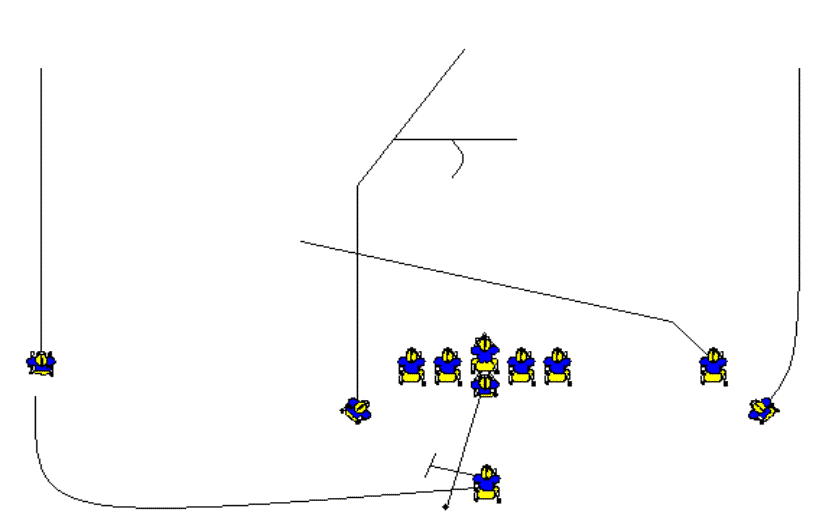
A SIDE ORDER OF FOOTBALL
THE
WILD BUNCH:
A
SIDE ORDER OF FOOTBALL
By
Ted Seay
NUMBERING SYSTEM:
TWO
DIGITS = RUNS: Back (H=2, FB=3,
Z=4) and hole (see Pages 3 and 4).
THREE
DIGITS = PASSES:
First
digit is QB drop
and protection - 100 is 5-step cup, 200 is half-roll, 300 is play action.*
(See Page 24 for Pass Protection rules.)
Second
digit is motion:
2 sends H to Bunch, 1 sends Z to Spread, 0 = No Motion.
Third
digit is route
package: 0 = Seam, through 7 = Slide.
*Note:
In play action (300), second and third digits are the
running play being faked.
NOTE:
This document is in the public domain --
no
copyright is claimed on any of the author's material herein.
Q:
Do you consider the Wild Bunch an "order of football?"
A:
No. The Wing-T is an order
of football.
The
Wild Bunch is more of a side order.
I
am a big fan of the Mouse Davis Run-and-Shoot offense, and have been ever since
I was an undergrad at Berkeley around 1980.
Like many others, I had heard of the unbelievable scores Davis' offense
had posted at Portland State since 1975. Davis
was brought in for a one-year stint at Cal as Offensive Coordinator under Head
Coach Roger Theder while I was a student there.
I still remember sitting in the stands at Memorial Stadium during open
practices that summer, when Davis would run the offense through his
revolutionary package, and I would furiously scribble notes and diagrams.
A running back I shared a class with explained to me the Davis theory of
reactive offense: classifying
defensive secondaries as Three-Deep, Two-Deep, Man or Blitz, then adjusting
routes based on defensive reactions. Those
reactions were highlighted by the use of long motion across the formation on
almost every play.
My
love affair with the Run-and-Shoot culminated in a head coaching job in
Melbourne, Australia from 1988-90, where I installed the R&S and took a
last-place team into the semi-finals. The
second year, two teams ran the R&S, and the other one won the championship
(the Division III studs they imported from Ohio didn't hurt, either).
All
during the 80's, though, I was torn between the demonstrated power and
simplicity of the R&S, on the one hand, and the fascinating experiments that
Joe Gibbs, Bill Walsh and others were performing with compressed formations, on
the other. I tried time and again
to apply the bunched receiver principle to the R&S, but without success.
Finally, while working in the U.S. in the summer of 1995, I had the
opportunity to coach an entry in a high school 7-man passing league.
The head coach and offensive coordinator (both die-hard Power-I types)
weren't around that summer, so I interpreted the HC's instructions in May to
"have some fun" fairly broadly: I
installed the original version of the Wild Bunch (I think I called it something
really lame like the "Cluster Bomb").
Key
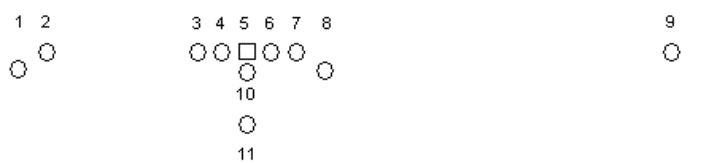
to Page 4 Illustrations
1: Z back
4: Bunch Guard
7: Spread Tackle
10: Quarterback
2: Y end
5: Center
8: H back
11: Fullback
3: Bunch Tackle
6: Spread Guard 9:
X end
(Note:
Numbers 1-9 in Right and Left below are also our hole numbers for runs.)
WILD
BUNCH: FORMATION AND ADJUSTMENTS
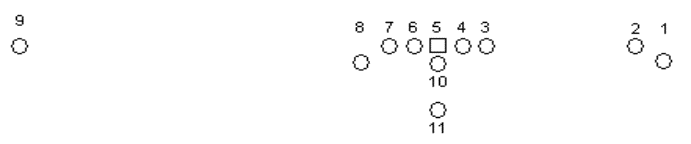 Right
Right
Left
Swap Right
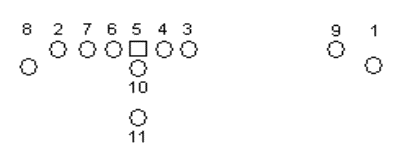
Swap Left
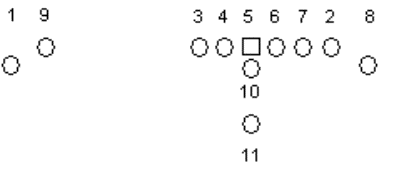
The
X end (17 yards from his tackle, but no closer than 6 to the sideline) and H
back (1 yard from the same tackle, 1 yard back) made up the Spread side, while
the Y end (6 yards from the other tackle) and Z back (1 yard further out, 1 yard
back) formed the Bunch side. The FB's feet were 5 yards from the LOS, directly
behind the QB. The (theoretical)
line used one-foot splits. We sent
H in motion across the formation to form the Bunch, or Z in the other direction
to form R&S Trips. To the
R&S Seam, Go, Slide and Smash patterns, I added a bunched Slant and Fade.
Using those six patterns and a Draw off of Go action, we tore a hole
through the competition. Like Lucy
Ricardo, though, I had "a lotta 'splainin' to do" when the coaches got
their team back that August...
In
1997, Andrew Coverdale and Dan Robinson's outstanding The Bunch Attack:
Using Compressed Formations in the Passing Game (Coaches Choice
Books: Champaign, IL, 1997)
codified and greatly added to the bits and pieces of Bunch offense I had picked
up along the way. The Wild Bunch emerged in a recognizable form that year:
the passing game consisted of Seam, Cross, Smash, Go, Mesh, Triangle,
Switch, Slide and Over route packages. The
running game was a combination of R&S (Trap and Draw) and modern one-back
(Inside Zone and Counter Gap). I
have since added the Fly Sweep series (Sweep, Dive and Bootleg) to provide a
sequenced run-pass threat, and to get H or Z out wide with the ball while using
the same motion that creates the Bunch or R&S Trips.
Where
the tendencies of R&S and Bunch have conflicted, I have gone with
simplicity. There is only one
formation, for example, not including the Swap adjustment to blitz situations
(Page 4, lower diagrams -- see discussion of zone blitz on Page 27).
This saves an unbelievable amount of practice time, and allows the
offensive to get more practice reps of the 16-18 core plays we normally carry.
Since we flip-flop the offense, players get used to running plays, both
right and left, from the same position relative to their teammates. (With the defense spread across the field, and motion across
the formation used on almost every down, the Davis R&S has utilized
"only" one formation, yet has managed to avoid stereotyping for the
last quarter century -- so I'm not too worried about its stepchild, the Wild
Bunch.)
If you're looking for a way to "air it out", look no further. The Wild Bunch offers the best of two highly-evolved passing attacks -- the R&S provides an unparalleled method for stretching the defense and reading its adjustments to long motion, while the Bunch Attack offers some of the most cunning route packages ever designed. In fact, with both arsenals and the Fly Sweep sequence to choose from, offensive football becomes downright fun, especially in the Red Zone. There is no way for the defense to overload against one receiver or one route package without instantly and obviously exposing a weakness elsewhere. As for the running game, I leave the last word to Mouse Davis: "The only way to stop us running is to let us pass."