Earth's Grand Canyon is a wondrous
spectacle of history and slow, steady power. Mount Everest, the tallest
of all Earth's mountains, reaches nearly thirty thousand feet above sea
level. As encompassing and overwhelming as these features are, geologic
features on Mars far outmatch these tiny irregularities on Earth's crust.
Olympus Mons on Mars is the solar system's largest mountain (actually a
shield volcano) towering twenty-five kilometers above the surrounding plain.
Valles Marineris is a huge gash cutting three quarters the distance around
the planet, easily dwarfing the Grand Canyon on Earth. Total relief
on the Martian surface is thirty-two kilometers. It would follow
that adiabatic cooling is of major importance among Martian climatic controls.
Below are links to images taken
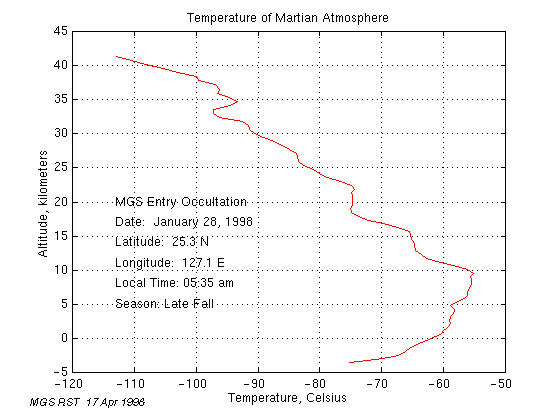
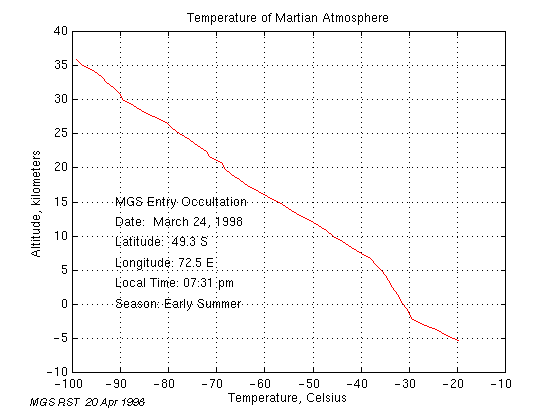
by the Mars Global Surveyor (Twicken and Hinson, 1996). Like the
normal lapse rate on Earth, the Martian lapse rate undergoes directional
changes in its temperature curve as altitude increases. Since these
changes in Earth's normal lapse rate are attributed to different chemical
and other characteristics in the stratification of the atmosphere, one
can assume a similar explanation for the appearance of the Martian lapse
rate.
Late
Fall Temperature versus Altitude
Early
Summer Temperature versus Altitude
The lack of definitive temperature
inversions in the early summer chart suggest a fairly uniform atmosphere
at that time. Possibly, the warming and expanding atmosphere, with
increasing summer winds provides the mechanism for a fairly homogenous
atmosphere.
Although Mars has very large relief,
one must keep in mind that Mars has no oceans. If the oceans were
striped away on Earth, vast trenches would be revealed in subduction zones.
The relief on a waterless Earth would be much greater that what is now
displayed on Mars. This follows the fact that tectonic activity on
Earth is still shaping and reshaping the crust while Mars is tectonically
dead (or very nearly dead).