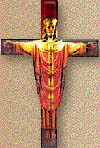
St. Candidus
He, whose
relic resides in the altar stone of Christ the King Roman Catholic
Church in Hollywood.
The information
below has been copied from a brochure written by Msgr. Francis
J. Weber, Archivist for the Los Angeles Archdiocese.
"According to Alban
Butler, Candidus was a member of the Theban Legion,
a group of Christian soldiers recruited by Maximian Herculius
in Upper Egypt for the purpose of putting down a recalcatrant
tribe of Gauls called Bagaudae.
When Maximian ordered all
his soldiers to join in offering sacrifice to the pagan gods
for the success of their expedition, the members of the Theban
Legion refused to take part in the rites.
Candidus, known as the senator militum,
was among the leaders of the Theban Legion who led the opposition
to Maximian, noting that "we are your soldiers, but we are
also servants of the true God. We cannot renounce Him who is
our Creater and Master, and also yours even though you reject
Him."
Maximian, seeing no hope
of overcoming their constancy, ordered that the entire legion
be put to death. This all occurred near Agaunum (c. 287 a.d.)
and September
22nd is the day
that Candidus and his companions are commemorated in the Roman
Martyrology.
St. Eucherius, the bishop
of Lyons during the first half of the 5th century, is the source
of the story about Candidus.
Though certain aspects of the account are ambiguous, it seems
clear that the martyrdom is an historical fact.
For many centuries, the
principal relics of Candidus
and his companions were preserved in a 6th century reliquary
at the Abbey founded by Saint Theodore of Octodurum.
Prior to the 3rd century,
Candidus was a name without Christian significance
and one probably derived from pagan ancestors. That Candidus
was fairly well-known by the 9th century is attested to by at
least two prominent clerics who took his name, Candidus of Fulda
(d. 845) and Candidus, the Anglo-Saxon disciple and confiant
of Alcuin."
So,
you may ask, how did the bones of a third-century martyr end
up in Southern California? Read on!
"Very little is known
about the peregrination of the relics of Saint Candidus which were enshrined in the Serra
Chapel at San Fernando Mission in the final weeks of 1992. The
presumption is that shortly after they were encased within a
waxen portrayal of the Saint, the relics were brought from Rome
by Bishop Thaddeus Amat, probably in January of 1868,
In any event, upon his
return from the Eternal City, Bishop Amat entrusted the relics
to the care of the Lazarist Fathers who then conducted Saint
Vincent's College in Los Angeles."
How
did Candidus' bone fragment get from St. Vincent's college and
the Lazarist Fathers to Christ the King Church in Hollywood?
Msgr. Weber explains that ...
"It was probably at
that time that the bishop removed a portion of a bone from the
reliquary.
Since
the 1860's, over 90% of the altar stones used in Southern California
contain relics of Saint Candidus.
Shortly after the new church
of Saint Vincent de Paul was dedicated by Bishop Franckis Mora,
on February 20, 1887, the relics were moved from the college
chapel to the new ediface at the northeast corner of Grand Avenue
and Washington Boulevard.
In 1892, new altars were
installed in the church and the relics of Saint Candidus were placed beneath the shrine
of the Sacred Heart, at the at the far end of the Gospel side
of the sanctuary. The relics remained in place for the next thirty-eight
years, until 1925, when the present Saint Vincent's Church was
opened at West Adams Boulevard abnd Figueroa Street.
Father Terrence O'Donnell,
C.M., a former pastor of Saint Vincent's Parish, explained that
when the relics were moved from the old to the new Saint Vincent's
Church in 1925, the documentation (along with one of the parochial
Baptismal registers) was stored in a wastepaper basket. An overly
zealous custodian threw the basket and its contents into the
trash.
For some unknown reason,
there were no provisions made in the Spanish Renaissance Church
for Saint Candidus, although portions of his relics
were placed in the altars of the Miraculous Medal and Saint Joseph
for their consecration in 1930.
The wooden sarcophagus
was placed atop the vesting cabinets of the eastern-most sacristy
and there they remained until the mid-1980s when they were consided
to a storage area in the church's cavernous basement."
What
has happened to the rest of Candidus' relics, those parts of
him that are NOT scattered among the various altars of Southern
California's Roman Catholic churches, including Christ the King's?
"In September of 1991,
the massive sarcophagus and its contents were moved to the San
Fernando Mission. The waxen figure of Candidus was sent to the South Coast Fine Arts Preservation
Center for cleaning and the wooden case to Carmel where it became
the model of a wholly new altar-shrine built by Richard Menn.
Its tabernacle is part
of the Escaray collection acquired by the archdiocese in 1944.
Hand-finished wooden candlesticks were the gift of the late Msgr.
John Cosgrove.
Without any question, the
Serra Chapel, with its altar-shrine of Saint Candidus, is unique
along the Pacific Slope. Its beauty, history and tradition combine
to produce one of the truly outstanding houses-of-worship in
the Western United States."
|