1) Identify all the users.
- For model aircraft enthusiasts.
- SAE students who hold AMA and/or MAAC licenses.
2) Observe users and target environment.
- For outdoors use in open fields (no trees, no power-lines in the way).
- To fly in rain or shine.
- Modify design according to take-off and landing (particularly the landing gears).
- user must have a fair level of competency
3) Perform task analysis.
- Theory and design for optimization of lift, rigidity, and stability, while reducing drag. Also engine capabilities into considerations.
- Design starting with the fuselage.
- Next, design airfoil and wing aspect ratio and the overall length of the plane as a function of each other. For example, if the airfoil is thick, then it permits a wing with a longer chord length, which would in effect determine the length of the tail boom for overal length and stability.
- Extra modifications of the wings may include winglets, flaps, ailerons, and dihedrals, and reinforcement trusses.
- Computer aided simulations and testing.
4) Solicit user preferences.
- Controlability and maneuverability issues.
- Comfort in handling.
- Maintenance requirements.
5) Pros and Cons of existing designs.
Consdering Bi-plane Model:
Pros:
- Extra wing to add extra lift.
- Due to wingspan limitation, a bi-plane configuration would help.
Cons:
- More servos required?
- Positioning of the second wing on top of the first wing is vital.
- Streamline of air flow may counter each other in between the two wings.
- Difficult to secure second wing into proper positioning.
Considering Outboard Horizontal Stabilizer (OHS) Model:
Pros:
- Theoretically produces greater lift.
- Experimental wind tunnel proto-types have shown better results than conventional configurations.
- Angle from landing gear to end of tail booms is greater, therefore increasing angle of attack on wing during take-off.
- The tail wings on the booms makes use of the vortices generated from the edges of the wing to help generate extra lift.
Cons:
- 6ft limit in competition means the overall width of the aircraft is limited, which translates to down scaling the entire model, which leads to less effective lift.
- Difficult to manufacture to specific geometry (particularly the booms trailing from each end of the wing; booms must be leveled identically with no deviations).
- Servos to the booms' veritical wings may prove challenging.
- Unconventional design (novelty design) which may require higher level of experience, not recommended for beginners.
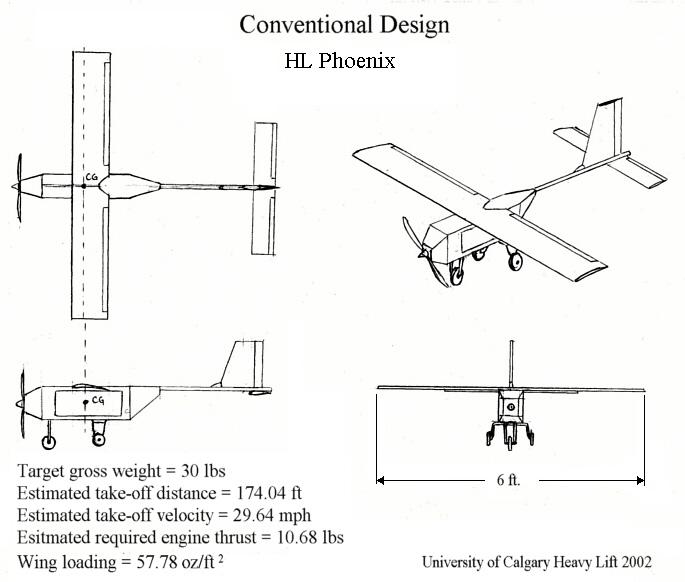
Considering Conventional Custom Model:
Pros:
- It is a proven model that works.
- Calculating for stability may be relatively easier than the other considered designs.
- Connecting servos in regular fashion (does not require imaginative approaches).
- Well balanced, hence why it is conventional.
- Although it has a conventional configuration, it is still customizable to the designers' liking.
Cons:
- Competition rules enforce a wing span limitation which could hamper the design.
- May lose points on originality and lack of innovation.
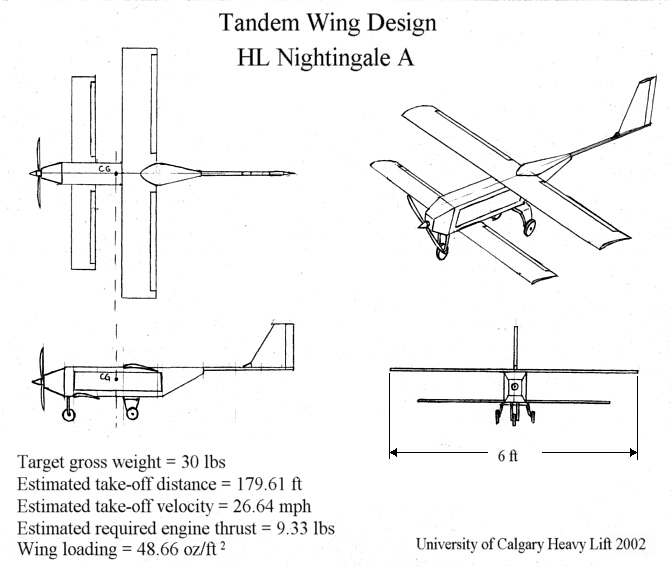
Considering Tandemn Wing Model:
Pros:
- Extra wing to help with lift and support.
- A proven design that is stable.
- Reduced average wing loading.
- Reduced overall drag.
Cons:
- Difficult design.
- May need different sets of airfoils for front and rear wings.
- Positioning of wings and separation distance is vital.
- Configuring servos to fit the design may be a challenge.
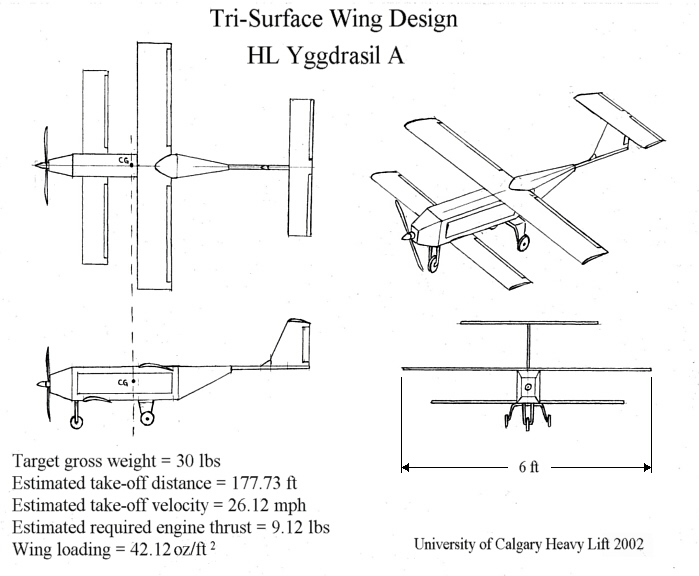
Considering Tri-surface Wing Model:
Pros:
- Three wings to help with lift and support.
- A proven design that is stable.
- Even more reduced average wing loading.
- Reduced overal drag.
Cons:
- Even more difficult to design.
- May need different sets of airfoils for front, middle, and rear wings.
- Positioning of wings and separation distance is vital.
- Configuring servos to fit the design may be a challenge.
Concept Design Review Package [DOWNLOAD]
Project Plan [DOWNLOAD]
