MAY 1985 || STARS
1985 would be a quiet year for Priest on the tour circuit, as they spent time over in Phoenix, Arizona where Rob Halford made his home, recording demos at Chaton Studios and writing ideas for their next album. But it would prove to be quite a busy year for Rob Halford. An admirer and good friend of Tony Iommi and of Ronnie James Dio, Rob would find himself involved with projects for both artists:
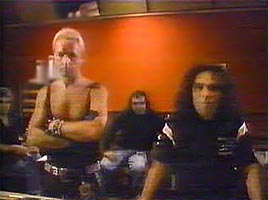
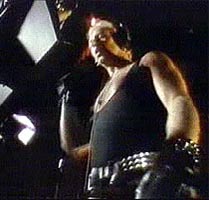
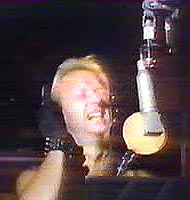
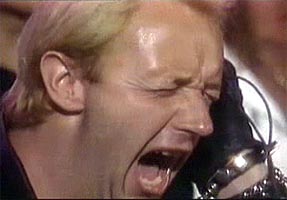
On May 20 and 21, 1985, Rob lent his vocals to Dio's famous charity recording of "Stars" on the HEAR 'N' AID album.
|
"I've known Rob for years and years. He always turned up backstage to see us and I'm proud to count him as a true friend. I care a lot for the guy and he will always have a true ally here. When we did the HEAR 'N' AID record, Rob moved his entire schedule to do that for us. I can remember asking him and thinking to myself that it might not happen because Judas Priest was busy, but Rob basically said, 'Anytime, anywhere - just call me'. The Children Of The Night fund was very important to him and he made it a priority, That's exactly what he did too."
"This is the only sector of music that hasn't really done anything in the form of relief for what's going on over in Africa, and it's just a joy to be involved, you know..." |
Also in May of '85, Tony Iommi found himself without his former Sabbath mates, as well as stranded on a solo project without a singer. In the end, label pressures caused SEVENTH STAR to be a Black Sabbath release instead of an Iommi solo album, and Glenn Hughes got the vocal slot for the entire album, but at the early planning stages, ideas were kicked around about bringing a few high-level singers in, among them the names of fellow Brummies Robert Plant and Rob Halford, whom Tony would talk to later on about it:
|
"One day Tony Iommi told me he was thinking of putting together a solo record. This was very early stages, as he had no band at all at this point... As things went on, we learnt Tony had in mind to use Jeff Glixman as a producer and he wanted different singers involved. I remember the names Plant, Coverdale, Halford and Hughes mentioned. That was the initial plan."
"I think we were working on the Judas Priest tour for TURBO, which for us was another hugely successful album, our third platinum record in a row. I think Tony had got it in his mind but had been unable to follow it through. Actually, it is all kind of lost in the memory banks. I think we spoke, but how far it got, I can't remember." |
JUNE 1985 || TURBO SESSIONS START
After the huge success of the DEFENDERS OF THE FAITH world tour, plans got under way to release a double-live album. But Judas Priest were also approaching their 10th anniversary with CBS Records and realized this would be the 10th studio album of their career as well, so to commemorate the event, they decided to hold off the live album and pursue a new studio release instead
|
"It was basically for a number of reasons. The main one was that we were really into the idea of coming up with something new for our 10th studio album. Also, the timing has to be just right when you bring out a live album and the general consensus was that it wasn't quite right, simply because we had so many new ideas that we really wanted to present to the fans. But, it's more or less been verified with Bill Curbishley and everybody else concerned that we're definitely going to put out a new live LP after this world tour." "We really didn't set out to do anything other than make a new Judas Priest record. The fact that it emerged as something extraordinary was quite by accident. We were the victims of a most pleasant circumstance - we had a great deal of time to prepare for this album. That's something we never really had the pleasure of having before." "The fact that we are celebrating our 10th year as a recording band with our 10th LP made us want to give the fans something very special. That's all we tried to do." |
British pop music success had always been a driving factor for Priest from the very beginning. The production team known as 'Typically Tropical' had produced SAD WINGS OF DESTINY in '76; BRITISH STEEL produced two highly successful hits in 1980, helping push music videos and MTV into the forefront of pop culture; and 1982's SCREAMING FOR VENGEANCE saw the band's first platinum success, landing them on such world-wide arenas as US Festival and Live Aid. Throughout their career, Judas Priest have demonstrated that a major key to their success has always been to take a melodic approach to heavy metal, while at the same time, remaining the heaviest and fastest of them all. This time around, the guys were going to lighten up a bit and be in a celebratory mood - in one interview they joked that they were even beginning to depress themselves with their dark songs! But they were determined now to celebrate their first decade with an effort that would be fun, experimental and a crowd-pleaser:
|
"We could have filled TURBO up with half a dozen hard-hitting, seven-minute long metal tracks, but then you start looking back on the other albums you've done to see what the most successful ones were. And, when it boiled down to it, our most successful songs were the most commercial ones, like 'Breaking The Law', 'Living After Midnight' and 'You've Got Another Thing Comin'...So, when we were doing TURBO, we just picked out the tracks that we thought the majority of people would end up liking. |
But TURBO finds Priest as innovators and leaders of a technical revolution in an all new environment - a digital world ready for a commercial breakthrough. As new innovations in digital recording were becoming available at the time, producer Tom Allom and the band were intent on using the technology (including synth guitars - a first for heavy metal) to its fullest to enhance the overall sound capabilities of the new album. With writing sessions completed in Spain, the band flew to the beautiful Bahaman island of Nassau in the summer of 1985 and entered Compass Point Studios, one of the world's first studios to use Sony Digital recording equipment and decks... In fact, TURBO is noted as being the first all-digitally recorded heavy metal album!
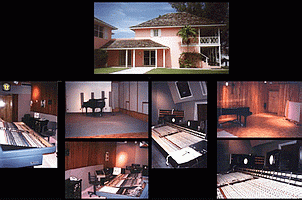
The Current Compass Point Studios - Rooms A & B
|
"The songs, the performance, the production - everything just came together the way we wanted. In a way, I believe it's a more sophisticated album and, of course, we definitely worked in a different recording style with Sony Digital. That allowed us to explore certain technical dimensions that we'd never worked in before. That enhanced the overall quality and production. The actual sounds coming out of the speakers just blew us away. And, when you've worked in studios for as long as we have, you can really tell the difference between working digitally and the normal way. More than anything, you get a better separation in the sounds, where nothing overlaps. And, since we were aware that we were going to be making CDs, the best way to record them is digitally. "The disadvantages of shifting from analogue to digital recording are few. It depends on how good your ears are. People who have much better ears than me say that analogue sounds better. Personally, I can�t tell the difference. There is a sort of earthiness and warmth to analogue, which digital, perhaps, doesn�t have; but digital is just so much more easy to manipulate, and it�s obviously the way forward. It�s just that for years we�ve been using a technology which is already twenty-five years old, and it�s only the new generation of digital recorders that are doing justice to digital recording. |
Tom Allom had been instrumental in putting great sound effects on Judas Priest records since 1980's BRITISH STEEL, but in those days, there were no digital samples or other convenient ways of producing those effects. Now the band once again teamed with Allom, giving him the opportunity to venture along with Priest into uncharted waters and new frontiers...
|
"Well, the reason we've continued to work with Tom Allom is basically down to the fact that, as the years go by, he gets better and better all the time. And, without a doubt, I don't care what anybody says, he really is one of the finest record producers in the world. And I'm not just saying that because it's Tom - there are times when I don't like him! We have the occasional confrontation, but a lot of producers just don't have the amazing musical ear that Tom's got. He's an excellent musician, and he's great on the control desk because he used to be an engineer. Aside from that, he comes up with a lot of great ideas." |
Well-known veteran recording engineer Bill Dooley was also called upon to dial the knobs for the Turbo album. Bill was a graduate of Boston, Massachusetts' Berklee College of Music in 1976 and has been involved with Atlantic, A&M and Village Recording Studios (among others). Dooley has also racked up credits on hundreds of major record releases as a session and mixing/mastering engineer.
So with a top-notch recording team and a world-class all-digital studio, it was time to put together a monumental album to celebrate the 10th studio recording of Judas Priest!
July 1985 || TWIN TURBOS
Initially, Judas Priest were set to do something really special for this
release - a concept of sorts:
The band wanted to release an album of material that would chronicle the different styles of metal Priest had explored in their career, leading up to the new approaches they were currently experimenting with, and put it all together with a digital precision they felt would be technically superior to anything that had previously been done in metal. The songwriting sessions had gone extremely well - so well in fact, that the band had enough material for a double album and a working title: 'TWIN TURBOS'. 18 songs were recorded and set to go, when CBS Records put a halt to the project. Double albums were quite uncommon (costs and prices were higher, which meant sales and profits were lower), usually reserved for live recordings and "best of" collections. K.K. claims the band wanted to offer the double LP at a single album price, but according to a
1986 report in Sweden's OKEJ magazine, "the powers that be" wanted a standard album full of potential singles and the Priest members were forced to cooperate...
|
"CBS refused to release a double album described as a 'journey through the history of metal' and the new Judas Priest release will be a more regular single album." "The concept originally was we were going to try and do like a 'history of Priest', and we wrote 19 tracks and we were going to do a double album. It's Priest's 10th album and we wanted to, as a gesture, give the kids something, but unfortunately, when we came to put it together, we couldn't logistically put it out for the price of more than one album and we didn't feel that was achieving what we started out to do, which was to donate something to the kids and our fans who'd stuck with us through 10 years. "For the first time in our career we'd actually written enough songs for a double album. I wanted to call it 'TWIN TURBOS', but that didn't work out so we put all the most commercial stuff on one album. We were probably aware that it would be hard for some Priest fans to accept but we wanted to have an album with a consistency of style throughout. Previously, they had all been very varied." "Actually, we talked quite extensively about it, and then we recorded 19 tracks for a double album, which we wanted TURBO to be at the time. Then we picked nine tracks that we thought were a bit different, sat down and rearranged them and really tried to capture a slightly different feel. We wanted a change, but not too much of a change either, we just wanted to do something different. But, of course, when you do that you have to expect a bit of apprehension from people, which we got. But I guess TURBO is eventually turning out to be our most successful album to date, so we can ignore them anyway. Also, in retrospect, everybody has come back to us and said that they had been a bit skeptical at first, but now they realize it's really the way to go. We are proud of the fact that some people look at Judas Priest as frontrunners, really!" "I think during the writing process, we always thought that we had been so prolific with the ideas, and it's always great for a band to do a double album. We liked the idea, but just putting the strongest ideas together that had some sort of flow, like TURBO did, seemed to be a stronger idea at the end of the day. "At the time of TURBO, we had all these songs and it didn't come about for what ever reason. The record company said, 'No, it's got to be a single album', so we said, 'OK, what do we do? We got 20 songs, 10 of which were TURBO and 10 of which were other songs. 'Ram It Down' for example from the RAM IT DOWN album was one of those songs - there was 'Monsters Of Rock' and a couple of other things on there you know? Probably bits and pieces. The rest of it we sort of discarded because as time moves on...we just said, 'Let's start fresh.'" "We heard all sorts of things about TURBO, which can only be expected when you do something which is a step forward, an advancement in a certain musical direction using synth guitars. Some people liked it, some didn't. Some people, when they like something, say strawberries on cream, don't want it to change. They don't want you to try anything different We can appreciate that... We thought TURBO would take us flying into the charts and be very well received by the radio stations and general media more so than DEFENDERS OF THE FAITH was. It didn't really work out like that for some reason. I suppose Priest are just unacceptable even though Scorpions have become accepted and Quiet Riot and Twisted Sister were, but Priest have never really broke through in the big style like that. If anything, our fans prefer us that way. We are something of a cult band, if that's the right word." "We are fortunate because as a band we've always been on the up, always getting more successful. Sadly, I've seen a lot of bands hit that sort of peak and then eventually start supporting again, you know, which we will never do. We always put a lot of thought into the way that we are going to go, and we always change. Each album has got a new sound or direction, and as individuals we change as well, and I think that is what gives us the longevity as a band. We do think about it a lot, because if you don't, people will get fed up with you. Like if every Judas Priest album sounded the same. Then the people would say, 'Well, we bought the last one'..." "With TURBO, although people were a little apprehensive about it to start with, they did finally accept it. I think people thought we were prepared to go another direction. Subconsciously we wanted to make the point that Priest will never change and that if anything we will get heavier as the years go on. "I think that if we had been ashamed of TURBO, we would never had released it. The fact is, TURBO was a successful album. Particularly in America: It's gone platinum which is over a million copies. You know, bands go through different periods musically and image wise, and I'm happy that we've been able to do that. Again, coming back to this feeling of not wanting to be repeating yourself over and over again with the clothes, with the music that you play - just trying to have something new to say all the time... We're just trying, like we've always done, to show people that heavy metal isn't just one dimension. It's not just like heavy riffs in A or heavy riffs in the chord of E; you can take it lots of different ways. So, Judas Priest is 'Turbo Lover'; Judas Priest is 'Freewheel Burning'; Judas Priest is 'Living After Midnight'; Judas Priest is 'Victim Of Changes'. "We felt with TURBO, if this is our time to do it, let's go out and purposely do a really commercial album. I've never told anyone that, but it's true. It just fit the time, ya know? It just seemed right to make it lighter and happier, than dark and sinister; do you know what I mean? It just flowed. Bands go through phases with how the world feels at the time." "We�ve never been afraid to try any bell or any whistle. We�ll give it a go. If it sounds great, then great. If it doesn�t, we can let it go. It�s a simple as that. With TURBO, we used these guitar synthesizers that went from a guitar and through a processor, and you could make them sound like anything. We thought, this is a great idea. We probably went a bit over the top with it. It had a lot of mixed reviews when it came out, and it may have lost us some fans, but we probably gained a few as well. I think now it is starting to be recognized as a bit of a landmark. We always get people yelling for 'Turbo Lover' - it is one of the fans� favorites, which surprised me." "To tell the truth, it's just one of those things that happened because we found ourselves in an incredibly creative period. Glenn, K.K. and I started writing in Marbella, Spain, and it reached a point where we had in excess of two albums worth of material. So what we did in the end was stockpile all the extra material that didn't go on TURBO, which we will ultimately release in one form or another." |
Eventually most of the TWIN TURBOS demos did surface as Rob promised, showing up on RAM IT DOWN and as many of the bonus tracks on The Re-Masters series. The following is a listing of the 18 tracks that were recorded during the TURBO session:
Released on TURBO:
1. Turbo Lover
2. Locked In
3. Private Property
4. Parental Guidance
5. Rock You All Around The World
6. Out In The Cold
7. Wild Nights, Hot & Crazy Days
8. Hot For Love
9. Reckless
Released on RAM IT DOWN:
10. Ram It Down
11. Hard As Iron
12. Love You To Death
13. Monsters Of Rock
Released on the Re-Masters series:
14. Red, White & Blue
15. Prisoner Of Your Eyes
16. All Fired Up
Still unreleased:
17. Under The Gun
18. Fighting For Your Love
One other song recorded during the TURBO sessions, but not intended for the album, was called "Turn On Your Light":
|
"This track was recorded by Glenn and Rob one night, in one take, and captures the sentiments and emotions of the song beautifully. Glenn added the middle and end lead at a later date." |
AUGUST 1985 || JEFF MARTIN
Though it is not often credited in the liner notes (mostly due to legal reasons), many bands, including Priest, have used outside musicians (such as keyboard players and backing vocalists) on previous albums, and in the case of TURBO, one particular musician got to play an un-credited part in the recording of the album:
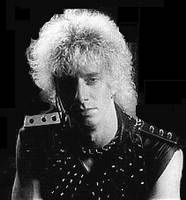
At the time, vocalist Jeff "Motorman" Martin was still in the Phoenix, Arizona heavy metal outfit Surgical Steel, who had just finished filming a part in the cult film THUNDER ALLEY and for whom Rob Halford had lended his coaching and voice to their demo the previous year. Soon after, martin would team up with guitar genius Paul Gilbert to form Racer X (who would also play host to future Judas Priest drummer Scott Travis), but in late August 1985, Rob Halford invited his friend Jeff to the Bahamas to attend the TURBO sessions:
|
"Rob had flown me and my wife out to the Bahamas where they were recording Turbo at Compass Point. I even sang on one of the tunes: 'Wild Nights, Hot & Crazy Days' - I sang on the chorus. I wrote lyrics to 'Private Property' and Rob used the second verse. Katrina and I stayed at an English stone cottage right on the beach just a few blocks from the studio with Rob's brother Nigel, his sister Sue, and his mom and dad. I have yet to meet anyone as cool and loving as them - testimony to why Rob is such a cut above! I also played pool with Julio Iglesias, who was doing an album at Compass Point at the same time. My true claim to fame: I won! "Jeff showed me the pictures from the Bahamas - some really cool pictures of him and Halford launching a toy rocket... and Jeff made the comment, 'How's this? Motorman and the Metal God playing with rockets!'" |
As Jeff mentioned, Julio Iglesias was also recording an album at Compass Point Studios, which sparked a long-running rumor when music publications began reporting that Iglesias was recording a song with Judas Priest. There was even a quote by Julio himself saying the song was an "electric bolero". The reports didn't sit well with the fans at the time, and the press began saying Judas Priest had sold-out. But when the song failed to appear on the TURBO album, the story was passed off as mere rumor. And when The Re-Masters finally gave us the unreleased recording of "Prisoner Of Your Eyes", it was clear that Julio's voice was not on the song. That seemed to be the end of the story until Judas Priest paid their first-time visit to Argentina in 2001 and a journalist from a local magazine caught up with the band and asked about the Julio Iglesias rumor:
|
"The true story from this stuff is that we were recording in the Bahamas and Julio Iglesias was recording in an adjacent studio. I remember that we were doing a song that wasn't included on the TURBO record - that song was 'Prisoner Of Your Eyes'. Recently we remastered the old Priest catalog. We went into the studio and we found a lot of songs that we recorded but never released on the LPs, and 'Prisoner Of Your Eyes' was one of them. As far as I can remember, Rob was singing that song in the studio and Julio listened to him and said to one of our technical experts, 'I want to sing on this song!' But in the end, it never happened." |
SEPTEMBER 1985 || FUEL FOR LIFE
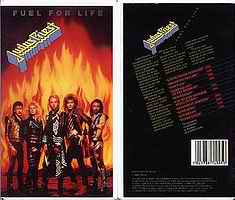
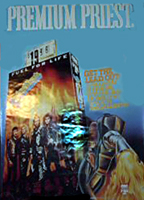
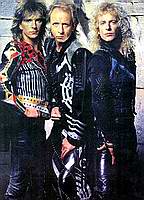
With TURBO ready for release, Judas Priest fired up the promotion machine for their 10th album. Dubbed Fuel For Life, it was their most elaborate and ambitious outing ever. Along with the usual magazine ads and radio spots, TV commercials were also aired to promote the TURBO album.
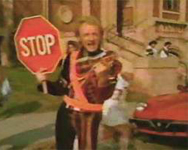
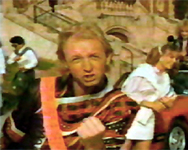
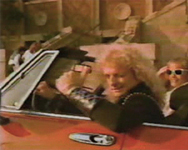
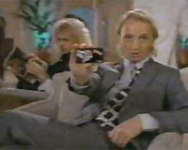
One featured Rob as a school crossing guard giving a "public service announcement" warning against getting into "a stranger's car" and admonishing to "always make sure you're burning on Turbo power." But the school girl still ends up in K.K.'s car, and off they go in a peel-out of burning rubber...
 |
 |
 | |||||||
|
| |||||||||
NOVEMBER 1985 || ROB'S PERSONAL CRISIS
With a breakthrough album in BRITISH STEEL and the platinum status of SCREAMING FOR VENGEANCE, the members of Judas Priest were riding a tidal wave of success - while facing the pressure of trying to maintain the momentum:
|
"Running on cocaine and Jack Daniels - I mean excess in the biggest possible word. We pigged out on sex and drugs and rock 'n' roll". "Sipping martinis at all hours of the day - marvelous how we got through it really!" |
Yet for all the success and excess, Rob felt alone and isolated. He struggled with the fact that he was gay and having to keep it a secret because of his heavy metal image:
|
"You come off stage and there would be all these girls and so on in the dressing room. That wasn't my world; I didn't fit in. There was no place for me to go, because that's not where I felt I belonged - I wasn't with my own people." "It's horrible. The show ends, everybody goes to the titty bar or the nudie bar, and they all pick up a bunch of chicks and go up to their rooms. That's not me. I'm a gay man. So it was a very isolated, lonely kind of experience. You do this great show in front of thousands and thousands of adoring fans, [many of them men]... "Rob wasn't encourage to reveal his secret to the public. It's fair to say we were happy with Rob and with his image. We didn't want anything to happen that was gonna change that". "I can't pretend to imagine the pressure that placed on him, because the band were perceived as being so macho." |
Between the pressures of fame and the confusion of his feelings, Rob was sinking into depression:
|
"There was a tremendous feeling of a lack of esteem and emptiness and complete helplessness - and that sounds bizarre when you walk out onstage in front of 20,000 people and scream your lungs out - but most of those shows, I was smashed out of my mind. I was a full-on, roaring, drug-taking, whacked-out-of-my-mind metal maniac. |
After a November '85 late night rehearsal in Phoenix, Arizona for the TURBO tour (possibly when the band recorded "Heart Of A Lion" at Chaton Recordes), Rob overdosed on the powerful painkiller, but he managed to call for help and was hospitalized. But after Rob was released from the hospital, his troubles were far from over...
Not long after returning from the hospital, a cataclysmic event took place that caused Rob to seek rehab for drug and alcohol abuse:
|
"Most of the men I'm attracted to are straight men. The boy I was dating back then had a cocaine problem. We had one of those bombastic physical attractions, and there was a tremendous amount of violence. We used to beat the crap out of each other in the drunken and cocaine rages that we had. And one day we were fighting, and I left for my own safety and called a cab. As I was getting in the cab, he came up to me and said, 'Look, I just want to let you know I love you very much.' And when he turned away, I saw that he had a gun. Moments later he put the gun to his head and killed himself." |
The event was too tragic and was a wake up call to Rob, who on January 6, 1986, checked himself into a rehab center in Phoenix for 33 days to deal with his alcohol abuse. But when the rest of his band mates came to visit him, Rob didn't feel they took him seriously:
|
"They came to see me lying in my bed and my glucose drip and must have thought, 'What is he doing here?' or you know, 'What's this about?' They wished me well and a speedy recovery and you know, 'Let's get back on the road...'" "I always kinda have a problem with people that have like psychological problems and don't really know how much these people are looking for a little bit of sympathy, or whatever the deal is, you know? It's always kinda hard to take that kind of thing totally serious, but we just went 'round and said, 'Oh, com' on Rob, you know, you look fine, you sound fine, you must be fine.'" "I had to go through those moments and bloody knuckles and so on to get to the point of recovery." "I'm a recovering alcoholic. I've been through twelve years now. I know what makes me tick, whereas before I was clueless..." |
Completing rehab in February, Rob emerged revitalized, with a world tour waiting in the wings to showcase his full and sober talent. As the 1987 Priest...Live! video and album would reveal, Rob was at the top of his game, jumping around on stage and belting out ear-piercing banshee screams like never before:
|
"Rob had this unreal voice that every metal singer would die for, and it just got better when he gave up drinking." |
With a sober outlook and a new lease on life, during Priest's Canadian leg of the tour in July, Rob participated in a campaign that was right up his alley:
|
"Rob started the ball rolling for Bikers Against Drunk Drivers by signing a large white poster of North America that B.A.D.D. hopes will be filled by several artists that have a motorcycle theme and who are well respected by B.A.D.D`s target group Pre-Driving Adolescents... Halford who often rides on stage with his Harley has gone through some hard times with drinking and is proud to say he is clean and sober." |
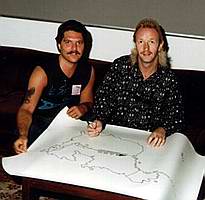
Rob Halford - B.A.D.D. to the bone!
|
"We used to record in a little studio in Ibiza, Spain and we would be fucking pissed [drunk] out of our minds, falling all over the place. But that's changed. Some of the guys still drink, but I haven't drank or drugged since January 6, 1986. I just knew that I was completely powerless over life, and when you admit that, it's your first step to becoming sane again. There's still a lot of temptation out there, and it's very easy to slip, but I've been given all the tools that I need to get me through each day, and it's working. |
MARCH 1986 || JAYNE ANDREWS ENTERS
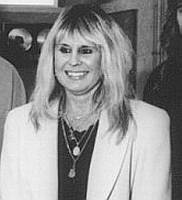
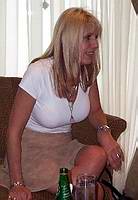
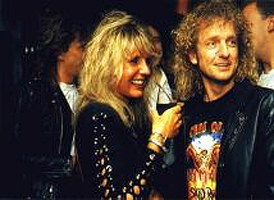
Jayne Andrews' history in the music industry includes working for Atlantic Records as well as being the personal assistant to Emerson, Lake and Palmer before joining Trinifold Management in March of '86, where she started out as the band's personal assistant and is credited as Production Assistant for the European leg of the TURBO tour. She then progressed to Management Co-Ordinator soon after and has held that title ever since.
|
"I started work here at Trinifold in March 1986 - I was originally the band's Personal Assistant and then progressed to Management Co-ordinator - basically you name it and I do it for the band! I now work directly for the band (but still out of the Trinifold offices) and we work very closely together as a team - they are my best friends as well!" |