A Value Network Approach
Verna Allee (2002) presents a new approach for managing knowledge organizations, she states that mastering value creation in knowledge economy requires an understanding of the pivotal role of intangibles and an insight on network dynamics. The methodology is grounded in principles of living systems, and represents a decided shift away from mechanistic models.
Allee (2002) advocates that from systems thinking perspective it is more useful to think of an organizations as value networks, a web of relationships that generates tangible and intangible value through complex dynamic exchanges between two or more individuals, groups, or organizations.
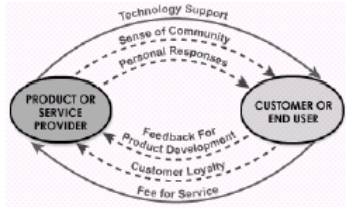
Figure 2.13
Modeling the value exchanges (Allee 2002)
Allee (2002) further states; while talking about analyzing the health and vitality of a value network, that effective self-organization is a critical success factor in a complex global environment. And self-organization can only happen when there are truly autonomous agents, such as people, who can make good decisions and take appropriate action. As network principles increasingly dominate the business landscape, it is vital that people learn to consider the health and vitality of the networks they are part of when taking action. The employees must be skilled in analyzing both the value they are receiving from the system and value they are contributing. Analyzing the impact of value inputs assures that people and their organization are receiving positive value for every tangible or intangible input they receive. If a participant feels they are not receiving fair value for their participation, they are quite likely to withdraw. Also, any participant that is not contributing real value to the network as a whole will become increasingly isolated, or even be expelled.
Allee (2002) gives a few core assumptions about Value Networks
1. Participants and stakeholders participate in a value network by converting what they know, both individually and collectively, into tangible and intangible value that they contribute to the network.
2. Participants accumulate value from their participation by converting value inputs into positive increases of their tangible and intangible assets, in ways that will allow them to continue producing value outputs in the future.
3. In a successful value network, every participant contributes and receives value in ways that sustain both their own success and the success of the value network as a whole. When this is not true, participants either withdraw or are expelled, or the overall system becomes unstable and may collapse or reconfigure.
4. Successful value networks require trusting relationships and a high level of integrity and transparency on the part of all participants.
5. Insights can be gained into value networks by analyzing: 1) the patterns of exchange 2) the impact of value transactions, exchanges, and flows, 3) the dynamics of creating and leveraging value.
6. A single transaction is only meaningful in relation to the system as a whole.