Culture based Knowledge
Sharing Model (CBKS)
Based on the literature review of Knowledge
Management domain and the view of knowledge discussed above, a model of
Knowledge Sharing focusing on corporate culture is proposed. The model
considers that the only source of knowledge in an organization is its employees.
Books, manuals, computer programmes etc. are not a true source of knowledge, but
they represent Knowledge Assets.
These knowledge assets
are converted into knowledge, when an employee interacts with them, and uses
his/her intellect to create value from these assets. The true value creation
therefore comes from the cognation ability of employees.
The importance of
knowledge assets are not overlooked, rather it is suggested that its management
may be considered by organizations under Intellectual Capital management
frame-works. The proposed model focuses on dynamics of knowledge sharing.
A book written by an
author, a film, rules of business, Management procedures or a computer programme
communicates with the user and convey the message of its creator to the user.
Knowledge assets can thus be viewed as potential resources for knowledge,
creating knowledge when invoked.
The model would be useful in
analyzing the knowledge flow bottlenecks in an organization and developing
strategies to improve knowledge utilization in organizations.
The Knowledge Sharing Model proposed is represented by diagram fig
(3.3). Four actors that influence knowledge flow in an organization are:-
a.
Communication Channels
b.
Individual attitude
c.
Group attitude and
d.
Organization Policies
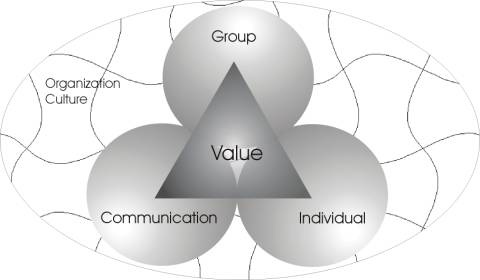
Figure
3.3
Culture Based Knowledge Sharing Model
a)
Communication Channels
The model
places books, technical documents, research reports, data bases, Internet
portals, seminars, interest groups and communities of practice as a channels
that facilitate knowledge transfer. Early human civilization was able to
transfer knowledge from generation to generation because they were able to
develop a language. Later on development of written script improved the process,
similarly in mathematics development of integration and differentiation was able
to convey very complex concepts, which was not possible before. The coming years
may see newer channels for knowledge transfer.
b)
Individual attitude
The model
considers individual attitude from the point of view of attaining new knowledge
from others in the group and secondly passing knowledge to colleagues working in
the group. Mutual respect, equality and non-discriminative attitude are
considered to be vital for knowledge sharing by individuals.
c)
Group attitude
Individuals interact together to form a group; good individuals would naturally
lead to good a group. But influence of group leader and group culture greatly
influence group interaction. Large organizations have groups and sub-groups. The
model considers group dynamics very important to increase knowledge sharing.
d)
Organization Policies
The
organizational policies navigate an organization towards better productivity or
disaster; it is an extension of the values maintained by the management.
Corporate culture is developed from the policies followed by an organization,
and plays an important part for the promotion and development of knowledge
sharing/ innovation activities in an organization.
Strongest criticism on the model may come from IT domain followers, objecting to
the need of a cultural change for the success of Knowledge Sharing initiative
and not the other way around. But recent research has proved that Knowledge
Management is more a culturally based issue, rather than a technical matter.
Similar to patriotism, or love. Patriotism cannot be grown directly in a child
or an adult, but a culture is developed to promote the feelings. If an orchard
is planted in a desert, it will never grow to blossom, until we provide it with
a suitable environment.
The model provides a framework for analyzing dynamics of knowledge flow in an
organization and guide management in taking initiatives to improve it. The model
advocates for dealing justly with knowledge-workers, being careful in providing
an encouraging environment for the knowledge workers.