
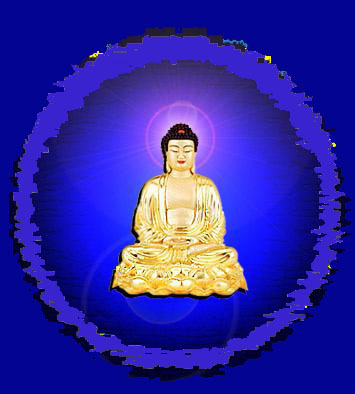
Amidism sect of Mahayana Buddhism centring on worship of Amida (in Japanese; Sanskrit Amitabha; Chinese O-mi-t'o-fo), Buddha (Buddha of Infinite Light), whose merits can be transferred to a believer. Amidism holds that the faithful--by believing in Amida, hearing or saying his name, or desiring to share in his Western Paradise--can be reborn in the Pure Land (see Pure Land Buddhism). Originating in India, Amidism emerged in China in the 4th century and by the 9th century was brought to Japan, where, in the 20th century, the Pure Land sects compose one of the two largest Buddhist groups. See also Amitabha. (see also Index: Pure Land Buddhism)
Amitabha ("the Buddha of Infinite Light"). Known in China as O-mi-t'o-fo and in Japan as Amida, it is one of the most popular forms of Mahayana Buddhism in eastern Asia today. Pure Land schools believe that rebirth in Amitabha's Western Paradise, Sukhavati (known as the Pure Land or Pure Realm), is ensured all those who invoke Amitabha's name with sincere devotion (nembutsu, referring to the Japanese formula of invocation, namu Amida Butsu). Chinese as: "NAMO 0-MI-T0-FO"
The Pure Land belief is based on three Sanskrit scriptures, the Amitayus-vipashyana-sutra ("Discourse Concerning Meditation on Amitayus") and the "larger" and "smaller" Pure Land sutras (Sukhavati-vyuha-sutras ["Description of the Western Paradise Sutras"]). These texts relate the story of the monk Dharmakara, the future Amitayus, or Amitabha, who made a series of vows that were meant to be fulfilled with the certainty of natural law when he became a buddha. The most important of these, the 18th, promised rebirth in the Pure Land to all the faithful who called upon his name, who would then remain in that beautiful land, free from pain and want, until they were ready for final Enlightenment.
In the larger Pure Land sutra, Buddha tells the story of Amitabha: many eons ago, as a monk, he learned from the 81st Buddha about the glories of innumerable Buddha Lands, whereupon he vowed to create his own Buddha Land (which he is now doing), making it 81 times more excellent than all the others and drawing into it all creatures who invoked his name. According to this sutra, in addition to calling upon Amitabha, one needs to accumulate merit and concentrate on Enlightenment. In the later, smaller Pure Land sutra, however, the Blessed Land is not a reward for good works but is accessible to anyone who invokes Amitabha at the hour of death.
In China the beginnings of the Pure Land cult can be traced back as far as the 4th century, when the scholar Hui-yüan formed a society of monks and laymen who meditated on the name of Amitabha. T'an-luan and his successors Tao-ch'o and Shan-tao systematized and spread the doctrine in the 6th and 7th centuries and are recognized as the first patriarchs of the school. In art, new emphasis was given representation of Amitabha, together with his attendant bodhisattvas Avalokiteshvara and Mahasthamaprapta. It has survived as an independent sect in China and has had its beliefs accepted by many members of other Buddhist sects in that country.
The Pure Land teaching was transmitted to Japan by monks of the Tendai school but by the 12th-13th century had separated as a distinct sect, mainly through the efforts of the priest Honen, founder of the Japanese Pure Land sect. Honen believed that most men were, like himself, incapable of obtaining buddhahood on this earth through their own efforts (such as learning, good deeds, or meditation) but were dependent on Amida's help. Honen stressed the recitation of nembutsu as the one act necessary to gain admittance to the Pure Land. (see also Index: Jodo)
Honen's disciple Shinran is regarded as the founder of the Shin, or True, sect, the largest of the Pure Land groups. According to the Shin school, faith alone is sufficient. Mere recitation of the name of Amida (as practiced by the Jodo school) is still indicative of a certain reliance on self-effort, just as are other forms of works such as doctrinal studies, austerities, meditations, and rituals. Shin interprets the continued repetition of the name as an expression of gratitude for the salvation that is assured from the very moment faith is first expressed. The school insists on exclusive devotion to Amida; the other Buddhist deities are not worshiped. The Shin sect has abandoned monastic practice, contrary to the usual Buddhist tradition.
The Jodo sect itself split up into five branches of which two are still in existence--the Chinzei, the larger of the two and often referred to simply as Jodo, and the Seizan. The Ji, or Time, sect was another variant; its name derived from the sect's rule of reciting the hymns of Shan-tao (Japanese: Zendo) six times a day.
Amitabha (Sanskrit: "Infinite Light"), Japanese AMIDA, Chinese O-MI-T'O, in Buddhism, the great saviour deity worshiped principally by members of the Pure Land sect in Japan. As related in the Sukhavati-vyuha-sutra (the fundamental scripture of the Pure Land sects), many ages ago a monk named Dharmakara made a number of vows, the 18th of which promised that, on his attaining buddhahood, all who believed in him and who called upon his name would be born into his paradise and would reside there in bliss until such time as they had obtained nirvana. Having accomplished his vows, the monk reigned as the buddha Amitabha in the Western Paradise, called Sukhavati, the Pure Land. (see also Index: Pure Land Buddhism)
The cult of Amitabha, which emphasizes faith above all else, came to the fore in China about AD 650 and from there spread to Japan, where it led in the 12th and 13th centuries to the formation of the Pure Land school and the True Pure Land school, both of which continue to have large followings today. Depictions of the Western Paradise and of Amitabha descending to welcome the newly dead are beautifully expressed in the Raigo paintings of Japan's Late Heian Period (AD 897-1185).
Amitabha as a saviour figure was never as popular in Tibet and Nepal as he was in East Asia, but he is highly regarded in those countries as one of the five "self-born" buddhas who have existed eternally (see Dhyani-Buddha). According to this concept he manifested himself as the earthly buddha Gautama and as the bodhisattva ("buddha-to-be") Avalokiteshvara.
His colour is red, his posture one of meditation (dhyana-mudra), his symbol the begging bowl, his mount the peacock, his consort Pandara, his family Raga, his element water, his sacred syllable "ba," or "ah," his skandha (element of existence) sanjna (perceptions of sense objects), his direction the west, his sense perception taste, his sense organ the tongue, and his location in the human body the mouth.
As a bestower of longevity, Amitabha is called Amitayus (Sanskrit: "Infinite Life"). In China and Japan the two names are often used interchangeably, but in Tibet the two forms are never confounded, and Amitayus is worshiped in a special Lamaist ceremony for obtaining long life. He is depicted wearing ornaments and a crown and holding the ambrosia vase from which spill the jewels of eternal life. See also Amidism; Pure Land Buddhism.
Sukhavati (Sanskrit: "Pure Land"), in Mahayana Buddhism, the Western Paradise of the Buddha Amitabha, described in the Pure Land sutras (Sukhavati-vyuha-sutras). According to followers of the Pure Land sects, which are widespread throughout East Asia, rebirth in Sukhavati is ensured by invoking the name of Amitabha (q.v.), particularly at the moment of death. No woman, however virtuous, may enter Sukhavati until she has first attained masculinity through rebirth. Sukhavati is expressively described in the Pure Land sutras as being a joyous world, soft and glowing, filled with the music of birds and the tinkling of trees adorned with precious jewels and garlands of golden bells. Amitabha sits on a lotus in the midst of a terraced pond, attended by the bodhisattvas ("buddhas-to-be") Avalokitésvara and Mahasthamaprapta. The newly dead enter into lotus buds, which unfold when the occupants have become entirely purified. They remain eternally in this land of bliss until the time of their final enlightenment. See also Pure Land Buddhism.
Sanskrit: "store of consciousness"), key concept of the Vijñanavada ("Consciousness-affirming") school of the Mahayana Buddhist tradition. Since that school maintains that no external reality exists, while retaining the position that knowledge, and therefore a knowable, exists, it assumes that knowledge itself is the object of consciousness. It therefore postulates a higher storage consciousness, the final basis of the apparent individual. The universe consists in an infinite number of possible ideas that lie inactive in storage. That latent consciousness projects an interrupted sequence of thoughts, while it itself is in restless flux until the karma, or accumulated consequences of past deeds, is destroyed. That storage consciousness contains all the impressions of previous experiences (vasanas, "perfumings"), which form the germs (bija) of future karmic action, an illusive force that creates categories that are in fact only fictions of the spirit. That illusive force (maya) determines the world of difference and belongs to man's nature, producing the erroneous notions of an I and a non-I. That duality is conquered only by enlightenment (bodhi), which transforms a person into a buddha.
A:link {color: teal; font-weight: bold} A:visited {color: #99CCCC; font-weight: bold} A:active {color: yellow; font-weight: bold} body {font: 12pt "garamond mt"; color: #333333} h1 {font: 28pt "garamond mt"; font-weight: also called ABHIDHARMAKOShA-ShASTRA (Sanskrit: "Treasury of Higher Law"), Chinese A-P'I-TA-MO CHÜ-SHE LUN, Japanese ABIDATSUMA-KUSHA-RON, encyclopaedic compendium of Abhidharma (scholasticism), the position of which within Buddhism has been likened to that of St. Thomas Aquinas' Summa theologiae for Roman Catholicism.
Its author, Vasubandhu, who lived in the 4th or 5th century in the northwestern part of India, wrote the work while he was still a monk of the Sarvastivada (Doctrine That All Is Real) order, before he embraced Mahayana, on whose texts he was later to write a number of commentaries. As a Sarvastivada work the Abhidharmakosha is one of few surviving treatments of scholasticism not written in Pali and not produced by Theravadins, who follow the Pali canon. The product of both great erudition and considerable independence of thought, the Abhidharmakosha authoritatively completed the systematization of Sarvastivada doctrine and at the same time incorporated Mahayanist tendencies.
Translated into Chinese within a century or two, the Abhidharmakosha has been used in China, Japan, and Tibet both as a standard introduction to the Hinayana Buddhism of the southern countries and as a great authority in matters of doctrine. In China it provided the basis for the Abhidharma (Chinese Chü-she; Japanese Kusha) sect. The work has inspired numerous commentaries. It also provides scholars with a unique amount of information on the doctrinal differences between ancient Buddhist schools.
The text is composed of 600 stanzas of poetry plus the equivalent
of 8,000 stanzas of prose commentary supplied by the author himself. As an introduction
to the seven Abhidharma treatises in the Sarvastivada canon
and a systematic digest of their contents, the Abhidharmakosha deals
with a wide range of philosophical, cosmological, ethical, and salvational doctrine.
|
[ GuestBook by TheGuestBook.com ] |
 Best View 800X600
using Microsoft Explorer 5.0
Best View 800X600
using Microsoft Explorer 5.0
 Thank You


Last Update Vesak 2545
(2001)