Praised By The WISE

Praised By The WISE
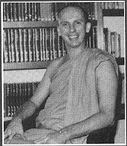 |
. Venerable Shrasvasti Dhammika is a Distinguished Lecturer and Buddhist
Monk from Australia. He has spoken on Buddhism and Asian religions
in universities and on television and radio in Australia and throughout
Asia
|
Famous
People comment on The Buddha and His Teachings
By Ven. S. Dhammika
Published By The Buddha Dhamma Mandala Society
ISBN 981-00-0332-3
Fifth Edition 1991
INTRODUCTION
Anyone who is considering changing their religion, or adopting a religion for the first time is about to do something that may have a profound effect upon their life. It is not the sort of thing that should be done in a rush, nor should it be done under the influence of heightened emotions. If the truth is to be discovered time must be taken, all the facts must be examined and questions must he asked and different points of view considered. We try to do all this before making most important decisions in our life, so why shouldn't we do it before making the most important decision in our life - that concerning our religious convictions?
To blindly and unquestionably accept the opinions of others would, be foolish but to neglect their opinions altogether would he foolish also. The insights and experiences of others, especially the wise, may help us deepen our understanding and put us in a better position to make the right choice. With the increased knowledge of Buddhism in the last hundred years a large number of Western intellectuals, including many Nobel Prize winners, have expressed a deep interest in and admiration for this ancient religion. A small but growing number are actually becoming Buddhists.
Some have been impressed by Buddhism's clear, rational thought, others by its gentle tolerance. Some have been surprised by how closely it resembles the discoveries of modern science while others have been attracted by its idea of an ethical life without the need to believe in a supreme god. The quotations collected in this booklet are of interest for several reasons.
Firstly, they show the universal appeal of Buddhism, its ability to speak to psychologist and poet, philosopher and mathematician. Is it not telling that the words of a man who lived so long ago could still he relevant and meaningful to a scientist like Einstein, a poet like Eliot or a philosopher like Russell? Again, they tell us as much about the people who wrote them as they do about Buddhism itself.
We read what some of the great minds of our time have to say about the Buddhist concept of detachment and love, about the rational element in Buddhism and about the Buddha's place in human history. They compare Buddhism with other religions, highlight its emphasis on reason and tell us how it may influence modern psychology. It is hoped that what is said in this booklet and who said it will motivate the reader to look deeper into the teachings of the Buddha, and, if intellectual satisfaction results, put its principles into practice.
As the Buddha himself says:
When you yourself know:
'These things are good; these things are not blameable;
These things are praised by the wise;
Undertaken and observed,
These things lead to your welfare and happiness',
Then enter upon and abide in them.
In point of age, therefore, most other creeds are youthful compared with this venerable religion, which has in it the eternity of a universal hope, the immortality of a boundless love, an indestructible element of faith in final good, and the proudest assertion ever made of human freedom.
Sir Edwin Arnold (1832-1904)
British poet, Journalist and Poet Laureate of England
The teachings of the Indian Prince has indeed nothing to dread from science . . . Words would fail me if I attempted to express how necessary I think knowledge of this high faith and philosophy is to leaven the materialism of the West . . . It is, at all events, a truth which influenced not only the mightiest thinkers of Greece and Rome, but also the beginnings of Christian teachings - which it antedated by five or six hundred years. It may well claim kindred with all the great faiths, persecuting and opposing none which differ with it, and this for reasons which are easily seen in the teachings themselves. In relation to its noble and scientific austerity no words are needed.
L. Adam Beck
An American Traveler and author
To the Christian, Love is the highest virtue; to the Buddhist, Wisdom, for they hold that ignorance is the root of all evil. Love, all the same, ranks high ......Tolerance and loving kindness, both based on Buddhist wisdom, are perhaps the chief reason why the middle way of Gotama has come down through 2500 years.
Sir Charles Bell KCIE, CMG ( 1870-1945)
British Diplomat and Lexicographer
Dr. Amadou-Mahtar M 'Bow
Director - General, UNESCO
C D Broad (1887-1971) British Philosopher
J.Bronowski (1908-1974)
American Author and Philosopher of Science
Marie B. Byles (1900-1979)
Australian author and mountaineer
Buddha's message of compassion
and devotion to the service of humanity is more relevant today than at any
other time in history. Peace, understanding and a vision that transcends purely
national boundaries are imperatives of our insecure nuclear age.
Javier
Perez De Cuellar
Peruvian Diplomat from 1982 and
Secretary General of United Nation
It cannot be denied that there is a real beauty of an Oriental kind in the various expressions which the Buddhists use; and that there was real grounds for the enthusiasm which gave them birth. Never in the history of the world had such a scheme been put forth, so free from any superhuman agency, so independent of so even antagonistic to the belief in a soul, the belief in God, and the hope of a future life...
Whether these be right or wrong, it was a turning point in the religious history of man when a reformer, full of the most earnest moral purpose and trained in all the intellectual culture of his time, put forth deliberately, and with a knowledge of the opposing views the doctrine of salvation to be found here, in this life, in an inward change of heart, to be brought about by perseverance in a mere system of self culture and self control.
Buddhist or non-Buddhist, I have examined every one of the great religious systems, of the world, in none of them I have found anything to surpass, in beauty and comprehensiveness, the Noble Eightfold Path and the Four Truths of the Buddha.
Prof. T. W. Rhys Davids (1843-1922) British Orientalist lexicographer and
the first person to hold a chair in Comparative Religion in a British university
Like the other
teachers of his time, Buddha' taught through conversation, lecturers and parables.
Since it never occurred to him, any more than Socrates or Christ, to put his
doctrine into writing, he summarised it in sutras (threads) designed to prompt
the memory. As preserved for us in the remembrance of his followers these
discourses unconsciously portray for us the first distinct character of India's
history: a man of strong will, authoritative and proud, but of gentle manner
and speech, and of infinite benevolence. He claimed enlightenment but not
inspiration; he never pretended that a god was speaking through him. In controversy
he was more patient and considerate than any other of the great teachers of
mankind .
Like Lao-tze and Christ he wished to return good for evil, love for hate; and he remained silent under misunderstanding and abuse . . . Unlike most saints, Buddha has a sense of humour, and knew that metaphysics without laughter is immodesty.
Will Durant (1885-1 981) American Historian and Pulitzer Prize Winner
The individual feels the nothingness of human desires and aims and the sublimity and marvellous order which reveal themselves both in nature and in the world of thought. He looks upon individual existence as a sort of prison and wants to experience the universe as a single significant whole, the beginnings of cosmic religious feeling already appear in early stages of development - e.g. in many of the Psalms of David and in some of the Prophets. Buddhism, as we have learnt from the wonderful writings of Schopenhauer especially, contains much stronger elements of it.
The religion of the future will he a cosmic religion. It should transcend a personal God and avoid dogmas and theology. Covering both the natural and the spiritual, it should he based on a religious sense arising from the experience of all things, natural and spiritual and a meaningful unity. Buddhism answers this description. If there is any religion that would cope with modern scientific needs it would be Buddhism.
Albert Einstein (1879-1955) German physicist, mathematician. Winner of the Nobel Prize
But Eliot's attraction to Buddhism was not simply a philosophical one. Nirvana is extinction* the annihilation of desire, the freedom from attachments - and there was, as can he seen from his poetry, an over-riding desire in the young Eliot to be free. The absolutism of Buddhism is quite as relentless as anything he had found in Maurras and, although he was perhaps attracted to it for much the same reasons, the Eastern religion had more romantic affiliations for someone who wished to break free from the familial bonds which otherwise held him.
Peter Ackrayd's comments on English poet T. S. Eliot (1888-1965)
*The extinction of greed, hatred and delusion.
At the back of the shrine outside the temple, grows the sacred tree under which, or rather the ancestor of which, Buddha sat. Squares of gold leaf have been stuck on to the trunk and boughs. The temple, together with several acres of garden full of trees and flowers and votive stones, chapels, hells, and statues, lies on a deep courtyard below the level of the surrounding country. The view when one drives up and sees everything suddenly from the edge of the embankment is, as the books say, 'not easily forgotten'. There can't be anything like it in the world.
E.M. Forster (1879-1970) British novelist
Man gave up the illusion of a fatherly God as a parental helper - but he gave up also the true aims of all great humanistic religions: overcoming the limitations of an egotistical self, achieving love, objectivity, and humility and respecting life so that the aim of life is living itself, and man becomes what he potentially is.
These were the aims of the great Western religions, as they were the aims of the great Eastern religions. The East, however, was not burdened with the concept of a transcendent father - saviour in which the monotheistic religions expressed their longings.
Taoism and Buddhism had a rationality and realism superior to that of Western religions. They could see man realistically and objectively, having nobody but the 'awakened' ones to guide him, and being able to he guided because each man has within himself the capacity to awake and be enlightened.
This is precisely the reason why Eastern religious thought, Taoism and Buddhism - and their blending in Zen Buddhism* assume such importance for the West today. Zen Buddhism helps man to find an answer to the question of his existence, an answer which is essentially the same as that given in the Judaeo-Christian tradition, and yet which does not contradict the rationality, realism, and independence which are modern man's precious achievements.
Paradoxically, Eastern religious thought turns out to be more congenial to Western rational thought than does Western religious thought itself.
Erich Fromm (1900-1980)
German American Psychoanalyst and Social Philosopher
* The Japanese meditation tradition
There may be a great significance in the fact that Pythagoras in Greece and the Buddha in the Orient occur at the same time in the sixth century B.C. Both are powerfully, perceptively thinking and acting human individuals who, coming out of a past in which only mystically ordained kings counted and humans were omniexpendable pawns, produced mathematical tools and philosophis forever thereafter to employ.
R.Buckminster Fuller (1895-1984)
American Inventor, Social Engineer and Philosopher
I have no hesitation in declaring that I owe a great deal to the inspiration that I have derived from the life of the Enlightenment One.
Asia has a message for the whole world, if only it would live up to it. There is the imprint of Buddhistic influence on the whole of Asia, which includes India, China, Japan, Burma, Ceylon, and the Malay States. For Asia to be not for Asia but for the whole world, it has to re-learn the message of the Buddha and deliver it to the whole world.
His love, his boundless love went out as much to the lower animal, to the lowest life as to human beings. And he insisted upon purity of life.
Mahama Gandhi ( 1869-1948)
Indian Thinker and Apostle of Non Violence
It was when I was up at Oxford in the early 1970's that I became interested in Buddhism. My life was full of confusion and distress of every kind, and I found in Buddhist philosophy a way of thought that enthralled me by its calm and radical analysis of desire, its rejection of all the self-dramatisiting intensities by which I lived, and its promise of a possible strong and unsentimental sincerity.
Andrew Harvey British author, poet and Fellow of All Souls College, Oxford
I left India and returned to Colombo, where I was the guest of a Singhalese student I knew in Perth. They were Buddhists, their house was in the grounds of a temple, and the atmosphere of the household was very peaceful and unbelievably gentle. I talked a lot about Buddhism with them, and they took me up to a temple in the hills, in Kandy, where I met the monks and talked to a very old abbot, who explained more about Buddhism to me. found Buddhism fascinating.
Their concept that you progress towards the Ineffable through a number of existences seemed to me much more intellectually satisfying than the Christian belief that you come just once and are cast into circumstances maybe of great wealth or of great moment, but that you come to God or don't come to God on the basis of that one life. The logical attraction of Buddhism after the devastating experience of India was a further part of my breaking down. I was never on the point of embracing Buddhism but I found, and still find, it infinitely more satisfying than the Judeo-Christian philosophy.
Robert J. Hawke Rhodes Scholar, Trade Union Leader from 1983and Prime Minister of Australia
Now in this realm Buddha's speeches are a source and mine of quite unparalleled richness and depth. As soon as we cease to regard Buddha's teachings simply intellectually and acquiesce with a certain sympathy in the age-old Eastern concept of unity, if we allow Buddha to speak to us as vision, as image, as the awakened one, the perfect one, we find him, almost independently of the philosophic content and dogmatic kernel of his teachings, a great prototype of mankind.
Whoever attentively reads a small number of the countless speeches of Buddha is soon aware of harmony in them, a quietude of soul, a smiling transcendence, a totally unshakeable firmness, but also invariable kindness, endless patience. As ways and means to the attainment of this holy quietude of soul, the speeches are full of advice, precepts, hints.
The intellectual content of Buddha's teaching is only half his work, the other half is his life, his life as lived, as labour accomplished and action carried out. A training, a spiritual self training of the highest order was accomplished and is taught here, a training about which unthinking people who talk about "quietism" and "Hindu dreaminess" and the like in connection with Buddha have no conception; they deny him the cardinal Western virtue of activity.
Instead Buddha accomplished a training for himself and his pupils, exercised a discipline, set up a goal, and produced results before which even the genuine heroes of European action can only feel awe.
Herman Hesse (1877-1962)
German author and winner of the Nobel Prize
The more I studied satipathana*, the more impressed I became with it as a system of mind training. It is in line with our Western scientific attitude of mind in that it is unprejudiced, objective and analytical. It relies on personal, direct experience, and not on anyone else's ideas or opinions. It is exceedingly simple and makes use of 'bare attention' basically as simple as a sustained 'ah look' but within a carefully chosen and disciplined system. It therefore explores all premature judgements, all talking 'about it and about,' all arguments, discussions and such waste of time as we in the West are inclined to be fond of. In fact, it gets you out of the rut and bondage of yourself, your prejudices, your clichés, your blindness and your self-opinionatedness, to set you free to see and prove a real world.
Dr E. Graham Howe MB. BS. DPM.
Eminent British Physician
* Buddhist meditation.
The way of Buddhism is Middle Way between all extremes. This is no weak compromise, but a sweet reasonableness which avoids fanaticism and laziness with equal care, and marches onward without that haste which brings its own reaction, but without ceasing. The Buddha called it the Noble Eightfold Path to Nirvana, and it may be regarded as the noblest course of spiritual training yet presented, in such a simple form, to man.
Buddhism is neither pessimistic nor 'escapist'. It is a system of thought, a religion, a spiritual science and a way of life which is reasonable, practical and all-embracing. For 2,500 years it has satisfied the spiritual needs of nearly one third of mankind. It appeals to those in search of truth because it has no dogmas, satisfies the reason and the heart alike, insists on self-reliance coupled with tolerance for other points of view, embraces science, religion, philosophy, psychology, mysticism, ethics and art, and points to man alone as the creator of his present life and sole designer of his destiny
Among the early Buddhists, the metaphysical theory was neither affirmed or denied, but simply ignored as being meaningless and unnecessary. Their concern was with the immediate experience, which, because of its consequences for life, came to be known as 'liberation' or 'enlightenment'. The Buddha and his disciples of the southern school seem to have applied to the problems of religion that 'operational philosophy' which contemporary scientific thinkers have begun to apply to the natural sciences.
The modern conception of man's intellectual relationship to the universe was anticipated by the Buddhist doctrine that desire is the source of illusion. To the extent that one has overcome desire, a mind is free from illusion. This is true not only of the man of science, but also the artist and the philosopher. Only the disinterested mind can transcend sense and pass beyond the boundaries of animal or average-sensual human life.
Perfect non-attachment demands of those who aspire to it, not only compassion and charity, but also the intelligence that perceives the general implications of particular acts, that sees the individual being within the system of social and cosmic relations of which he is but a part. In this respect, it seems to me, Buddhism shows itself decidedly superior to Christianity. In the Buddhist ethic, stupidity, or unawareness, ranks as one of the principal sins. At the same time, people are warned that they must take their share of responsibility for the social order in which they find themselves. One of the branches of the Eightfold Path is said to be 'right means of livelihood', the Buddhist is expected to refrain from engaging in such socially harmful occupations as soldiering, or the manufacture of arms or intoxicating drugs.
Aldous Huxley (1894-1963)
British author, Playwright and thinker
It is a remarkable indication of the subtlety of Indian speculation that Gautama should have seen deeper than the greatest of modern idealists. The tendency of enlightened thought of today all the world over is not towards theology but philosophy and psychology. The bark of theological dualism is drifting into danger. The fundamental principles of evolution and monism are being accepted by the thoughtful.
Prof. Julian Huxley (1887-1975) British author, Zoologist and Director General of UNESCO
I am ignorant of Buddhism and speak under correction, and merely in order the better to describe my general point of view; but as apprehend the Buddhistic doctrine of karma, I agree in principle with that.
When a modern
western psychologist reads the Pali Nikayas*, he again finds passages which
he recognizes as belonging to his field and are concerned with typical psychological
problems. Perception, imagination and thinking are described and the idea
of psychological causality is developed, although in very vague terms. Behaviour
and consciousness are explained as dynamic processes, governed by needs. There
are the rudiments of an understanding of unconscious processes. We find interesting
descriptions of different personality types. And the literature is full of
advice on how to change the conscious processes evidently based on careful
observation and experimentation.
Dr Rure C. A. Johnson M.A. D. Phil Swedish psychologist and research psychologist for the Swedish National Defence
As a student of comparative religions, I believe that Buddhism is the most perfect one the world has even seen. The philosophy of the theory of evolution and the law of karma were far superior to any other creed.
It was neither the history of religion nor the study of philosophy that first drew me to the world of Buddhist thought but my professional interest as a doctor. My task was to teat psychic suffering and it was this that impelled me to become acquainted with the views and methods of that great teacher of humanity, whose principal theme was the chain of suffering, old age, sickness and death.
Dr C.C. Jung (1875-1961)
Swiss psychologist Founder of the Jungian school of psychology
* Buddhist scriptures
Paul couples love with faith and hope, and his conception of love involves faith and hope: "Love," he says, "believes all things, hopes all things." The love I mean does not believe all things and hope all things. It survives disillusionment and persists in despair. Love is not love that ceases without hope or faith. As long as faith and hope support it, it is hardly more than puppy love. That love is pleasant is a fashionable myth, or, to be more charitable about it, an exception. The Buddha knew that love brings "hurt and misery, suffering, grief and despair"; and he advised detachment. The love I consider a virtue is not a blind love of the lovers or the trusting, hopeful love of Paul, but the love that knows what the Buddha knew and still loves, with open eyes.
Prof. Walter Kaufmann American philosopher and author
He read widely and deeply in Buddhist text, translated sutras from French, and even wrote a biography of the Buddha. But at the root of his absorption in Buddhism was the fact that he felt it offered him direct philosophical consolation for the disappointment in his life. . . Jack embraced the first law of Buddhism above all others, the statement that "All life is suffering" . . It was as if the words had been written for him.
The idea of unity-in-diversity can be followed all the way back to the Pythagorean 'Harmony of the Sphere' and the Hippocratic's 'sympathy of all things: 'there is one common flow, one common breathing, all things are in sympathy'. The doctrine that everything in the universe hangs together partly by mechanical causes but mainly by hidden affinities (which also accounts for apparent coincidences), provides not only the foundation for sympathetic magic, astrology and alchemy: it also runs as a leit-motif through the teachings of Taoism and Buddhism, the neo-Platonists, and the philosophers of the early Renaissance.
Arthur Koestler (1905-1983) Hungarian novelist and journalist
If I knew the Buddha would be speaking here tomorrow, nothing in the world could stop me from going to listen to him. And I would follow him to the very end.
J.Krishnamuri Indian philosopher (l895-1986)
The Indian, the Aztec, old Mexico! All that fascinates me and has fascinated me for years, there is glamour and magic for me. Not Buddha. Buddha is so finished and perfected and fulfilled and "'volender" and without new possibilities - to me I mean.
D.H. Lawrence (1885-1930)British novelist
Today science is challenging the finite quality of the human brain, a brain consisting of some 10,000 million electrically stimulated cells programmed with the instincts of our long history and receptive to new notions whether true or false.
The aggregate of these cells provides our ever-changing personality and their partial removal by surgery or altered rhythm by shock treatment changes our character.
By such crude methods, aggression can be turned into fear, hatred to affection - how much better that they should be changed by appreciation of the realities that the philosophy of Buddha has placed in our hands.
William Mac Quilty British Award winning film maker, Traveller and Fellow of The Royal Geographical Society
The message of the Buddha is a message of joy. He found a treasure and he wants us to follow the path that leads us to the treasure. He tells man that he is in deep darkness, but he also tells him that there is a path that leads to light. He wants us to arise from a life of dreams into a higher life where man loves and does not hate, where a man helps and does not hurt. His appeal is universal, because he appeals to reason and to the universal is us all:
It is you who must make the effort. The Great of the past only show the way.' He achieved a superior harmony of vision and wisdom by placing spiritual truth on the crucial test of experience; and only experience can satisfy the mind of modern man. He wants us to watch and be awake and he wants us to seek and to find.
Juan Mascan Spanish Academic and Educationalist, Lecturer at Cambridge University
I have so often tried to isolate the quality of "Zen" * which attracted me so powerfully to its literature and later to the practice of zazen#. But since the essence of Zen might well be what one teacher called the moment-by-moment awakening of mind, there is little that may sensibly be said about it without succumbing to that breathless, mystery-ridden prose that drives so many sincere aspirants in the other direction. In zazen, one may hope ~ penetrate the ringing stillness of the universal mind.
Peter Mathiessen American Novelist, Naturalist and Explorer. Winner of The National Book Award in 1979
* The Japanese meditation tradition.
Maugham's interest in mysticism and Eastern philosophy is not a sudden development of his later life. Although his early questioning of Christianity culminated in the atheism represented in Philip Carey, he continued his examination of the religions of the East and his enquiries into mysticism. 'Faith' a short story published in 1899' considers sympathetically the dilemma of a young monk who loses the ability to believe in God. 'The Painted Veil' treated in however a superficial manner, the serenity of the belief in 'The Way'.
In the 'Gentlemen in the Parlour', Maugham discusses the philosophy of Buddha, and he confessed to finding considerable attraction in the belief in the transmigration of souls . . . Because of the impact which the 'Razor's Edge' made in 1944, it has generally been overlooked that in the 'Narrow Corner', Maugham had already treated in considerable depth the philosophy of Indian religion. In this understated serious novel there is extensive discussion of Buddhism, and the progress of the story is a movement in the direction of that belief by the central figure.
R. L. Calder's comments On the works of English novelist W. Somerset Maugham (1874-1965)
Buddhism is much less a matter of organized and institutional orthodoxy than a state of mind. Buddhism does not aim directly at theological salvation but a total clarification of consciousness. It is not so much a way of worshipping as a way of being. Exterior cultural accretions are much less important than they may seem, and the Buddhist cultural awareness is endowed with mercury like formlessness, which erodes the statistical eye of the Western scholar.
Father Thomas Merton (1915-1968)
American Catholic Priest, Author and Social Crtics
Of all the great religious teachers of the world, none has incarnated and lived the idea that ultimate reality is beyond the grasp of the ordinary mind with such purity and concentration as the Buddha. This, in part, explains why the Buddha's discourses say nothing about the existence of a Supreme Being, for example, or about immortality . .
Its strategy of negation has misled many Westerners into thinking Buddhism is pessimistic and anti-life. Some have even thought of Nirvana, the ultimate goal of Buddhist discipline, as a sort of spiritual suicide. Nothing could be further from the truth and, in fact, there is no religion which has a higher estimation of human possibility.
Prof. Jacob Needleman Scholar,
Author and Professor for philosophy at San Francisco State College
Whenever one thinks of the Buddha, one inevitably thinks of His great teaching; and I often feel that, perhaps, if we think more of that basic teaching of the avoidance of hatred and violence, we may be nearer the solution to our problem.
In this world of storm and strife, hatred and violence, the message of the Buddha shines like a radiant sun: Perhaps at no time was that message more needed than in this world of the atomic and hydrogen bombs . . . Let us remember that immortal message and try to fashion our thoughts and actions in the light of that teaching . . . and help a little in prompting right thinking and right action. . . . If any question has to be considered, it has to be considered peacefully and democratically in the way taught by the Buddha.
Jawaharlal Nehru (1889-1964)
Indian Prime Minister
Here it is grasped that one must not hate even evil, that one must not oppose it, that one not hate even oneself; that one should not merely acquiesce in the suffering that such a way of lie entails, that one should live entirely in positive feelings, that one should take the side of one's opponent in word and deed, that and through a supersfetation of the peaceable, good natured conciliatory, helpful ad loving states one impoverishes the soil in this standpoint is possible only when no moral fanaticism prevails, i.e. when evil is hated, not for its own sake, but only because it opens the way to states that are harmful to us ( unrest, work, care, entanglements, dependence). This is a Buddhist standpoint : here is sin is not hated, there the concept in lacjking.
Buddhism is hundred times more realistic than other religions. It has entered upon the inheritance of objectively and coolly putting up with problems. It came to life after several hundred years of philosophical development. The notion of God is done away with as soon as it appears, prayer is out of the question. So is asceticism. No categorical imperative. No coercion at all, not even within the monastic community. Hence it also does not challenge to fight against those of different faiths. its teaching turns against nothing so impressively as against the feeling of revengefulness, animosity and resentment.
Frederick Nietszche (1884-1900)
German philosopher
If we ask, for instance, whether the position of the electron remains the same, we must say 'no'; if we ask whether the electron's position changes with time, we must say 'no'; if we ask whether the electron is at rest, we must say 'no'; if we ask whether it is in motion, we must say 'no'.
The Buddha has given such answers when interrogated as to the conditions of a man's self after his death; but they are not familiar answers for the tradition of seventeenth and eighteenth century science.
J Robert Oppenheimer ( 1904-1967)
American Physician
Anyone from a king to a barber who wished to listen to the Buddha's teachings, or follow him in his missionary wanderings, or join the Sangha, the formal fellowship of Buddhist disciples, was free to do so. Even women, after some hesitation were admitted to the Sangha, whose establishment is often counted as one of the Buddha's most practical achievements, in large measure responsible for the eventual spread and continuity of Buddhist doctrine in the Asian world.
The founding of an Order appears also to illustrate still further the Buddha's psychological acumen, for though he taught that each human being must trend the path to "awakening" or "deliverance" alone, he also realized what sustainment there could be in daily association with others working towards a common goal. Of the establishment of the Buddhist Sangha, Arnold Toynbee has said that it was a greater social achievement than the founding of the Platonist academy in Greece.
Nancy Wilson Ross (1901-1986)
American Journalist, War Correspondent and Author.
Of the great religions of history I prefer Buddhism, especially in its earliest forms, because it has had the smallest element of persecution.
Buddhism is a combination of both speculative and scientific philosophy. It advocates the Scientific Method and pursues that to a finality that may be called Rationalistic. In it are to be found answers to such question of interest as "What is mind and matter? Of them which is of great importance? Is the universe moving towards a goal? What is man's position? Is there living that is noble?" It takes up where science cannot lead because of the limitations of the latter's instruments. Its conquests are those of the mind.
I cannot myself feel that either in the matter of wisdom or in the matter of virtue Christ stands quite as high as some people known to history. I think I should put Buddha and Socrates above him in those respects.
Bertrand Russell (1872-1970) British Mathematician, Philosopher, Author and Social Critic,
We find the doctrine of metempsychosis, springing from the earliest and noblest ages of the human race, always spread abroad in the earth as the belief of the great majority of mankind, nay, really as the teachings of all religions with the exception of that of the Jews and the two which have preceded from it: in the most subtle form, however, and coming nearest to the truth, as has already been mentioned, in Buddhism.
It almost seems that, as the oldest languages are the most perfect so also are the oldest religions. If I were to take the results of my philosophy as a yardstick of the truth, I would concede to Buddhism the pre-eminence of all religions of the world
Arthur Schopenhauer (1788-1860)
German philosopher
While the
materialist is mainly interested in goods, the Buddhist is mainly interested
in liberation. But Buddhism is 'The Middle Way' and therefore in no way antagonistic
to physical well-being. It is not wealth that stands in the way of liberation
but the attachment to wealth; not the enjoyment of pleasurable things but
the craving for them.
The keynote of Buddhist economics, therefore, is simplicity and non-violence. From an economist's point of view, the marvel of the Buddhist way of life is the utter rationality of its pattern amazingly small means leading to extraordinarily satisfactory results.
It is in the light of both immediate experience and long term prospects that the study of Buddhism economics could be recommended even to those who believe that economic growth is more important than any spiritual or religous values.
For it not a question of choosing between "modern growth" and "traditional stagnation". It is a question of finding the right path of development, theMiddle Way between materialist heedlessness and traditonalist immobility, in short, of finding 'Right Livelihood'.
Dr E. F. Schumacher, CBE. (1911-1977) British Rhodes Scholar, Economist, Journalist and Economic Adviser to The National Coal Board from 1950-1970
He gave expression to truths of everlasting value and advanced the ethics not of India alone but of humanity. Buddha was one of the greatest ethical men of genius ever bestowed upon the world.
Albert Schweitzer (1875-1 965)French Scholar, Theologian and Philospher, Winner of The Nobel Prize.
Buddhism, better than most religions, seems to have adapted to modern life. Many considering it to be, among other things, not only a method of self discovery but a source of ideas for social orientation without equal in the West.
Lucien Stryk American author, poet and winner of Isaac Rosenbaum Poetry Award
Buddhism was
the first spiritual force, known to us in history, which drew close together
such a large number of races separated by most difficult barriers of distance,
by difference of language and custom, by various degrees and divergent types
of civilization. It had its motive power, neither in international commerce,
nor in empire building, nor in a scientific curiosity, nor in a migrative
impulse to occupy fresh territory. It was a purely disinterested effort to
help mankind forward to its final goal.
Rabindranath Tagore (1861-1941) Indian poet and educationalist.
Winner of The Nobel Prize.
I ever believe that the mark of a truly educated and imaginative person facing the twenty-first century is that he feels himself to be a planetary being. Perhaps my own Buddhist upbringing has helped me more than anything else to realize and to express in my speeches and writings this concept of world citizenship.
As a Buddhist, I was trained to be tolerant of everything except intolerance. I was brought up not only to develop the spirit of tolerance, but also to cherish moral and spiritual qualities, especially modesty, humanity, compassion, and, most important, to attain a certain degree of emotional equilibrium.
U Thant (1910- 1974) Burmese Educator,
Diplomat and Secretary General of the United Nations
I know that some will have hard thoughts of me, when they hear their Christ named beside my Buddha. Yet I am sure that I am willing they should love their Christ more than my Buddha, for love is the main thing.
David Henry Thoreau (1817-1862)
American essayist, poet and transcendentalist
I believe that Buddhism is very relevant to the thought of the present day. Basically, its thought is familiar to us because it is the same kind of thinking as that employed in science; not perhaps the thinking of Einstein and Heisenburg, but rather that of Tyndall and Thomas Huxley.
Robert H Thousless MA., PhD, Sc.D.
British. Distinguish Christian scholar, author, Fellow of the British Psychological Society and Fellow of Corpus Christi College, Cambridge.
The period between the seventh and fifth century BC, was a time of spiritual searching throughout the ancient world. It saw the beginning of Greek philosophy, the rise of the prophets of Israel, Confucius in China and (according to Parsi tradition) the time of Zoroaster in Persia.
This period saw the birth of the Jain and Ajivika teachings, with the greatest of all, 'the Light of Asia' Gautama the Buddha . . . A doctrine of annihilation* in which an omnipotent God has no place, might seem one of profound pessimism, yet Buddhism was saved from being negative by the emphasis placed on free-will and humility.
The importance of compassion, of charity and alms giving, all combined to generate a religion of warmth and love. Together with Jainism, Buddhism helped to create a revolutionary concept, that of 'ahimsa' or harmlessness; the idea of respect for others which evolves from a self-respect. *Annihilation of greed, hatred and delusion.
Prof. Hugh Tinker Professor of government and politics at the school of Orient and African Studies, London University
In divining that, the experience of pain was an inseparable
concomitant of consciousness and will, the Buddha has shown a penetrating
psychological insight. Hinduism
regards man's universe as being an illusion; the Buddha anticipating some
of the schools of the modern Western psychologists by about twenty-four centuries, held
that the soul is an illusion too.
Arnold Toynbee (1889-1 975) British historian
Rightly or wrongly - and here I am not defining a thesis, I am only describing the state of mind of a Victorian girl in her teens, the Buddha and his philosophy seemed logically and ethically superior to the Christ and the teachings of the New Testament. Further, Buddhist metaphysics had at least a superficial likeness to the philosophy of modern science. The agnosticism of Buddha as to an ultimate cause was even more complete than that of Herbert Spencer. Unlike the crude eternal bliss and eternal damnation of the Christian Church, the doctrine of Karma seemed in harmony with such assumptions of modern science as the universality of causation and the persistence of force.
Beatrice Webb (1881-1943) British social reformer, economist and Fabian Socialist.
The
fundamental teachings of Gautama, as it is now being made plain to us by study
of original sources, is clear and simple and in the closest harmony with modern
ideas. It is beyond all disputes the achievement of one of the most penetrating
intelligence the world has ever known.
Buddhism is the advance of world civilization and true culture
than any other influence in the chronicles of mankind.
HG Wells ( 1866-1946) British historian, socialist and science fiction writer.
Buddhism is the most colossal example in the history of applied metaphysics.
It was because he showed in his life what he taught was both practical and reasonable that he exerted such a mighty influence upon mankind. He sought to put a new temper into men, to imbue them with a new spirit, give that a new heart. It was more than could be achieved in only 2,500 years. But mankind is still young and impressionable. The impression Buddha made was deep. Reinforced by like impressions made in different ways by other religious leaders it will surely work itself out and its effects be felt in ever increasing degree. The heart of men will indeed be cleansed. From the joy in that heart will spring compassion fixed in an instant in the race. All hardness will be melted - conflict turned to composure.
Sir Francis Younghusband (1863-1942) British explorer, geographer and dipolmat.
Buddhism has conquered China as a philosophy and as a religion, as a philosophy for the scholars and a religion for the common people. Whereas Confucianism has only a philosophy of moral conduct, Buddhism possesses a logical method, a metaphysics and a theory of knowledge. Besides, it is fortunate in having a high tradition of scholarship in the translation of Buddhist classics, and the language of these translations, so succinct and often so distinguished by a beautiful lucidity of language and reasoning, cannot but attract the scholar with a philosophical bias. Hence, Buddhism has always enjoyed a prestige among Chinese scholars, which so far Christianity has failed to achieve.
Lin Yutang (1895-1976) Chinese writer,thinker, journalist and playwright
End
Venerable Shrasvasti Dhammika is a Distinguished Lecturer and Buddhist Monk from Australia. He has spoken on Buddhism and Asian religions in universities and on television and radio in Australia and throughout Asia.
Buddha Dhamma Mandala Society Towner
PO Box 1442 Singapore 91332
Last Known Address:
567-A Balestier Road Singapore 1232
Tel : (65) 352 2859
|
[ GuestBook by TheGuestBook.com ] |
Thanks You For Your Feed backs 

 Best View 800X600
using Microsoft Explorer 5.0
Best View 800X600
using Microsoft Explorer 5.0


Last Update Vesak 2545
(2001)