THE BEGINNING of THE CANADIAN FLAGS
THE BEGINNING of THE CANADIAN FLAGS
THE BEGINNING of THE CANADIAN FLAGS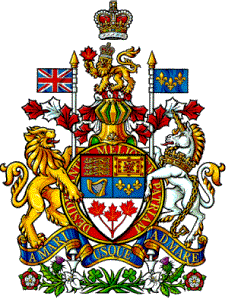
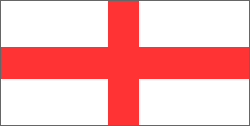
 The St. George's Cross -- an English flag of the 15th century -- was carried by
John Cabot, a Venetian sailing under English colours, and flown over Canadian soil
when he reached the east coast of Canada in 1497.
The St. George's Cross -- an English flag of the 15th century -- was carried by
John Cabot, a Venetian sailing under English colours, and flown over Canadian soil
when he reached the east coast of Canada in 1497.
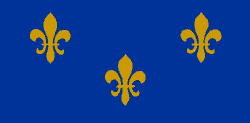 The fleur-de-lis was a symbol of French sovereignty in Canada from 1534, when
Jacques Cartier landed and claimed the new world for France, until the early 1760s,
when Canada was ceded to the United Kingdom. Although a number of French military
flags were used in Canada during this period, including the white flag of la Marine
royale after 1674, the fleur-de-lis held a position of some prominence.
The fleur-de-lis was a symbol of French sovereignty in Canada from 1534, when
Jacques Cartier landed and claimed the new world for France, until the early 1760s,
when Canada was ceded to the United Kingdom. Although a number of French military
flags were used in Canada during this period, including the white flag of la Marine
royale after 1674, the fleur-de-lis held a position of some prominence.
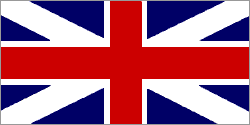 In the early 1760s, the official British flag was the two-crossed jack or the Royal
Union flag (known more commonly as the Union Jack). Although first flown in 1621,
the Royal Union flag was used at all British establishments on the North American
continent from Newfoundland to the Gulf of Mexico. This flag is often referred to as
the flag of Canada's United Empire Loyalists.
In the early 1760s, the official British flag was the two-crossed jack or the Royal
Union flag (known more commonly as the Union Jack). Although first flown in 1621,
the Royal Union flag was used at all British establishments on the North American
continent from Newfoundland to the Gulf of Mexico. This flag is often referred to as
the flag of Canada's United Empire Loyalists.
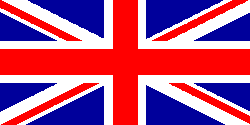 Following the Act of Union between Great Britain and Ireland in 1801, the
diagonal Cross of St. Patrick was incorporated with England's St. George's Cross and
Scotland's Cross of St. Andrew. This gave the Royal Union flag its present-day
configuration. This flag was used across British North America and in Canada even
after Confederation in 1867.
Following the Act of Union between Great Britain and Ireland in 1801, the
diagonal Cross of St. Patrick was incorporated with England's St. George's Cross and
Scotland's Cross of St. Andrew. This gave the Royal Union flag its present-day
configuration. This flag was used across British North America and in Canada even
after Confederation in 1867.
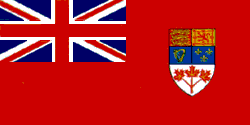 The Red Ensign, a red flag with the Union Jack in the upper corner, was created
in 1707 as the flag of the British Merchant Marine. From approximately 1870 to 1904,
it was used on land and sea as Canada's flag, with the addition of a shield in the fly
bearing the quartered arms of Ontario, Quebec, Nova Scotia and New Brunswick.
Although its use on land had never been sanctioned except by public usage, in 1892 the
British admiralty approved the use of the Red Ensign for Canadian use at sea. This
gave rise to the name the Canadian Red Ensign.
The Red Ensign, a red flag with the Union Jack in the upper corner, was created
in 1707 as the flag of the British Merchant Marine. From approximately 1870 to 1904,
it was used on land and sea as Canada's flag, with the addition of a shield in the fly
bearing the quartered arms of Ontario, Quebec, Nova Scotia and New Brunswick.
Although its use on land had never been sanctioned except by public usage, in 1892 the
British admiralty approved the use of the Red Ensign for Canadian use at sea. This
gave rise to the name the Canadian Red Ensign.
As new provinces entered Confederation, or when they received some mark of identification (sometimes taken from their seal), that mark was incorporated into the shield on the Canadian Red Ensign. By the turn of the century, the shield was made up of the coats of arms of the seven provinces then in Confederation.
In 1924, this unofficial version of the Canadian Red Ensign was changed by an Order in Council and the composite shield was replaced with the shield from the royal arms of Canada, more commonly known as the Canadian Coat of Arms. At the same time, this new version was approved for use on Canadian government buildings abroad. A similar order in 1945 authorized its use on federal buildings within Canada until a new national flag was adopted.
 The Canadian Red Ensign was replaced by the red and white maple leaf flag on
February 15, 1965.
The Canadian Red Ensign was replaced by the red and white maple leaf flag on
February 15, 1965.