CANADA'S COAT of ARMS
CANADA'S COAT of ARMS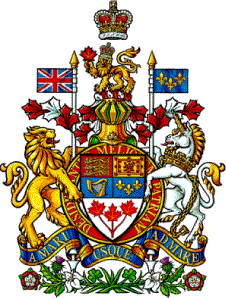 CANADA'S COAT of ARMS
 Shortly after Confederation, a Great Seal was
required and a design was approved by a royal
warrant dated May 26, 1868. This design displayed,
quarterly, the arms of the original four provinces of
the new federation: Ontario, Quebec, Nova Scotia
and New Brunswick. It was never used as the Great
Seal, but was gradually adopted as the arms of Canada (for a reason
unexplained by history, another Great Seal was adopted for Canada
representing Queen Victoria and the throne of her coronation; this
Great Seal is however altered at the beginning of each reign, so as to
show the effigy of the new Sovereign).
When other provinces joined Confederation, the attempt to add the
arms of the new provinces to this federal composite design resulted in
a crowded and confused appearance. For this reason, the Canadian
Government submitted a request to the Sovereign for a grant of arms.
This request was approved and the arms assigned to Canada were
appointed and declared in the proclamation (text on next page) of His
Majesty King George V dated November 21, 1921. This action was
proceeded with on the basis of an Order of the Governor General in
Shortly after Confederation, a Great Seal was
required and a design was approved by a royal
warrant dated May 26, 1868. This design displayed,
quarterly, the arms of the original four provinces of
the new federation: Ontario, Quebec, Nova Scotia
and New Brunswick. It was never used as the Great
Seal, but was gradually adopted as the arms of Canada (for a reason
unexplained by history, another Great Seal was adopted for Canada
representing Queen Victoria and the throne of her coronation; this
Great Seal is however altered at the beginning of each reign, so as to
show the effigy of the new Sovereign).
When other provinces joined Confederation, the attempt to add the
arms of the new provinces to this federal composite design resulted in
a crowded and confused appearance. For this reason, the Canadian
Government submitted a request to the Sovereign for a grant of arms.
This request was approved and the arms assigned to Canada were
appointed and declared in the proclamation (text on next page) of His
Majesty King George V dated November 21, 1921. This action was
proceeded with on the basis of an Order of the Governor General in
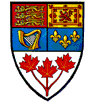 The shield at the
centre of the Coat of Arms is the most important part of the design. In
heraldry, it is the shield "that tells the story" of a country. In Canada's
shield, the first and second divisions depict four emblems that symbolize
the four founding peoples of Canada. The third division makes it distinctly
Canadian.
The shield at the
centre of the Coat of Arms is the most important part of the design. In
heraldry, it is the shield "that tells the story" of a country. In Canada's
shield, the first and second divisions depict four emblems that symbolize
the four founding peoples of Canada. The third division makes it distinctly
Canadian.
In the 11th century, Henry I, known as "the lion of justice", may have been the first English king to use a lion. It is uncertain as to why a second lion suddenly appeared. When Henry II married Eleanor of Aquitaine, whose family emblem was also a lion, it is believed that he added the third lion. There is no question that, when he led his English troops in the Crusades, Richard I, "the Lion-Hearted" carried a shield emblazoned with three golden lions on a red background. To this day they have been the royal symbol of England.
 On the advice of the
Prime Minister of Canada, Her Majesty The Queen approved, on July 12, 1994
that the arms of Canada be augmented with a ribbon with the motto of the
Order of Canada: "Desiderantes Meliorem Patriam". (They desire a better
country).
On the advice of the
Prime Minister of Canada, Her Majesty The Queen approved, on July 12, 1994
that the arms of Canada be augmented with a ribbon with the motto of the
Order of Canada: "Desiderantes Meliorem Patriam". (They desire a better
country).
 The helm (heaume or
helmet), which in heraldry is usually placed above the shield of arms,
not only serves as a means of displaying the crest, but also has a significance
of its own, since its type denotes the rank of the person bearing the arms.
On the helm lies a mantling or lambrequin. The mantle, originally, was
to protect the head and shoulders of the wearer from the sun's heat. It
has become a decorative accessory to the crest and shield.
The helm (heaume or
helmet), which in heraldry is usually placed above the shield of arms,
not only serves as a means of displaying the crest, but also has a significance
of its own, since its type denotes the rank of the person bearing the arms.
On the helm lies a mantling or lambrequin. The mantle, originally, was
to protect the head and shoulders of the wearer from the sun's heat. It
has become a decorative accessory to the crest and shield.
The arms of Canada show a royal helmet, which is a barred helm of gold looking outward and draped in a mantle of white and red which are the official colours of Canada.
 On the royal helmet
is the crest. This symbol consists of a wreath or ring of twisted white
and red silk on which stands a crowned gold lion holding in its right paw
a red maple leaf. The lion is a symbol of valor and courage.
On the royal helmet
is the crest. This symbol consists of a wreath or ring of twisted white
and red silk on which stands a crowned gold lion holding in its right paw
a red maple leaf. The lion is a symbol of valor and courage.
The crest is used to mark the sovereignty of Canada. It is now the symbol used on the Governor General's Standard.
 The
figures that stand on either side of the shield are known in heraldry as
"supporters" and are often depicted in a ferocious manner. The King of
England chose two lions while Scotland chose two unicorns.
The
figures that stand on either side of the shield are known in heraldry as
"supporters" and are often depicted in a ferocious manner. The King of
England chose two lions while Scotland chose two unicorns.
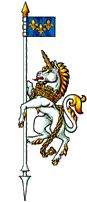
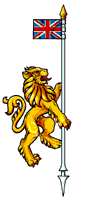
When James VI of Scotland became James I of England in 1603, he chose one lion and one unicorn as the supporters of his royal shield. Canada adopted the same pattern and used a lion on the shield's right holding a gold pointed silver lance from which flies the Royal Union flag, and a unicorn with gold horn, mane and hoofs, on the shield's left. Around its neck is a gold and chained coronet of crosses and fleurs-de-lis. The unicorn holds a lance flying a banner of royalist France, namely three gold fleurs-de-lis, on a blue background. The two banners represent the two principal founding nations that had established Canada's most enduring laws and customs.
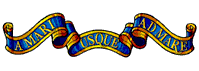 Canada's motto "A
Mari usque ad Mare" (From sea to sea) is based on biblical scripture: "He
shall have dominion from sea to sea and from the river unto the ends of
the earth (Psalm 72:8)". The first official use of this motto came in 1906
when it was engraved on the head of the mace of the Legislative Assembly
of the new Province of Saskatchewan. The wording of the motto came to the
attention of Sir Joseph Pope, then Under Secretary of State, who was impressed
with its meaning. He later proposed it as motto for the new design of the
coat of arms, which was approved by Order in Council on April 21, 1921
and by Royal Proclamation on November 21, 1921.
Canada's motto "A
Mari usque ad Mare" (From sea to sea) is based on biblical scripture: "He
shall have dominion from sea to sea and from the river unto the ends of
the earth (Psalm 72:8)". The first official use of this motto came in 1906
when it was engraved on the head of the mace of the Legislative Assembly
of the new Province of Saskatchewan. The wording of the motto came to the
attention of Sir Joseph Pope, then Under Secretary of State, who was impressed
with its meaning. He later proposed it as motto for the new design of the
coat of arms, which was approved by Order in Council on April 21, 1921
and by Royal Proclamation on November 21, 1921.
 At the base of Canada's
Royal Arms are found the floral emblems of the four founding nations of
Canada.
At the base of Canada's
Royal Arms are found the floral emblems of the four founding nations of
Canada.
English rose
The rose first became the symbol of England when Henry III married Eleanor of Provence and the golden rose of Provence became England's new floral symbol. From this golden rose eventually came the red rose of the House of Lancaster and the white rose of the House of York.
 On top of the "achievement
of the arms of Canada" is the imperial crown which is indicative of the
presence of a monarch as Canada's Head of State.
On top of the "achievement
of the arms of Canada" is the imperial crown which is indicative of the
presence of a monarch as Canada's Head of State.
The shapes of symbols in a coat of arms can be altered by an artist
since heraldry is an art as well as a science. However the symbols themselves
can never be changed without formal approval. In 1957, when Canada's arms
were slightly modified to produce a cleaner more contemporary design, the
Government replaced the original Tudor crown of the 1921 design by a crown
that would represent not just one of the royal families of English monarchs,
but centuries of kings and queens of England. In accordance with the expressed
wishes of Her Majesty Queen Elizabeth II, the Saint Edward's crown is now
used for the arms of Canada. It is this crown that has been used for the
coronation of kings and queens in Westminster Abbey for centuries.